November 9, 20268 min readADHD and focus

Why ADHD Anger Hits So Fast, and What Helps

ADHD anger is usually emotion dysregulation: fast, hot reactions that are slow to settle. Here is what nine studies show and what to try.

Rachel Stein

Last reviewed: October 2026

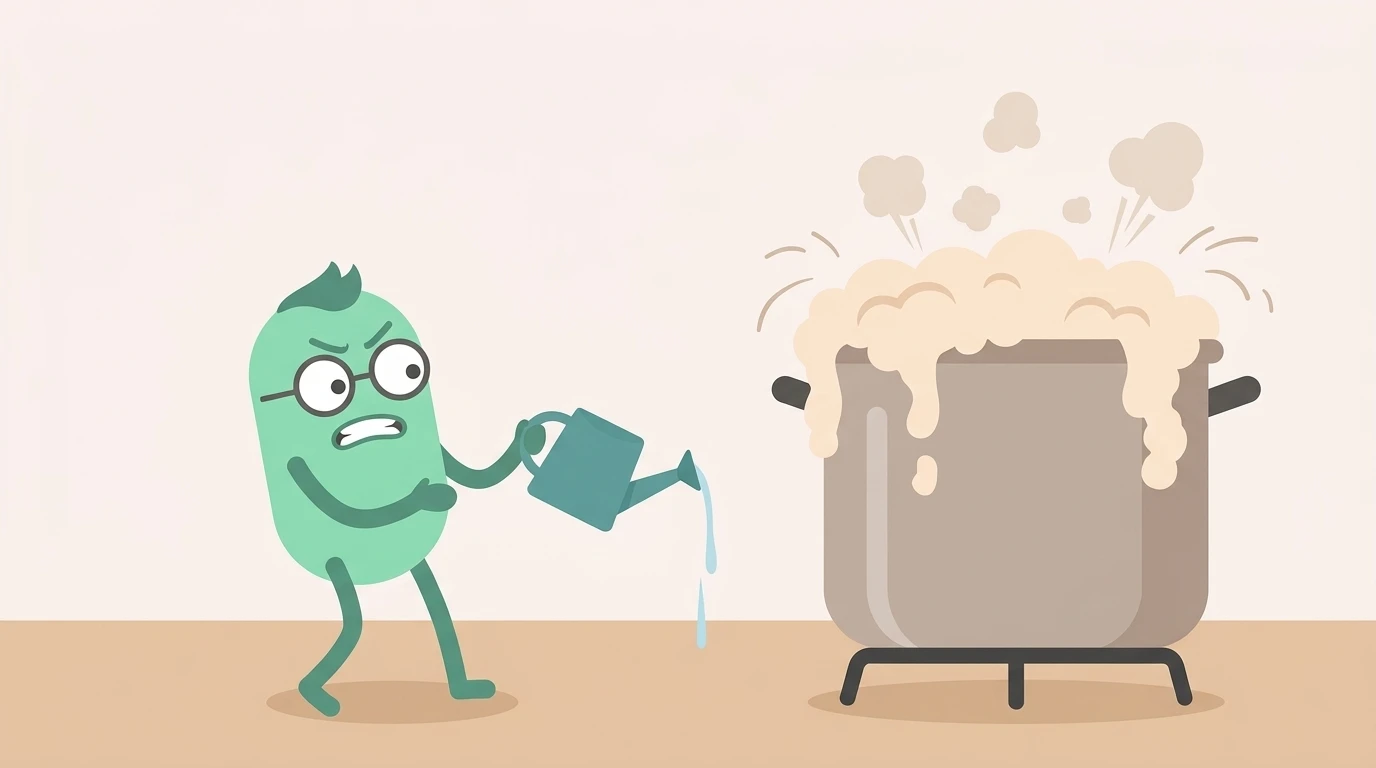
A tense green buddy with glasses and a tight grimace tips a small watering can that drips only a thin trickle while a huge pot beside it foams over with steam bursting upward.

ADHD anger is usually emotion dysregulation: reactions that arrive fast, run hot and take a long time to settle. It is common in adults with ADHD, though it is not a formal diagnostic criterion. In one 98-person trial, both DBT and CBT groups improved, and a treatment review with your prescriber is the practical next step.

No paper behind this post measures "anger" by name in adults with ADHD. The studies measure emotion dysregulation, emotional lability (unstable shifting between emotional states) and reactive aggression, so those are the labels used below. Several compare groups at one point in time, which shows association and not cause, and some samples are small. Each section says what the study can and cannot show.

Why am I so angry all the time with ADHD?

The best-supported answer is that adults with ADHD tend to have stronger, faster emotional reactions and a harder time bringing them down. In a 2020 meta-analysis in BMC Psychiatry, Beheshti, Chavanon and Christiansen pooled 13 studies covering 2,535 adults and found general emotion dysregulation was much higher in adults with ADHD than in healthy controls (Hedges' g = 1.17). Negative emotional responses, meaning irritable and impulsive emotional reactions, rose with ADHD symptom severity (r = 0.63).

Two limits apply. Heterogeneity was very high (94% in the between-group studies), and the authors could not run meta-regressions to test what explained the differences. A group average cannot tell you why you in particular feel angry. If criticism or rejection is usually what lights the fuse, our post on RSD and ADHD covers that trigger.

Is anger a symptom of ADHD in adults?

Not formally. A 2025 narrative review in the International Journal of Molecular Sciences by Bogdańska-Chomczyk, Majewski and Kozłowska states that DSM-5 does not list emotional instability among the core diagnostic criteria. The same review describes low frustration tolerance, irritability, mood swings and temper outbursts as typical in clinical practice, with patients often reporting that they get angry or upset quickly and then struggle to calm down.

Some researchers argue dysregulation belongs among the core features. The Beheshti meta-analysis concluded that its findings support emotion dysregulation as a core feature of ADHD. A 2023 systematic review of 22 studies in PLOS ONE links dysregulation to symptom severity, executive functioning and psychiatric comorbidities. That review also says the available studies are scarce and very varied. Our guide to ADHD and emotional regulation gives the wider picture.

What is emotional dysregulation in adult ADHD and how common is it?

It is a pattern of emotional reactions that are intense, change quickly and are hard to bring down. How common it is depends on the sample and the questionnaire. The 2025 narrative review cites a range of roughly 34 to 70% of adults with ADHD. A 2024 study in the Journal of Psychiatry & Neuroscience by Greenfield, Msghina and colleagues opens with "up to two-thirds".

The most specific number comes from Martz, Weiner and Weibel (2023). They ran a cross-sectional cluster analysis of 20 self-report questionnaires in 460 newly diagnosed adults. Dysregulation showed up in two of five clusters, covering 67.52% of the sample. They found two shapes, emotional instability and emotional impulsivity, and both were predicted by childhood maltreatment. The design is cross-sectional, so it cannot show that maltreatment caused them, and the clinic sample probably had more severe symptoms than adults with ADHD in general. The dysregulation factor also contributed to functional impairment.

How is ADHD emotional regulation different from just having a temper?

The studies cannot sort an individual into "temper" or "ADHD", because they compare groups. What they describe is a profile. In the 2020 meta-analysis, emotional lability was the strongest facet of dysregulation (g = 1.20, 95% CI 0.57 to 1.83), and overall dysregulation correlated with symptom severity (r = 0.54). The 2023 PLOS ONE review adds that adults with ADHD use non-adaptive emotion regulation strategies more often than adults without ADHD.

So the pattern to look for is speed and recovery time: how fast the reaction rises, how large it gets relative to the trigger, and how long it takes to come down. Our post on the ADHD shame cycle takes on what often follows an outburst. A clinician can assess whether what you describe fits dysregulation, a mood or anxiety condition, or something else.

Why do men with ADHD get so angry?

The evidence is thinner than the search interest suggests. In a 2022 case-control fMRI study in Frontiers in Psychiatry, Jakobi and colleagues compared 78 adults with persistent ADHD and 78 without. Adults with ADHD had higher reactive aggression scores on a questionnaire, and higher scores were also associated with sex in that sample.

Inside the ADHD group, higher scores went with activity in the right insula, the hippocampus and middle and superior frontal areas. The authors propose that emotional hyper-reactivity in the salience network, plus more effortful top-down regulation, might contribute to dysregulated behavior. They also found that problems in relationships, family or self-image went with higher reactive aggression, which our guide on ADHD and relationships picks up from the partner's side.

These are correlations in one sample using an implicit emotion task, and the paper says nothing about treatment. It does not show that men with ADHD are angrier than women with ADHD in general, and the 2023 PLOS ONE review warns that not accounting for gender can inflate group differences.

Does ADHD medication help with anger and emotional outbursts?

Ask your prescriber, because no study here answers it directly. The closest is the 2024 study by Greenfield, Msghina and colleagues of 24 adults with ADHD and 22 matched controls, tested before and after a stimulant challenge. The ADHD group had lower emotion induction scores both before (mean difference 5.55, p = 0.03) and after (5.75, p = 0.03), and the authors concluded these deficits were not reversed by the stimulant.

That result does not show that medication fails. It was a small cross-sectional study with no placebo group, and it tested a single acute dose, so it says nothing about how long-term daily treatment affects anger. A 2023 trial of internet-delivered CBT by Nasri and colleagues (104 adults, 67% on ADHD medication) offers a related point from its authors: most adults are offered only medication, which they describe as not enough for about 50 to 70% of patients. Take your own pattern, including when outbursts happen relative to your dose schedule, to your prescriber, and do not change a prescription on your own.

Does CBT or DBT help with anger in adults with ADHD?

Both are studied for adult ADHD, and none of the trials in this set measured anger by name. In a 2026 randomized trial in BMC Psychiatry, Zhang, Qian and colleagues assigned 98 adults to 12 weeks of group DBT skills training (n = 49) or group CBT (n = 49), with follow-up to six months. Both groups improved on core ADHD symptoms, and the groups did not differ at the end of treatment (d = 0.06) or at six months (d = 0.17). Scores on a difficulties-in-emotion-regulation scale improved within each group, but no difference between groups held after correction, and the authors say DBT could not be shown to be non-inferior.

There was no untreated control arm, so some improvement may reflect time and attention. The sample had relatively high IQs, and people with severe or unstable conditions were excluded. For the CBT side in more depth, see our guide to cognitive behavioral therapy for adult ADHD.

Mindfulness is less clear for emotion. A 2025 meta-analysis of 10 controlled trials in Medicine by Kim and Jung found self-reported ADHD symptoms improved (SMD = 0.48, 95% CI 0.19 to 0.76). Negative affect did not change significantly (SMD = 0.31, 95% CI -0.06 to 0.67, P = .11), and the authors call effects on emotional well-being inconclusive, with moderate to substantial heterogeneity and small trials.

How can I calm down fast when ADHD anger spikes?

No trial in this set tests an in-the-moment technique, so treat the steps below as practical planning and not as proven treatment. They are built around the profile above: fast onset and slow recovery. The goal is to buy time between the spike and the words or actions.

Agree an exit line in advance. Pick one sentence with the people closest to you, such as "I'm spiking, I'll come back in an hour." Agreeing it on a calm day means you do not have to invent it mid-surge.

Delay the reply. Put the phone down and leave the draft unsent.

Change the setting. Walk outside or move to another room. The point is distance from whatever lit the fuse.

Name it in one sentence. Say or write "this is a spike, and it will pass." Then go back to the conversation when you can speak at your usual volume.

Review it the next day. Ask what happened in the ten minutes before. A buddy (an accountability partner) on GetMotivated.ai can be the person you text the exit line to and check in with the next day, and a challenge can give you one small skill to practice daily.

When should I see a professional about anger and ADHD?

See one if outbursts are costing you relationships, work or safety, or if your anger scares you or the people around you. The research links dysregulation with greater functional impairment and psychiatric comorbidity, and a clinician can assess both and review treatment options with you. If anger ever turns into hurting someone else or yourself, contact a clinician or emergency services right away, and in the US you can call or text 988.

Tonight, take ten minutes and write down the last three times your anger spiked. For each one, note what happened in the ten minutes before, how fast it rose and how long it took to come down. Bring that page to your prescriber or therapist, and text one person your exit line before you sleep.

Next time you search, our newest guide shows up.

Sources

Emotion dysregulation in adults with attention deficit hyperactivity disorder: a meta-analysisResearch
Beheshti A et al.
BackgroundEmotional symptoms are increasingly considered a core feature of attention deficit/hyperactivity disorder (ADHD). We aimed to quantify the evidence of emotional dysregulation and its respective facets in individuals with adult ADHD compared to healthy controls using meta-analysis.MethodsTwo electronic databases (PubMed, PsycINFO) were reviewed to identify studies. Studies were eligible for inclusion that had reports on any measure of emotion (dys) regulation in adults (> 18 years of age) in clinically diagnosed patients with ADHD as well as healthy control participants. We included a total of 13 studies (N = 2535) to assess (1) the standardized mean difference in emotion dysregulation (ED) as a general factor and its specific facets (i.e., emotional lability, negative emotional responses, and emotion recognition) between adults with ADHD and healthy controls; and (2) the associ
Evidence of emotion dysregulation as a core symptom of adult ADHD: A systematic reviewResearch
Soler-Gutiérrez AM et al.
Attention Deficit Hyperactivity Disorder (ADHD) is a developmental disorder, with an onset in childhood, that accompanies the person throughout their life, with prevalence between 3 and 5% in adults. Recent studies point towards a fourth core symptom of the disorder related to the emotional information processing that would explain the repercussions that ADHD has on the social, academic, and professional life of the people affected. This review aims to describe emotion dysregulation features as well as the brain activity associated in adults with ADHD. A search of the scientific literature was launched in specialized databases: PsycInfo, Medline, Eric, PsycArticle, Psicodoc and Scopus, following PRISMA guidelines. Twenty-two articles met the inclusion criteria: (a) an ADHD clinical diagnosis, (b) participants over 18 years old, (c) emotion regulation measurement, (d) empirical studies, a
Emotional dysregulation and stimulant medication in adult ADHDResearch
Greenfield MS et al.
BackgroundEmotional dysregulation affects up to two-thirds of adult patients with attention-deficit/hyperactivity disorder (ADHD) and is increasingly seen as a core ADHD symptom that is clinically associated with greater functional impairment and psychiatric comorbidity. We sought to investigate emotional dysregulation in ADHD and explored its neural underpinnings.MethodsWe studied emotion induction and regulation in a clinical cohort of adult patients with ADHD before and after a stimulant challenge. We compared patients with age- and gender-matched healthy controls using behavioural, structural, and functional measures. We hypothesized that patients would demonstrate aberrant emotion processing compared with healthy controls, and sought to find whether this could be normalized by stimulant medication.ResultsBehaviourally, the ADHD group showed reduced emotion induction and regulation c
Mindfulness-based interventions for adults with ADHD: A systematic review and meta-analysisResearch
Kim HH & Jung NH
BackgroundAttention-deficit/hyperactivity disorder (ADHD) frequently persists into adulthood and is associated with impairments in attention, emotional regulation, executive functioning, and quality of life. Although mindfulness-based interventions (MBIs) have been proposed as promising non-pharmacological treatments, the evidence regarding their efficacy in adults with ADHD remains inconsistent.MethodsA systematic search was conducted using the MEDLine, CINAHL, and PsycINFO databases to identify controlled trials published up to 2023. Studies were included if they evaluated the effects of MBIs in adults with ADHD using a control group, regardless of randomization. Only studies in which mindfulness was the primary therapeutic modality were included, even if limited psychoeducational or behavioral components were present. Ten studies met the inclusion criteria. Outcomes were categorized i
Group dialectical behavior therapy skills training versus group cognitive behavioral therapy for adults with ADHD: a randomized controlled trialResearch
Zhang LQ et al.
BackgroundAttention-Deficit/Hyperactivity Disorder (ADHD) is a neurodevelopmental disorder characterized by inattention, hyperactivity, impulsivity, emotion dysregulation, and executive dysfunction. Current treatment guidelines recommend a multimodal approach. Cognitive Behavioral Therapy (CBT) has proven effective for alleviating core symptoms, improving executive functioning, and reducing emotional comorbidities, with benefits sustained for up to one year. Dialectical Behavior Therapy (DBT), an adaptation of CBT that integrates mindfulness and emotion regulation components, has also shown potential benefits in adult ADHD populations. However, no prior studies have directly compared CBT and DBT in Chinese adults with ADHD. This trial aimed to compare the efficacy of group DBT and group CBT in adults with ADHD across multiple dimensions, with follow-up assessments extending to six months
Neural Correlates of Reactive Aggression in Adult Attention-Deficit/Hyperactivity DisorderResearch
Jakobi B et al.
Despite not being part of the core diagnostic criteria for attention-deficit/hyperactivity disorder (ADHD), emotion dysregulation is a highly prevalent and clinically important component of (adult) ADHD. Emotionally dysregulated behaviors such as reactive aggression have a significant impact on the functional outcome in ADHD. However, little is known about the mechanisms underlying reactive aggression in ADHD. In this study, we aimed to identify the neural correlates of reactive aggression as a measure of emotionally dysregulated behavior in adults with persistent ADHD during implicit emotion regulation processes. We analyzed associations of magnetic resonance imaging-based whole-brain activity during a dynamic facial expression task with levels of reactive aggression in 78 adults with and 78 adults without ADHD, and also investigated relationships of reactive aggression with symptoms an
Identifying different patterns of emotion dysregulation in adult ADHDResearch
Martz E et al.
BackgroundEmotion dysregulation (ED) is a core intrinsic feature of adult presenting Attention Deficit Hyperactivity Disorder (ADHD). However, the clinical expressions of ED are diverse and several questionnaires have been used to measure ED in adults with ADHD. Thus, to date, the characteristics of ED in adult ADHD remain poorly defined. The objective of this study is to identify the different patterns of ED in adults with ADHD.MethodsA large sample of 460 newly diagnosed adults with ADHD were recruited. Patients completed a total of 20 self-reported questionnaires. Measures consisted in the several facets of ED, but also other clinical features of adult ADHD such as racing thoughts. A factor analysis with the principal component extraction method was performed to define the symptomatic clusters. A mono-dimensional clustering was then conducted to assess whether participants presented o
ADHD in Adulthood: Clinical Presentation, Comorbidities, and Treatment PerspectivesResearch
Ewelina Bogdańska-Chomczyk et al.
Internet-delivered cognitive behavioral therapy for adults with ADHDArticle
ebi.ac.uk · Berkeh Nasri et al.
This randomized controlled trial evaluated internet-delivered cognitive behavioral therapy (iCBT) and internet-based applied relaxation training (iART) for 104 adult outpatients with ADHD. Both iCBT and iART significantly reduced ADHD symptoms compared to treatment as usual, with improvements persisting up to 12 months.

Topics

AI-ready summary

ADHD anger is not a formal diagnostic criterion, but emotion dysregulation is common in adults with ADHD, with a pooled effect of g = 1.17 across 13 studies. One fMRI study of 78 adults with ADHD and 78 without found higher reactive aggression in ADHD, associated with sex. DBT and CBT groups both improved in a 98-person trial, and mindfulness trials were inconclusive for emotion outcomes.

Key takeaways

  • No adult ADHD paper in this set measures anger by name. The evidence is on emotion dysregulation, emotional lability and reactive aggression.
  • A 2020 meta-analysis of 13 studies (N = 2,535) found general emotion dysregulation higher in adults with ADHD than in controls (g = 1.17), with very high heterogeneity.
  • A 2022 fMRI study of 78 adults with ADHD and 78 without found higher reactive aggression in ADHD, associated with sex in that sample. It shows association, not cause.
  • A single stimulant challenge did not close the emotion induction gap in 24 adults. That study cannot tell you what daily treatment does, so talk to your prescriber.
  • Agree an exit line with the people around you before the next spike, and write down what happened in the ten minutes before the last three.

FAQs

Why am I so angry all the time with ADHD?

Adults with ADHD tend to have stronger, faster emotional reactions and more trouble settling them. A 2020 meta-analysis of 13 studies and 2,535 adults found emotion dysregulation was much higher in ADHD than in healthy controls (Hedges' g = 1.17), though the studies varied widely.

Is anger a symptom of ADHD in adults?

Anger is not a formal diagnostic criterion. A 2025 narrative review notes that DSM-5 does not list emotional instability among the core criteria, yet it describes irritability, low frustration tolerance and temper outbursts as common clinical features.

What is emotional dysregulation in adult ADHD and how common is it?

It is a pattern of emotional reactions that are intense, shift quickly and are hard to bring down. It was part of two of five clusters covering 67.52% of 460 newly diagnosed adults in a 2023 clinic study, and a 2025 narrative review puts the range at roughly 34 to 70% of adults with ADHD.

Why do men with ADHD get so angry?

In a 2022 fMRI study of 78 adults with ADHD and 78 without, reactive aggression was higher in ADHD and higher scores were associated with sex in that sample. It shows association in one sample, and a 2023 systematic review warns that not accounting for gender can inflate ADHD-versus-control differences.

Does ADHD medication help with anger and emotional outbursts?

A 2024 study of 24 adults with ADHD found emotion induction deficits were still present after a single stimulant challenge. It had no placebo group and says nothing about long-term daily treatment, so ask your prescriber about your own case.

Does CBT or DBT help with anger in adults with ADHD?

In a 2026 trial of 98 adults, both group DBT and group CBT improved core ADHD symptoms over 12 weeks with no difference between them. The trial did not measure anger by name and had no untreated comparison group.

Keep reading