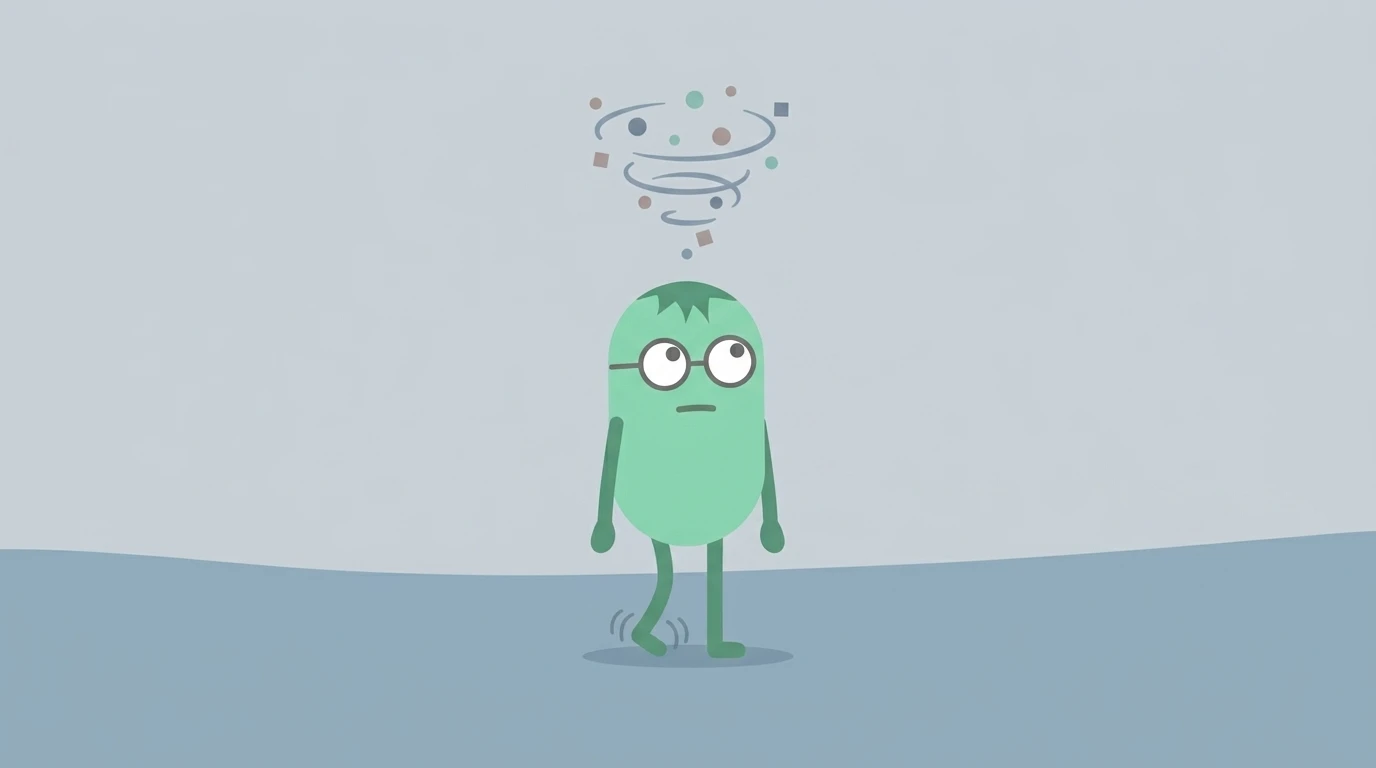
Can ADHD in men make you feel restless or unable to relax?
Yes, though it often looks different from the child version. Young and colleagues describe hyperactivity in adulthood being replaced by "inner restlessness" and discomfort. The 2025 review describes it as difficulty relaxing and fidgeting, such as a leg that will not stop moving.
Restlessness does not belong to one sex in these data. In the 2024 meta-analysis in Psychological Medicine, led by Susan Young across 52 studies, adult rating scales for hyperactivity and impulsivity showed no significant sex difference (3 studies, 576 women and 466 men). A 2026 study of 212 adults at a tertiary clinic in Pisa, led by Magnesa and senior author Perugi, also found no significant sex difference on the Barratt Impulsiveness Scale.
What points toward ADHD is a long history of the pattern, since childhood and in more than one setting.
Is ADHD different in men and women?
Only a little, on average. The Young meta-analysis pooled 18,408 people (8,423 females and 9,985 males) and found that "out of 15 meta-analyses, only three showed significant sex differences." All three were small. Across ages, males had slightly more severe hyperactivity and impulsivity. In adult rating scales, women scored slightly lower than men on inattention (890 women, 697 men). When clinical interviews alone were analyzed, there was no sex difference. Nine of the 51 manuscripts were rated poor quality, and adult data were thin.
Studies disagree on presentation type. The Pisa study found the inattentive presentation more common in women and the combined presentation more common in men. The 2025 review says presentation categories do not differ meaningfully by sex in adulthood. Treat the subtype split as unsettled.
Patterns also overlap. The 2020 consensus statement notes that excessive talking, blurting out answers and interrupting have been reported more often by women. If you want the other side of the picture, see why ADHD in women gets missed for decades.
Can a man have undiagnosed ADHD into adulthood?
Yes. In the Barcelona study, published in European Psychiatry in 2025 by Mestres, Richarte and Ramos-Quiroga, 900 adults were diagnosed at one adult ADHD program, and 54.9% were men. Men were diagnosed at a younger average age than women, 24.13 years against 28.96, yet symptom onset did not differ between them (p = 0.220). Men in this sample were also younger overall. In this sample the spread was wide, with a standard deviation of about 15 years.
The 2025 review says externalizing symptoms increase detection in men, whereas internalizing profiles delay recognition in women. One inference, which these studies do not test, is that men whose trouble stays inside could be overlooked. This is a clinic sample, so it describes who gets diagnosed and not everyone who has ADHD.
Is my drinking or risk-taking linked to ADHD?
It can be linked, and the link is clearer for alcohol than for risk-taking. In the Barcelona cohort, 39.4% of men reported alcohol use against 28.2% of women, and 22.6% of men reported cannabis against 12.9% of women. Men also had a higher incidence of legal problems.
Anker, Bendiksen and Heir studied 548 patients (277 women, 271 men) at an Oslo outpatient clinic in BMJ Open in 2018. More men had alcohol and substance use disorders, and substance dependence was the most common comorbid disorder in men. The authors note these sex differences resemble those in the general population, so they may not be unique to ADHD. The Pisa study found substance and impulse-control disorders numerically more common in men, but the difference did not reach significance.
Accidents and injuries are a different story. A German insurance-claims study in Acta Psychiatrica Scandinavica (2023), with Hartman as last author, compared 17,041 adults with ADHD against matched adults without. ADHD raised the risk of accidents and injuries (relative risk 1.57 for mild, 1.82 for severe), and the excess was largest in women. Taking ADHD medication was linked to lower risk of mild incidents (RR 0.76) in both sexes.
All of this is cross-sectional or claims data. None of it shows that ADHD causes drinking. If you drink to quiet your head, say so at your appointment, because substance use is one of the things a clinician needs to sort out.
Why am I always late or quitting jobs; is that ADHD?
It might be part of it. Lateness and disorganization are listed among adult inattentive features in the 2025 review, and our guide to ADHD time blindness covers the time side.
Work shows the largest numbers. Mittendorfer-Rutz and colleagues followed all 9,718 Swedes aged 19 to 29 with a new ADHD diagnosis from 2006 to 2011 for five years, using registers, in Psychological Medicine in 2021. They compared them with matched controls and siblings. 21% received a disability pension against 2%, 24% had long-term sick leave against 7%, and 19% had long-term unemployment against 13%. Adjusted for other factors, the hazard ratios were 10.2, 2.7 and 1.7. Unemployment and disability pension risks were comparable in men and women, and long-term sick leave was somewhat higher in men (HR 3.0 against 2.5).
In Oslo, only about 60% of the clinic patients had work, against 70% to 80% in the general population. Work participation went with lower odds of substance dependence (OR 0.44), though the design cannot say which causes which.
These steps show whether ADHD is in the mix:
List the endings. Write down your last three jobs and how each ended. Look for the same cause appearing twice.
Log the lateness. For two weeks, note each late arrival and what you were doing in the half hour before.
Check the timeline. Ask whether similar trouble showed up in school, before age 12.
A buddy who checks in on your log each evening, or a shared challenge with a daily check-in, gives you an outside nudge to keep recording. Our guide to making work sustainable with ADHD has next steps.
Is ADHD behind anger or rage in men?
It may contribute, though no study here measured rage in men directly. The 2025 review reports that clinicians see irritability, low frustration tolerance and temper outbursts in adults with ADHD. In the Pisa study, men scored higher on a personality trait called Antagonism, a pattern also seen in general population samples, so it is not unique to ADHD.
The 2025 review says clinicians rule out chronic stress, sleep disorders and substance use before attributing symptoms to ADHD. Our guide to ADHD and emotional regulation explains why feelings can arrive at full volume. If anger has led you to hurt someone, tell a clinician that as well.
How does ADHD affect men in relationships?
In one 2025 online survey in Scientific Reports, with Retz as senior author, 316 adults (131 with ADHD, 185 without) completed partner-violence measures. Adults with ADHD scored higher on both perpetrating and experiencing partner aggression. The study found no meaningful interaction between ADHD and gender, so the ADHD link did not differ for men and women.
The limits are large. Only 96 participants were men, the ADHD group was 81.6% female, the survey was online and self-reported, and ADHD status rested on a self-report questionnaire plus a self-reported earlier diagnosis (87.0% of those who met the criteria), not a clinical assessment. The study does not show that ADHD causes violence. It suggests that conflict between partners is worth raising with a clinician. For the everyday side, such as forgotten promises that read as not caring, see ADHD and relationships.
How is ADHD diagnosed in adult men and where do I start?
A clinician diagnoses it. The 2025 review describes best practice as combining self-report, a clinician interview, information from other people and a look at daily functioning, while ruling out stress, sleep disorders and substance use. Screening tools identify risk, and a structured evaluation confirms the diagnosis. Our adult ADHD test guide explains what screening can and cannot tell you.
In the Pisa study, women rated their own severity higher than men did, while observer ratings did not differ by sex, which is one reason an outside view helps.
Write three examples. Pick recent moments that cost you something, with the date and what happened.
Add an outside view. Ask someone who knew you as a kid or knows you now to write two examples of their own.
Find the evaluator. Ask your regular doctor's office or your insurer who evaluates adults for ADHD in your area.
Set a ten-minute timer now, write your three examples, and send one message asking who evaluates adults near you.