How does a dopamine menu work?
It works by deciding in advance. The reasoning comes from three bodies of research, and none of them tested a menu, so treat this as design logic.
Reward timing. A 2022 review by Morsink, Van der Oord, Antrop, Danckaerts and Scheres in the Journal of Attention Disorders says leading ADHD models explain motivation through a dysregulated dopamine system, with altered sensitivity to reward and a dislike of waiting called delay aversion. A review of ADHD biology by Folego-Temoteo and colleagues in Bioscience Reports adds that in delay discounting tasks, people with ADHD tend to favor smaller immediate rewards over larger delayed ones.
The same review calls the evidence mixed. Some cohorts show no group difference, and in children the difference disappeared after adjusting for IQ. A menu gives small, fast rewards a place in the plan, so you choose them on purpose.
Interest. Champ, Adamou and Tolchard, writing in Psychological Review in 2022, describe consistently good, sustained attention on engaging tasks in ADHD and more symptoms in low-stimulation situations. That is a theory paper built on earlier studies, and it is not a trial. Our guide to interest-based motivation in ADHD explains the idea.
Needs. Morsink and colleagues also propose self-determination theory for ADHD research, which holds that motivation grows when three needs are met: autonomy, competence and relatedness. A small feasibility trial by Champ and colleagues tested an 11-session coaching program built on that theory in adults with ADHD, with 11 in the coaching group and 9 on a waitlist. Distress and ADHD symptoms improved in both groups, slightly more in the coaching group. A nonblinded researcher allocated participants and the sample was small, so the authors treat it as feasibility evidence and call for a definitive trial.
How do I make a dopamine menu for ADHD?
Make it in four steps, and keep each one short.
Step 1. List what you already like. Write down activities without judging them. A list you wrote yourself keeps autonomy with you, and a few items that involve other people cover relatedness. About a dozen items is enough to start.
Step 2. Sort by course and effort. Put each item under starters, entrees, sides, desserts or specials, and keep it small enough to finish. Small, finishable items give competence, the third need, room to be met.
Step 3. Add one rule. The next two sections show how to choose, and how to turn the choice into an if-then plan.
Step 4. Put it where you decide. Place it on your lock screen, the front of a notebook, or the wall by your desk, anywhere your eyes land when it is time to choose.
What should I put on a dopamine menu?
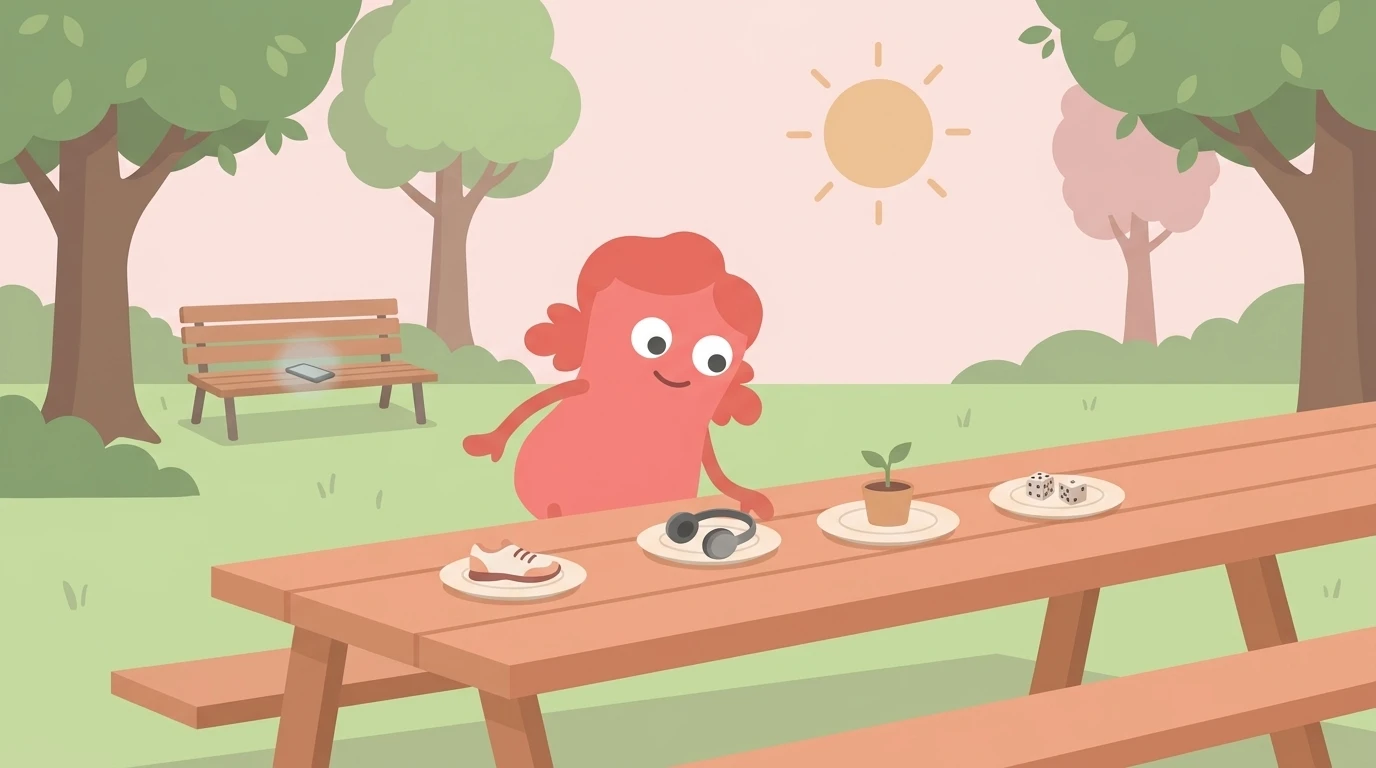
Fill each course with items from your own list. Here is how each of the first two courses looks.
Starters. These take a few minutes and lower the cost of beginning. Stand up and stretch, fill a glass of water, put on the playlist you only use for work, open the document and write one rough sentence, or set a two-minute timer. The same logic runs through our guide to tiny habits for ADHD.
Entrees. These are absorbing activities that leave you satisfied, such as a hobby, a workout, cooking, drawing, or a project with a clear end. They fit the interest research above, since engaging activities are where attention tends to hold. Choose ones with a natural stopping point, such as a finished sketch or a cooked meal.
What are good dopamine menu ideas for breaks and treats?
The other three courses cover everything around the work itself.
Sides. A side pairs something pleasant with a dull task, such as music while folding laundry, a walk during a phone call, or a podcast with the dishes. Add body basics too. A 2026 scoping review by Almudayfir and colleagues mapped 31 studies and found sleep hygiene, eating, physical activity and sedentary behavior as the main routine areas where people with ADHD struggle, mostly in children. It maps problems and does not show that any menu item fixes them.
Desserts. These are high-pull treats such as scrolling, games and sweets. A review of hyperfocus by Ashinoff and Abu-Akel gathers reports of people with ADHD who cannot understand how time passes during absorbing activities and find it hard to give them up. So a dessert gets a timer before you start, and it comes after a starter or an entree.
For the breaks themselves, Albulescu and colleagues pooled 22 study samples (N = 2335) of healthy workers and students in a 2022 PLOS ONE meta-analysis. Breaks lasting from 8 seconds to 10 minutes gave small gains in vigor (d = .36) and less fatigue (d = .35), with no significant gain in overall performance. Longer breaks helped performance more, and recovery from very draining tasks may need more than 10 minutes. The vigor and fatigue ratings were self-reported, and no participants were selected for ADHD.
Specials. These are occasional plans, ideally with another person, such as a class, a hike or a coworking session. A 2025 preprint by Ara and colleagues put 12 participants with ADHD through a virtual reality bricklaying task alone, with a human body double and with an AI body double. They finished faster and rated their accuracy and attention higher with either double, though the authors note earlier work found no conclusive effect. Our body doubling guide covers the idea, and a buddy on GetMotivated.ai can serve as the check-in person.
How do I use a dopamine menu?
Use one rule: match the course to the gap. If you cannot start, pick a starter. After a finished block, pick a side or a timed dessert, and with energy left, pick an entree. Pick the first item that looks possible, without rereading the whole list.
Then turn the rule into an if-then plan. In an American Psychologist review from 1999, Gollwitzer describes implementation intentions in the form "Whenever situation x arises, I will initiate the goal-directed response y!" He notes that intentions account for only 20% to 30% of the variance in behavior, largely because people fail to act on them. One study he cites, with hospitalized opiate patients in withdrawal, found that none of those who made an irrelevant plan wrote a required CV by 5 p.m., while 80% of those with a relevant plan did. The review gives no group sizes for that study.
Averaged across many trials, the effect is modest. A meta-analysis by Melum and Martiny-Huenger pooled 10 articles (12 comparisons, N = 2399) of if-then plans for eating fruit and vegetables and found about a quarter of a portion more per day (MD = 0.29), all self-reported.
So write yours plainly. "If I have sat for five minutes without starting, then I pick one starter." "If my dessert timer ends, then I stand up and pick a side." For more on stalling, see our guide to how to stop procrastinating with ADHD.
When should I use a dopamine menu?
Use it at three moments: before a task you keep avoiding, between work blocks, and when you catch yourself reaching for your phone out of boredom. Each is a point where the next choice is made by whatever is closest.
If the stall runs deeper, as in ADHD paralysis or executive dysfunction, shrink the menu to a card with three starters. A short list is easier to read when your head is full.
If low motivation comes with low mood lasting weeks, or ADHD is disrupting work or school despite your efforts, a clinician can assess what is going on. Bring your menu along, because it shows exactly what you have been trying.
Is there a dopamine menu template I can copy?
Copy this into your notes app and fill each slot with your own items. Starters, two to five minutes. Three tiny moves that get you into a task. Entrees. Three activities you enjoy that leave you satisfied. Sides. Two pairings for dull tasks and two body basics. Desserts. Two treats, each with a timer length written next to it. Specials. One plan with another person this month. My rule. If situation, then course.
How do I keep using my dopamine menu?
Treat the first week as an experiment. The routines literature is thin, with Almudayfir and colleagues finding no validated tool built to measure routines or habits in ADHD, and nothing here shows a menu sticks for everyone. Your own results are the best evidence you will get.
At the end of the week, delete items you never picked and add two you wish you had. Interests shift, so a living list beats a perfect one. Share the menu with a buddy and tell them which course you picked each day, so someone else sees the pattern with you.
Pick one starter from your list now and do it for two minutes.