Peer support is a group of people with a shared experience meeting, usually with a trained facilitator, to talk and listen without anyone playing doctor. No one assesses you or grades your progress. You talk as much or as little as you want, and the room runs on one rule: everyone there has lived something like what you're living now.
That last part is the whole point, and it's also what makes peer support hard to picture if you've never sat in a room like this. A support group isn't group therapy with a different name. It isn't a lecture. It isn't a place where a professional tells a circle of people what's wrong with them. It's closer to a conversation between people who already understand the thing you'd otherwise have to explain from scratch.
What peer support actually is
A 2025 realist review published in BMJ Open synthesized 20 qualitative studies to figure out what makes the peer relationship work, not just whether it works. The researchers built a framework they call APPEAR: peer support functions when the relationship is Accepting, Personalized, Empowering, Available, and Reciprocal. Reciprocal is the word that separates this from almost every other kind of help you've been offered. A therapist doesn't share their own struggle with you as part of the session. A peer does, because the exchange runs both directions.
The review also cites a widely used definition worth sitting with: peer support is "offering and receiving help, based on shared understanding, respect and mutual empowerment between people in similar situations." Not help handed down. Help traded.
That distinction shows up in the room itself. A facilitator with a shared lived experience isn't performing objectivity. They're not hiding behind a desk or a diagnosis. When someone in the group describes a bad week, the facilitator has usually had one too, at some point, with the same thing. That's not a lack of professionalism. It's the mechanism the research keeps landing on: mutual understanding, trust, and reciprocity are the interpersonal conditions that show up again and again in accounts of why peer support helps.
What a first session looks like
Nobody hands you a clipboard. There's no history-taking, no rating scale, no "on a scale of one to ten." Most groups open with a check-in: names, maybe how the week went, at whatever depth you're comfortable with. Some groups have a loose topic for the session. Others let the conversation go wherever the room needs it to go that day.
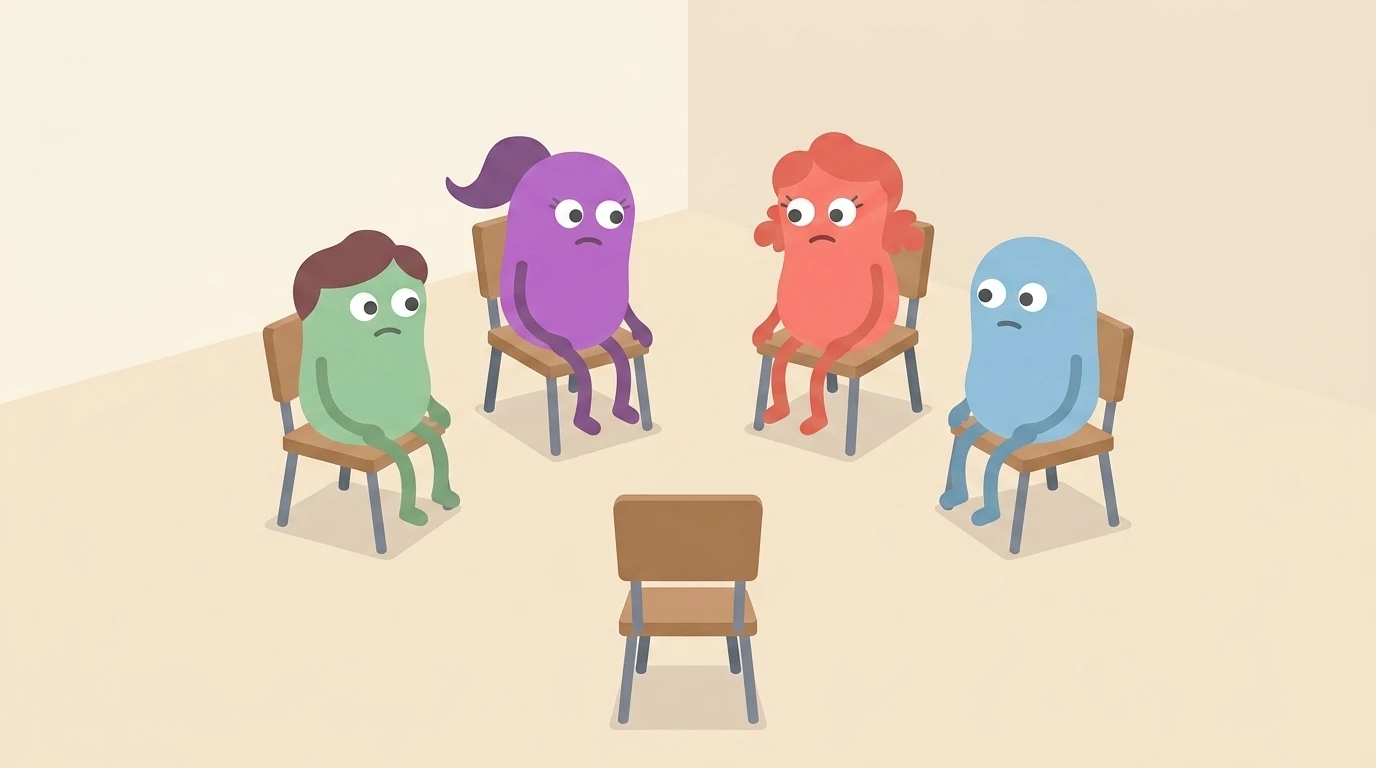
You'll notice the room doesn't feel like a waiting room. There's no front of the class. Chairs are usually arranged so everyone can see everyone else, because the format assumes conversation, not a presentation. The facilitator opens the space and keeps it safe, but they are not the center of it.
If you're joining a group built around a specific culture or community, this often matters more than people expect. A 2026 review in Current Psychiatry Reports on peer and non-specialist perinatal mental health support found that programs built on cultural resonance and trust, run by people who share the participant's background, were the ones with the strongest engagement. Feeling like the person across from you doesn't need the backstory explained changes what you're willing to say.