The Habit Substitution Method: What Research Supports
The most evidence-backed approach to breaking bad habits is not elimination — it's substitution. Keep the cue, keep the reward, replace only the routine.
This approach works because:
• It doesn't fight the basal ganglia — it gives it a new routine to encode instead
• It addresses the underlying need the habit serves rather than suppressing it
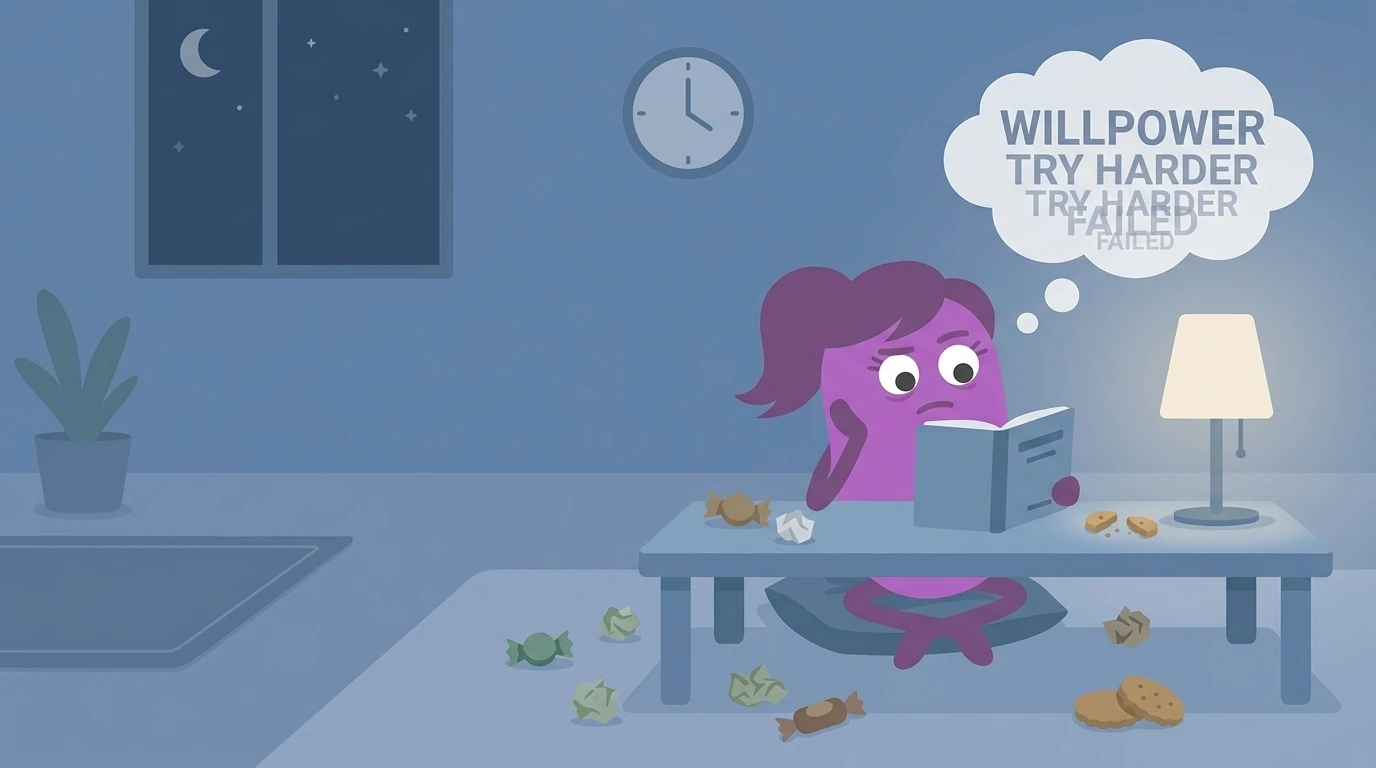
• It doesn't require sustained willpower because the new pattern eventually becomes automated
The four-step substitution process:
Step 1: Identify the cue. For one week, every time you engage in the unwanted habit, note: the time, location, preceding action, emotional state, and who else is present. Most habits have only one or two consistent cues. The pattern will emerge.
Step 2: Identify the actual reward. After performing the habit, ask: what do I actually feel better about? This requires honesty. A cigarette break isn't about nicotine after the first few weeks — it's often about social connection, leaving the desk, or a structured mental pause.
Step 3: Design a replacement routine. The replacement must deliver the same reward through a different mechanism. If the habit delivers stress relief, the replacement must also deliver stress relief — not just the absence of the habit.
Step 4: Write an implementation intention. Research consistently shows that specifying exactly when, where, and how you'll perform a new behavior dramatically increases execution rates. The format: "When [cue occurs], I will [replacement routine] in order to get [reward]."
Key Stat: UCL researcher Benjamin Gardner's review of habit formation research found that the time required to make a behavior automatic ranges from 18 to 254 days — with a median around 66 days for moderate-complexity behaviors. The "21 days" claim has no scientific basis. — Source: British Journal of General Practice
Environmental Design: The Most Underused Tool
David Neal, Wendy Wood, and Jeffrey Quinn's research on basal ganglia habit encoding found that habits are tightly coupled to environmental context. This means one of the most powerful tools for breaking bad habits isn't behavioral — it's spatial.
Practical Environmental Strategies
Remove the cue entirely when possible. If the cue is a visual trigger (chips on the counter, phone on the desk), removing it eliminates the automatic detection-initiation sequence before it can begin.
Change the environment associated with the habit. Habits encoded in specific environments are harder to perform in unfamiliar contexts. This is why travel — despite its stresses — often makes it easier to temporarily break patterns. You can use this deliberately: start a new routine in a new physical location.
Add friction to the unwanted routine. Every additional step between cue and habit execution gives the prefrontal cortex time to engage. Putting your phone in another room, keeping problematic foods in the back of the freezer, or logging out of distracting apps are not trivial obstacles — they interrupt the automation.
Reduce friction for the replacement behavior. If the replacement is harder to access than the original habit, the original wins. Lay out running shoes the night before. Keep healthy food at eye level. Put the book on the pillow.
The Role of Accountability in Habit Change
Research by Mitesh Patel and colleagues published in Social Science & Medicine found that social accountability and peer support are among the most reliable predictors of long-term behavior change — more reliable than individual motivation, education about the behavior, or even monetary incentives.
The mechanism is straightforward: habits form in response to environmental pressures, and social environments are among the most powerful. When the people around you expect a certain behavior, the social cue becomes a powerful trigger for the replacement routine. When you've told someone you'll report back, the anticipation of accountability adds a new reward to the replacement behavior — social approval — that compounds the neurological reward you're already targeting.
This is also why solo habit change attempts have such high failure rates. Trying to break a pattern in the same social environment where it formed, without any structural change in social expectations, means the original habit's cues remain intact while the replacement has no social reinforcement.
How GetMotivated.ai Addresses the Accountability Gap
Apps like Habitica gamify habit tracking and Streaks creates visual streak pressure — both of which can help in the early stages of routine substitution. But gamification doesn't provide the kind of real human accountability that research identifies as the most powerful long-term predictor of change.
GetMotivated.ai's approach to habit breaking is built around the accountability mechanism that the research actually supports:
Structured 30-day habit-breaking challenges provide the implementation framework that most people can't build on their own. The challenge specifies the replacement behavior, the check-in cadence, and the accountability structure — which removes the planning burden and the "starting tomorrow" trap that indefinite intention produces.
Buddy matching pairs you with someone working on the same or similar habit change. This isn't a forum where you post updates and hope someone replies — it's a consistent partner who expects your check-ins and whose own progress you're invested in. The mutual accountability produces the social expectation effect that Patel's research identifies.
Daily AI coaching check-ins catch the moments when cue-triggered urges are strongest and a replacement behavior needs reinforcement. This is the gap that apps like Noom cover for dietary behavior but leave open for broader habit change — GMAI's AI coaching is available at 10 PM when the cue hits, not only during office hours.
The structural advantage is that all three elements work together in the same platform: the replacement behavior plan, the human accountability partner, and the just-in-time coaching. Willpower is a resource that depletes — the system at GetMotivated.ai is designed to reduce the demand on that resource rather than assume you'll have more of it tomorrow.
Common Mistakes That Reset the Clock
Treating a slip as a failure. A single return to the unwanted behavior does not erase the neural pathway being built for the replacement. Research on habit formation treats slips as expected and finds they don't significantly affect long-term outcomes when the overall trajectory is consistent. The mistake is interpreting a slip as evidence that the strategy isn't working and abandoning the attempt entirely.
Trying to break multiple habits simultaneously. Each habit replacement draws on the same prefrontal resources for monitoring and reinforcement during the early encoding phase. Breaking more than one or two patterns at the same time consistently produces worse outcomes than sequential focus.
Not identifying the actual cue. Many people think their habit is triggered by general stress when the actual cue is a specific time (3 PM energy dip), location (the couch), or emotional state (boredom, not anxiety). Imprecise cue identification leads to imprecise replacement behavior design — and a replacement that doesn't fire when the cue appears.
Waiting for motivation. Motivation is an emotional state, not a stable resource. The implementation intention approach works specifically because it removes the need for motivation to be present at the moment of decision — the decision is pre-made. "When it is 8 PM and I'm on the couch, I will do 10 minutes of reading" fires automatically; "I'll read tonight when I feel like it" depends on a feeling that may not arrive.
Key Stat: Neal, Wood & Quinn's research found that people in stable, familiar environments had significantly higher rates of habitual behavior compared to people in novel environments — even when their explicit intentions were identical. Environment is not a background factor; it is an active habit trigger. — Source: Current Directions in Psychological Science