
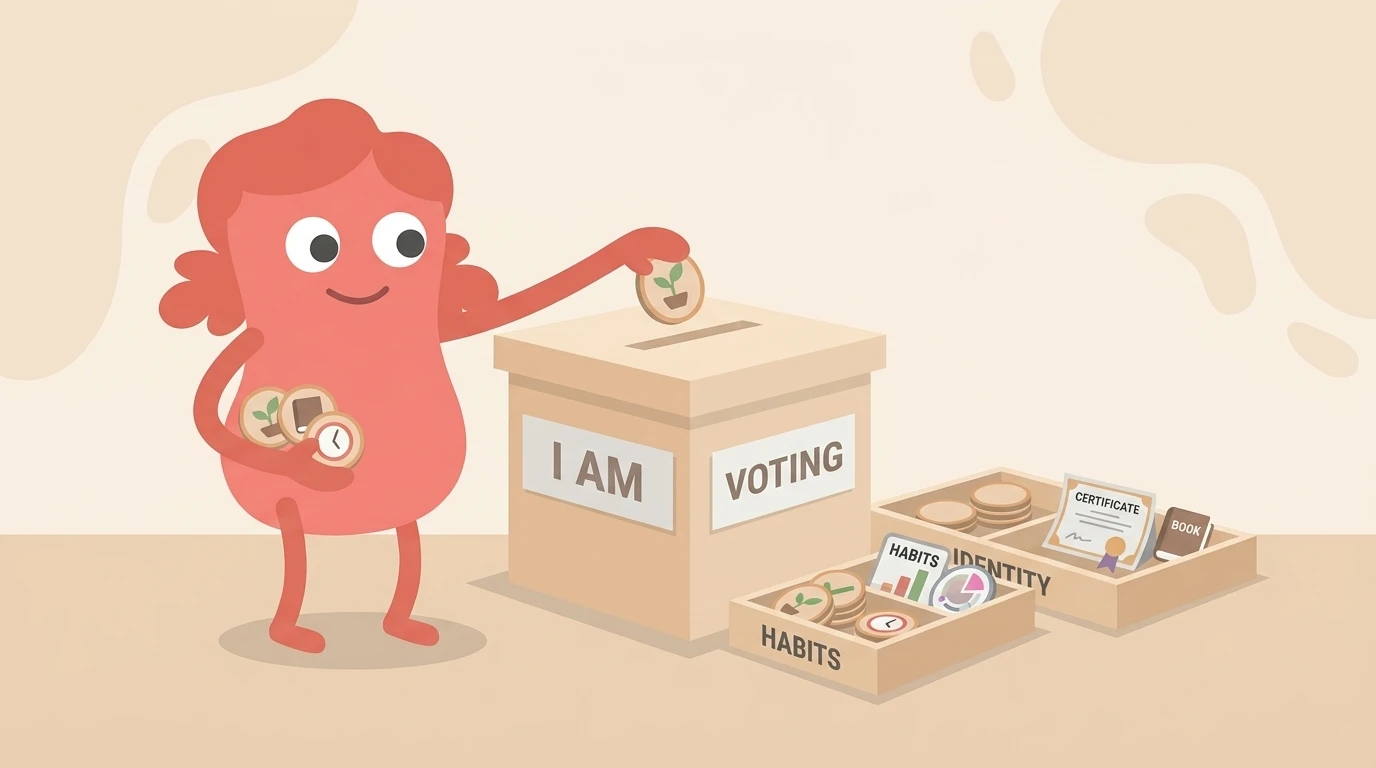
Identity-based habits are behaviors tied to who you believe yourself to be — and research consistently shows they outlast outcome-based goals because they tap into something more durable than willpower: your need to act consistently with your own self-concept. When you say "I am a runner" instead of "I should run more," you are not just reframing language. You are activating a different psychological mechanism entirely.
This article covers the science behind why identity-driven behavior change works, how it differs from conventional goal-setting, and the practical steps to start casting votes for the person you want to become.
What Are Identity-Based Habits and Why Do They Work?
Identity-based habits anchor behavior to self-concept rather than outcomes. The framework was popularized by James Clear in Atomic Habits, but the psychological foundation goes back to Prescott Lecky's 1945 work on self-consistency — the observation that people experience psychological discomfort when they act in ways that contradict who they believe themselves to be.
This is why willpower fails as a long-term strategy. Willpower is a finite resource you deploy against resistance. Identity eliminates much of the resistance. If you identify as a non-smoker, refusing a cigarette is not an act of discipline — it is simply what you do. The behavior becomes consistent with self-concept, not contrary to it.
The mechanism has three components:
1. Decide who you want to be. Not what you want to achieve, but the type of person who would naturally achieve it. "I want to lose 20 pounds" is an outcome. "I am someone who treats their body with care" is an identity.
2. Cast votes for that identity. Every action that aligns with your desired identity is a vote. You don't need to win every election — you need to win the majority. A single workout is not transformative; a consistent pattern of showing up builds the evidence base that the identity is real.
3. The identity reinforces itself. As evidence accumulates, the self-concept solidifies. Behavior that once required effort becomes part of "what I do" rather than "what I'm trying to do."
The Science Behind "I Am" vs "I Should"
Research by Wendy Wood, a behavioral scientist at the University of Southern California, found that 40-45% of daily behaviors are habitual — performed in the same context without deliberate decision-making. This means nearly half of what you do is driven by autopilot, not conscious choice. Identity shapes that autopilot.
A study by Verplanken and Orbell (2015) in Personality and Social Psychology Bulletin examined how social identity influences habit formation. Their finding: people whose desired behaviors were consistent with their group identity formed habits faster and maintained them longer. The social dimension of identity is not peripheral — it is one of the most powerful drivers of sustained behavior change.
Daryl Bem's self-perception theory adds another layer. Bem's research showed that the relationship between identity and behavior runs in both directions. You don't just behave according to who you are — you infer who you are from how you behave. Small actions create evidence that updates your self-concept, which then drives more behavior, which creates more evidence.
Key Stat: University College London researchers found that habit formation takes an average of 66 days — with a range of 18-254 days depending on the person and behavior. The '21 days' claim has no empirical support. — Source: Lally et al., European Journal of Social Psychology
How to Build an Identity-Based Habit (Step by Step)
Most people fail at habit formation because they start with the behavior rather than the identity. They ask "how do I get myself to exercise?" instead of "what kind of person exercises regularly, and how do I become that person?"
Step 1: Choose your identity statement
Make it specific enough to be meaningful, broad enough to survive bad days. Examples:
• "I am someone who moves their body daily" (not "I am training for a marathon")
• "I am someone who doesn't drink" (not "I am avoiding alcohol this month")
• "I am a person who keeps their word to themselves"
The broader identity survives the days when the specific behavior is impossible. A runner who gets injured can still be "someone who prioritizes their physical health" — and find another way to express that.
Step 2: Find the minimum viable vote
The vote does not need to be impressive. It needs to be consistent. A five-minute walk counts. One page counts. A single glass of water counts. The goal at the beginning is not transformation — it is evidence accumulation.
Many people abandon habits because they miss a day and then feel like the identity has been revoked. It hasn't. One missed vote does not lose the election. The pattern over weeks and months is what builds the self-concept.
Step 3: Make the identity visible and social
This is where most habit frameworks underperform. They treat identity change as a private internal project. Research on social identity shows that telling others about your desired identity — and surrounding yourself with people who share it — dramatically accelerates the shift.
Key Stat: A study from the Dominican University of California found that people who wrote down their goals and shared them with a supportive friend completed 76% of their goals, compared to 43% for those who kept goals private. — Source: Gail Matthews, Dominican University of California, 2015
When others see you as the person you're becoming, it creates external reinforcement that strengthens the internal identity. Being "the person in this group who runs" is more motivating than being "someone who's trying to run."
Why Outcome-Based Goals Fail and Identity-Based Habits Don't
The fundamental problem with "I want to lose 20 pounds" or "I should exercise more" is that both of these goals are adversarial. They position the current you as deficient. You are not enough yet. The motivation is to escape a state rather than express an identity.
This creates two failure modes:
Failure mode 1: Goal reached, behavior stops. If losing 20 pounds was the goal, reaching it ends the reason to continue. People who reach their goal weight and then regain it are living this failure mode. The behavior was never connected to who they are — it was a project with a completion date.
Failure mode 2: Goal feels too distant, motivation collapses. Outcome-based goals rely on the gap between current state and desired state for motivation. But when that gap is large, it can be discouraging rather than energizing. Identity doesn't have this problem — you can BE the person today, even if the outcomes aren't there yet.
Key Stat: The American Psychological Association reports that 80% of New Year's resolutions fail by February — with most people citing loss of motivation as the primary reason. Motivation tied to external outcomes is inherently unstable. — Source: APA Stress in America Survey
The Identity Trap: When "I Am Not That Kind of Person" Works Against You
Identity is a double-edged tool. The same mechanism that reinforces positive behavior can lock you into limiting self-concepts.
"I'm not a morning person." "I've never been good at exercise." "I'm someone who procrastinates." These are identity statements too — and the brain defends them just as vigorously as positive ones.
Breaking a negative identity habit requires the same vote-casting mechanism, but in reverse. You don't announce "I am now a morning person." You find the smallest possible action that contradicts the limiting identity and do it consistently until the evidence base starts to crack. Wake up five minutes earlier. That's it. The identity updates slowly as the evidence accumulates.
Psychologist Carol Dweck's research on growth mindset is relevant here. People with fixed mindsets treat identity as a stable characteristic. People with growth mindsets treat it as malleable. The latter change habits more readily — not because they have stronger willpower, but because they don't experience their current self-concept as a ceiling.
How Community Accelerates Identity-Based Change
No identity forms in a vacuum. Humans are social animals who calibrate self-concept partly by observing how others see them and who they're seen alongside.
James Clear noted that one of the most effective things you can do for habit formation is join a group where your desired behavior is the norm. In a running club, you are not "someone who is trying to run" — you are a runner, like everyone else in the room. The identity is socially confirmed before it's internally settled.
This is not trivial. Research on social identity theory by Henri Tajfel and John Turner shows that people derive significant self-concept from group membership. The groups you belong to shape who you believe yourself to be. Changing your groups — or finding groups that reflect your desired identity — is one of the highest-leverage moves in behavior change.
The challenge is that most habit-change tools are solitary. Apps track streaks. Books give frameworks. But neither puts you in a room (physical or digital) with people who are already the person you want to become.
How GetMotivated.ai Supports Identity-Based Change
Platforms built around social identity and structured community are rare in the behavior-change space. Most apps — Habitica, Streaks, standard habit trackers — optimize for individual streak-tracking, which is useful but misses the social identity dimension.
GetMotivated.ai's design maps directly onto identity-based habit research:
Group challenges place you alongside people who share your target identity. When your cohort is made up of people who prioritize daily movement, healthy eating, or focused work, you are not an individual trying to change — you are part of a community that already embodies the change. The identity is confirmed socially from day one.
Buddy matching provides the specific mechanism that the Dominican University research identified as most effective: a consistent other person who knows your goal and holds you accountable to it. Your accountability partner doesn't just track your streaks — they see you as the person you're becoming, which strengthens the identity.
AI coaching helps you articulate and refine your identity statement before you begin. Most people jump to behavior without clarifying who they're trying to become. The coaching process forces that clarity — which research suggests is the actual first step in durable habit formation.
The pattern is straightforward: apps like Noom or standard trackers handle the individual side of behavior change well. GetMotivated.ai layers on the social identity dimension that individual apps can't provide — because lasting behavior change requires both a clear internal identity and external community confirmation that you are becoming who you intend to be.