The Parole Board Study That Changed How Psychologists Think About Decisions
The most striking demonstration of decision fatigue in the real world comes from a 2011 study of an Israeli parole board led by researcher Shai Danziger. Over ten months, the research team analyzed 1,112 judicial rulings and found something disturbing.
At the start of each session, judges approved parole approximately 65% of the time. That rate declined steadily as they worked through cases — dropping to nearly zero just before a break. After eating and resting, the approval rate reset to around 65%. The pattern repeated across every session.
The cases themselves hadn't changed. The judges had. Decision fatigue was determining whether people went home or stayed in prison.
Key Stat: Judges approved parole 65% of the time at the start of sessions, falling to nearly 0% just before breaks — then resetting after rest. — Source: Danziger, Levav & Avnaim-Pesso (2011), PNAS
What Happens to Your Brain Under Decision Load
The neurological mechanism behind decision fatigue connects to what psychologist Roy Baumeister called "ego depletion" — the idea that self-control and decision-making share a common cognitive resource. Baumeister's foundational 1998 research showed that people who had to resist eating cookies (requiring self-control) subsequently gave up faster on a difficult puzzle than people who hadn't. The resource was shared, and it was finite.
When that resource is depleted, two things happen:
Impulsivity increases. The brain looks for fast, low-effort options. This is why you choose the most convenient food, not the food aligned with your goals. Why you scroll your phone instead of reading the book. Why you agree to commitments you don't want rather than the cognitive work of saying no.
Decision avoidance increases. The brain opts out of deciding entirely. This is why ambitious plans get pushed to "tomorrow." Why the gym bag stays packed but unused. Why you intended to meal prep but instead stared at the open refrigerator and ordered delivery.
Neither pattern is laziness. Both are predictable outcomes of a depleted decision-making system.
Why Evening Is When Habits Go to Die
Decision fatigue follows a consistent daily arc. Cognitive resources are highest in the morning — before you've made dozens of work decisions, responded to messages, navigated social dynamics, and handled unexpected problems. By evening, the tank is low.
This creates a cruel irony for habit formation: most new habits are attempted in the evening (after-work workouts, evening reading, cooking healthy meals) precisely when decision-making capacity is lowest. You're trying to exercise willpower at the point in the day when you have the least of it.
Key Stat: In research by Baumeister and colleagues, participants who had depleted their self-control resources were significantly more likely to choose default or impulsive options, regardless of their stated intentions. — Source: Baumeister et al. (1998)
Does Choice Overload Make Decision Fatigue Worse?
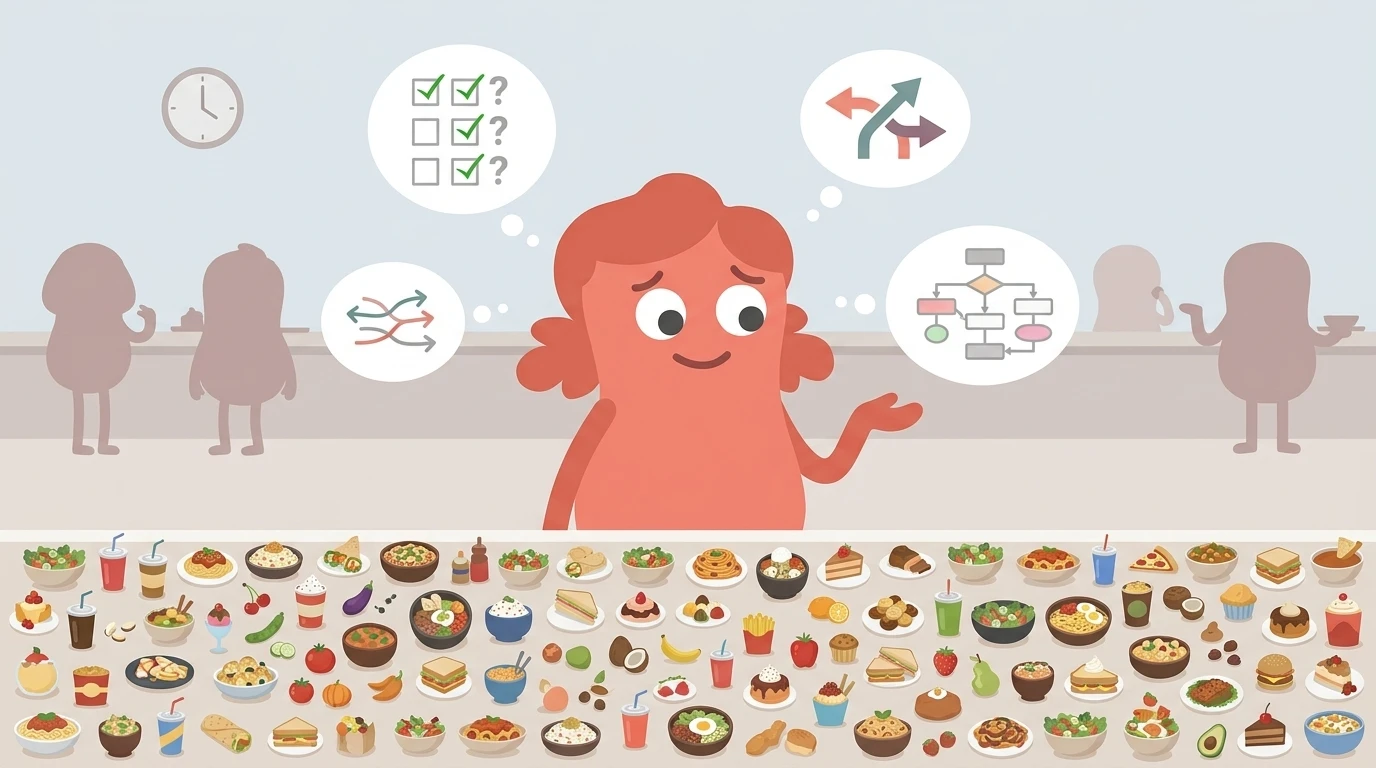
Yes — and this is where the modern information environment compounds the problem. A 2015 meta-analysis by Chernev, Böckenholt, and Goodman analyzed 99 studies on choice overload and found that having too many options reliably reduces satisfaction, decision quality, and the likelihood of making a decision at all.
Consider what a typical morning looks like before you've left the house: Which emails to answer first. What to eat for breakfast. What to wear. Which news to consume. What route to take. Which tasks to prioritize. Whether to check social media.
By the time you're at your desk, you've already made dozens of decisions from a system that doesn't distinguish "what to wear" from "which career path to pursue." The cognitive cost is real regardless of stakes.
The Paradox of More Options
Barry Schwartz documented this in his research on the "paradox of choice" — when people face more options, they report less satisfaction with whatever they choose, because more options means more awareness of what they didn't pick. More options also requires more cognitive work to evaluate each one.
This is why subscription services with narrow, curated choices often produce higher satisfaction than markets with unlimited options. It's also why pre-made decisions — routines, schedules, templates — are cognitively protective.
How Decision Fatigue Kills Habits Specifically
Habit formation depends on consistent execution. Decision fatigue disrupts this in three specific ways.
It creates inconsistency. When your decision-making capacity varies by time of day and accumulated load, so does your habit adherence. You work out on Tuesday because it's a light decision day. You skip Thursday because you made forty-three difficult choices before 3 PM. The habit never solidifies because the execution is unpredictable.
It raises the activation cost. Habits are behaviors that have been automated through repetition — they require minimal deliberate decision-making. But new habits haven't been automated yet. They still require active choice every time. Under decision fatigue, that active choice cost is higher, making it easier to default to established patterns (scrolling, eating familiar comfort food, watching TV) than to choose the new behavior.
It targets your highest-stakes choices. Research on ego depletion consistently finds that the behaviors requiring the most self-control — eating well, exercising, avoiding alcohol, maintaining sobriety — are the first to fail under cognitive load. These are exactly the behaviors most people are trying to change.
How to Beat Decision Fatigue: Reduce Decisions, Don't Build Willpower
The standard advice — build more willpower, develop more discipline, try harder — misunderstands the mechanism. Willpower isn't a muscle that strengthens with use. It's a resource that depletes with use. The solution is to reduce the number of decisions required, not to summon more force of will.
Strategy 1: Front-Load Decisions to the Morning
Make the day's most important choices before decision fatigue accumulates. If you're deciding at 7 PM whether to work out, you're fighting depleted cognitive resources. If you've already decided at 7 AM — including what you'll do, when, and for how long — the evening requires only execution, not choice.
Habit researchers call this "implementation intention": the specific if-then commitment ("If it's 6 PM on Tuesday, I will do a 30-minute run in the neighborhood"). Studies by Peter Gollwitzer show that implementation intentions dramatically increase follow-through compared to vague intentions.
Strategy 2: Build Routines That Remove Choice Points
James Clear, author of Atomic Habits, describes routines as "algorithms" — decision sequences that have been automated so they require no real-time deliberation. A morning routine that executes in the same order every day doesn't require decisions about what comes next. A meal plan that specifies what you eat on Tuesday night doesn't require Thursday-evening decision-making at the grocery store.
Each routine you establish is a portfolio of decisions you've permanently removed from your daily cognitive load.
Strategy 3: Pre-Commit to Structures You Don't Have to Redesign Daily
Meal prepping on Sunday eliminates food decisions across the week. A weekly workout schedule eliminates the daily "will I exercise today and what will I do" decision. A bedtime routine eliminates the evening negotiation between habits and impulses.
The common thread: all three strategies front-load the decision work to a time when cognitive resources are available, so that execution happens in periods when they aren't.
Key Stat: Research by Peter Gollwitzer found that people who formed specific implementation intentions — when, where, and how they would act — were 2-3 times more likely to follow through compared to those who only set general goals. — Source: Gollwitzer (1999), as cited in Baumeister & Tierney's Willpower
How GetMotivated.ai Removes the Decision Layer
The central insight from decision fatigue research is that behavior change fails not because people don't want to change, but because the daily friction of deciding how to change is itself exhausting. Apps like Todoist and Notion help you organize tasks, but they still require you to design the structure yourself — which is more decision-making, not less.
GetMotivated.ai takes a different approach: pre-built challenge structures that eliminate the daily architecture decisions entirely.
When you join a challenge on GetMotivated.ai, you don't decide what to do each day — the structure is already there. You don't figure out how to build accountability — you're matched with a buddy who expects to hear from you. You don't design a 30-day plan from scratch — you step into one that has already been designed based on what works.
This maps directly to what decision fatigue research prescribes. The cognitive work of behavior change shifts from "what should I do today?" (requires daily decision capacity) to "I follow the structure" (requires almost none). The hardest part of habit formation — deciding what to do and when, repeatedly, under fatigue — is handled in advance.
For people who have repeatedly tried to build habits and failed, this distinction matters. The problem often isn't motivation. It's that designing a habit system while also trying to execute it while also depleting cognitive resources on everything else in life is genuinely too much. Pre-built structures remove one of those three loads.
The Accountability Layer That Willpower Can't Replace
Decision fatigue research also points to something willpower-centric approaches miss: social accountability changes the math. When someone else expects you to show up — a workout partner, a challenge cohort, an accountability buddy — the decision to skip isn't just "do I feel like it?" It becomes "do I want to let this person down?"
That social cost activates different neural systems than pure willpower. It doesn't deplete the same way.
GetMotivated.ai's buddy matching pairs you with someone working on the same challenge. The expectation of check-ins creates a consistent accountability layer that operates even when your decision-making energy is at its lowest. You're not relying solely on depleted willpower — you're relying on a commitment to another person, which research consistently shows is more durable.