Types of Decisions That Trigger ADHD Paralysis
Decision paralysis doesn't hit every choice equally. Based on the patterns people report, certain decision types are consistently harder for ADHD brains:
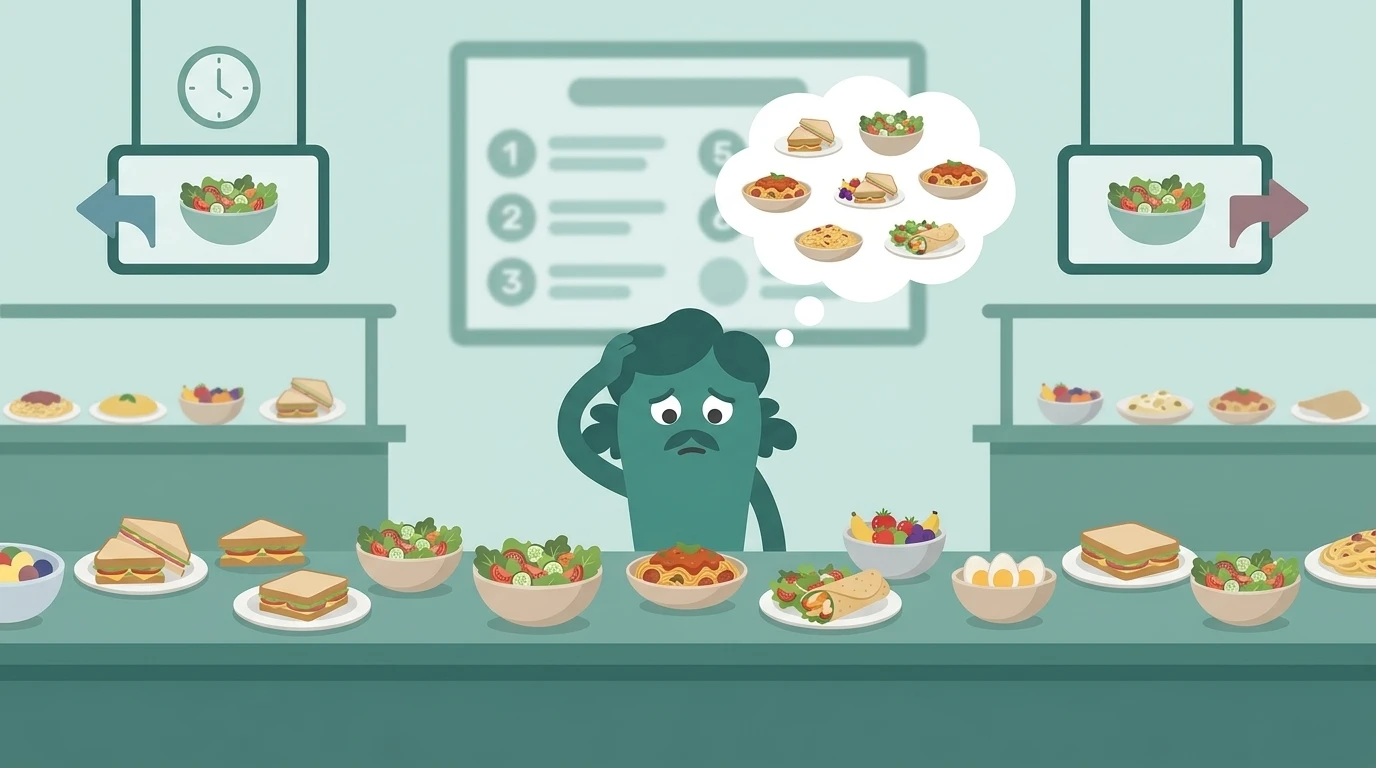
Low-stakes, high-frequency decisions (what to eat, what to wear, what to watch) — These trigger paralysis through cumulative decision fatigue. By mid-afternoon, the working memory and executive function reserves that support decision-making are depleted, and even trivial choices become paralyzing.
Open-ended, unstructured choices (what should I work on now? what do I want in life?) — Without external constraints, the ADHD brain has no anchor to organize options around. Every option is theoretically equal, which is a decision-making nightmare.
High-stakes, irreversible decisions (career change, relationship, moving cities) — Emotional amplification hits hardest when the consequences are real and permanent. The fear of the wrong choice compounds the working memory load.
Decisions with many valid options — Barry Schwartz's research on the Paradox of Choice demonstrates that more options produce more paralysis and less satisfaction — a phenomenon that is significantly amplified in ADHD, where working memory can't hold many options simultaneously.
What Doesn't Work for ADHD Decision Paralysis
Before getting to strategies, it's worth naming what doesn't work — because well-meaning advice often makes it worse:
Gathering more information — More information means more considerations for a working memory system already at capacity. Research often deepens the paralysis rather than resolving it.
Making pro/con lists — For some people, useful. For many ADHD brains, generating the list produces more "pros" and "cons" than existed before, expanding the decision space rather than narrowing it.
"Just decide and stop overthinking" — This is the advice equivalent of telling someone with a broken leg to walk it off. The overthinking isn't a choice; it's a function of executive dysregulation.
Waiting until you "feel ready" — With ADHD, the feeling of readiness often doesn't arrive until there's an external deadline forcing action. Waiting for internal readiness is waiting indefinitely.
Strategies That Actually Work
Reduce Options Before Deciding
The single most effective intervention for decision paralysis is option reduction — before you try to decide, cut the number of choices. If choosing from a restaurant menu is paralyzing, tell yourself you're picking from the first column only. If choosing between job offers is impossible, eliminate any that don't meet a single non-negotiable criterion first.
The goal is to get to two options. The ADHD brain handles binary decisions far better than multi-option arrays.
Use External Time Limits
Set a decision deadline that creates real consequences. "I will decide by 3 PM" is less effective than "I will tell my partner my decision at 3 PM." The social accountability creates the urgency the ADHD brain needs to activate.
Timers work similarly: "I will decide before this timer goes off." The external constraint gives the brain a closing mechanism it can't generate internally.
The Coin Flip Revelation
This sounds unserious but is genuinely useful: assign options to heads and tails and flip. When the coin lands, pay attention to your first emotional response. If you feel relief, that was your preference. If you feel disappointment, flip your answer.
The coin flip isn't a decision mechanism — it's a preference-revelation mechanism. The ADHD brain often knows what it wants but can't surface that preference through deliberation. The coin flip bypasses the deliberation and reveals the gut response.
Separate Deciding from Doing
One reason decisions feel so heavy is that they're conflated with commitment to action. Deciding to pursue a job means applying means writing a cover letter means... the full weight of the action chain lands on the decision itself.
Practice deciding something and writing it down without any immediate action. "I've decided I want to pursue the marketing role." Full stop. No action today. The separation reduces the emotional weight of the decision itself and makes it easier to commit.
Use an Accountability Partner or Body Double
Having someone present while you make a decision — not necessarily to advise, just to be there — activates the ADHD brain's social performance mode and reduces the circular overthinking loop. Tell someone "I need to make a decision in the next 20 minutes, will you sit with me while I do it?" The social pressure creates a closing mechanism.
GetMotivated.ai's buddy matching feature creates exactly this kind of accountability partnership. When you have a partner who expects to hear your decision, the open-ended indefinite deliberation of decision paralysis gets a natural endpoint. Rather than tools like neurolist or MyHomework that organize tasks without addressing the decision-making gap, a structured accountability relationship provides the external pressure the ADHD brain needs to close.
When Decision Paralysis Needs Professional Attention
Decision paralysis that significantly impairs daily functioning — missing career opportunities, leaving relationships in limbo, inability to complete routine daily choices — is worth addressing with professional support.
ADHD stimulant medication often dramatically improves decision-making by improving prefrontal cortex function and working memory capacity. ADHD-specialized CBT builds the metacognitive skills to recognize and interrupt the analysis loop. An ADHD coach can help you build decision frameworks that reduce cognitive load for recurring choice types.
The goal isn't to become someone who makes fast decisions effortlessly. It's to have reliable external systems and internal strategies that prevent decisions from being indefinitely deferred. Those systems exist and they work — but they need to match how the ADHD brain actually operates, not how decision-making is supposed to work.