The Double Edge in Practice
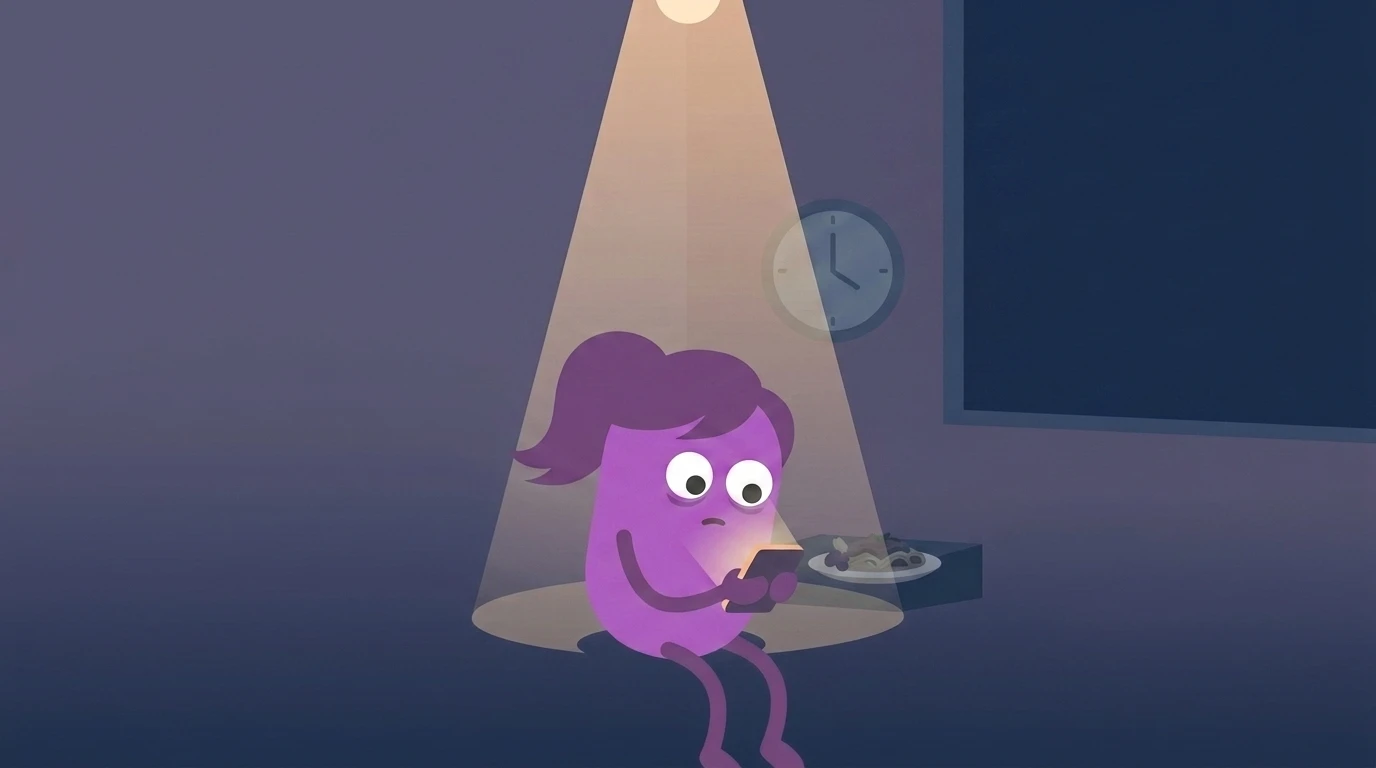
Knowing hyperfocus is real doesn't make it easier to live with, because its cost shows up in ordinary moments: the skipped lunch, the unanswered text, the meeting you were supposed to be in twenty minutes ago. The same mechanism that makes hyperfocus so productive — a reward system fully locked onto one thing — is what makes it so bad at noticing anything else. This is part of why hyperfocus and [ADHD paralysis](/blog/adhd-paralysis) can feel like opposite problems that come from the same root: a dopamine system that engages unevenly, either not enough to start, or too much to stop.
For a lot of people, the useful reframe isn't "how do I stop hyperfocusing" — that's rarely realistic — but "how do I put guardrails around it so the cost doesn't outweigh the benefit." That distinction shows up again and again in the research: hyperfocus itself isn't the problem researchers are trying to eliminate. The absence of structure around it is.
Video Games and Screens: A Case Study in Hyperfocus Triggers
Few things demonstrate the pull of hyperfocus as clearly as screens, and there's real data behind the pattern parents and adults alike tend to notice. A cross-sectional study comparing video-game use in children with and without ADHD, ages 4 to 12, found that children with ADHD had significantly higher video-game addiction scores and longer playtime than their non-ADHD peers. The detail worth paying attention to: impulsivity, specifically, was the ADHD symptom most strongly correlated with problematic gaming — and total screen time alone did not predict symptom severity. In other words, it isn't the number of hours on a screen by itself that signals a problem; it's what's driving the difficulty stopping.
That tracks with the uneven-engagement pattern described above. Games are engineered around exactly the ingredients that pull ADHD attention into overdrive: immediate feedback, clearly defined goals, and constant novelty. They're not uniquely "bad" for ADHD brains so much as unusually well-matched to what triggers hyperfocus in the first place — which is also true, to different degrees, of engrossing shows, deep-dive research projects, and creative work. The same mechanism that makes gaming absorbing for an ADHD kid is what makes a hobby, a novel, or a work project absorbing for an ADHD adult, for better and for worse. If unstructured screen time regularly displaces sleep, meals, or schoolwork, that pattern — not the hours themselves — is the signal worth discussing with a pediatrician or clinician.
How to Work With Your Hyperfocus Instead of Against It
None of the research above suggests hyperfocus should be suppressed — the goal is building enough structure around it that it stays an asset. A few evidence-informed approaches:
- Externalize the clock. Because hyperfocus reliably distorts time perception, don't rely on noticing the time — set a loud, physical alarm for meals, meetings, or medication before you start, not a phone notification you can silence on autopilot.
- Pick your hyperfocus targets on purpose when you can. Since hyperfocus responds to interest and novelty, redirecting it toward a genuinely important project — instead of hoping it lands there by accident — turns an unpredictable trait into a real productivity tool.
- Build a hard stop into the environment, not just your willpower. A partner, roommate, or [body double](/blog/dopamine-detox) checking in at a set time works better than an internal reminder, because the same reward system that's locked onto the task is also the one that would need to interrupt itself.
- Treat the video-game pattern the same way. If gaming (or any screen activity) regularly displaces sleep or responsibilities, external structure — set stop times, a visible timer, a person who checks in — tends to work better than relying on willpower alone, since willpower is exactly what a locked-in reward system overrides.
- Notice what it's telling you. Consistent hyperfocus on one kind of task and consistent avoidance of another is useful information about where your interest and reward systems naturally engage — information worth building your schedule and workload around rather than fighting.
None of these strategies require becoming a different kind of person. They just move the responsibility for noticing time and switching tasks off of an attention system that, by the research above, isn't reliably built to do that on its own — and onto an alarm, a person, or a schedule that is.
When to Get Support
Hyperfocus on its own isn't something that needs treating — plenty of people manage it well with structure alone. But if it's routinely costing you sleep, meals, relationships, or your job, or if a child's screen use is displacing schoolwork and family time despite consistent limits, that's worth raising with a doctor, psychologist, or psychiatrist. They can assess whether it's part of a broader ADHD pattern (including the executive dysfunction covered in the guide linked above) and whether medication, behavioral strategies, or both make sense for your situation.
It's also worth saying plainly what an evaluation isn't: it isn't an admission that something is wrong with you, and it isn't a verdict on your ability to succeed. It's simply a way to get an accurate map of how your particular attention and reward system works, so the strategies you build — alarms, body doubles, structured screen limits — are matched to your actual brain instead of borrowed wholesale from advice written for people whose attention works differently.
Frequently Asked Questions
What is ADHD hyperfocus? ADHD hyperfocus is an intense, involuntary state of absorption in a task the brain finds interesting, where time, hunger, and other obligations fade from awareness. Researchers describe it as a distinct attentional state, separate from ordinary sustained attention and from flow.
Is hyperfocus the same as flow? No. A review paper on hyperfocus argues it is a distinct attentional state from flow, even though both involve deep absorption. Flow is generally described as a positive, controllable, skill-matched state; hyperfocus in ADHD is more involuntary and can persist well past the point of being useful or pleasant.
Why do people with ADHD hyperfocus so easily on some things and not others? Researchers describe hyperfocus as arising from uneven attention and reward engagement in ADHD — the same brain that struggles to start a low-interest task can lock onto a high-interest one for hours. It isn't a discipline problem in either direction; it's a difference in how consistently attention gets allocated depending on how engaging a task is.
Is hyperfocus good or bad? Both. Research on adults with ADHD symptoms shows hyperfocus is genuinely double-edged: it can drive major creative or productive output, but it can also mean losing track of time and missing meals, messages, or deadlines. The goal isn't to eliminate it, but to build structure — reminders, anchors, and boundaries — around it.
Can hyperfocus be measured? Yes. A validated 12-item tool, the dispositional Adult Hyperfocus Questionnaire (AHQ-D), measures hyperfocus as a stable personal trait. In a validation study of 347 adults, it showed strong internal consistency (Cronbach's alpha 0.93) and split-half reliability (0.93), giving researchers and clinicians a standardized way to assess it.
Why is hyperfocus so common with video games for people with ADHD? A study of children with and without ADHD found kids with ADHD had significantly higher video-game addiction scores and longer playtime, with impulsivity the ADHD symptom most strongly linked to problematic gaming. Games are built around exactly the ingredients that trigger hyperfocus — immediate feedback, clear goals, and constant novelty.
How GetMotivated.ai Can Help
Structure is the piece that's hardest to build alone, especially when the same brain that hyperfocuses is the one that's supposed to remember to set the alarm. GetMotivated.ai pairs a daily plan with a buddy who notices when you've gone quiet for four hours, turning that ADHD reward system into an asset instead of leaving it to interrupt itself.