What Are the 4 Stages of Habit Forming?
Understanding why habits take this long requires understanding the mechanism. James Clear's Atomic Habits framework — grounded in behavioral science research — describes four stages that every habit must pass through before it becomes automatic:
1. Cue. A trigger that initiates the behavior. It can be a time of day, a location, an emotional state, or an immediately preceding action. Without a reliable cue, the behavior stays in "intentional" mode — requiring active decision-making every time.
2. Craving. The motivational force behind the habit. This is not desire for the behavior itself, but anticipation of the reward. Your brain doesn't crave scrolling social media — it craves the relief from boredom or loneliness that scrolling delivers. No craving means no motivation to initiate.
3. Response. The actual behavior — the habit you're trying to form. The response must be feasible at your current level of motivation and ability. This is why BJ Fogg's Tiny Habits research emphasizes making the behavior small enough to do even on a bad day.
4. Reward. The end result that satisfies the craving and teaches your brain that this loop is worth repeating. Rewards that arrive immediately and reliably accelerate habit formation. Delayed or inconsistent rewards slow it.
The automaticity that the UCL study measured is what happens when this loop has been completed enough times that the cue triggers the response without conscious deliberation. That process takes neural pathway reinforcement — and neural pathways don't care about arbitrary timelines.
Why Habit Complexity Matters More Than Willpower
The single strongest predictor of how long a habit takes to form is not your motivation level, personality type, or willpower. It's the complexity of the behavior you're trying to automate.
A rough complexity spectrum based on available research:
This matters for planning. If your goal is a daily exercise habit and you're basing your expectations on 21 days, you'll feel like a failure at week four, five, six, and seven — when you're actually making normal progress.
BJ Fogg's Tiny Habits research at Stanford offers a practical solution: start at the lowest possible complexity. "Two pushups after I pour my morning coffee" forms faster than "30-minute workout at the gym." Once the cue-response loop is established, complexity can increase.
What Is the 21/90 Rule?
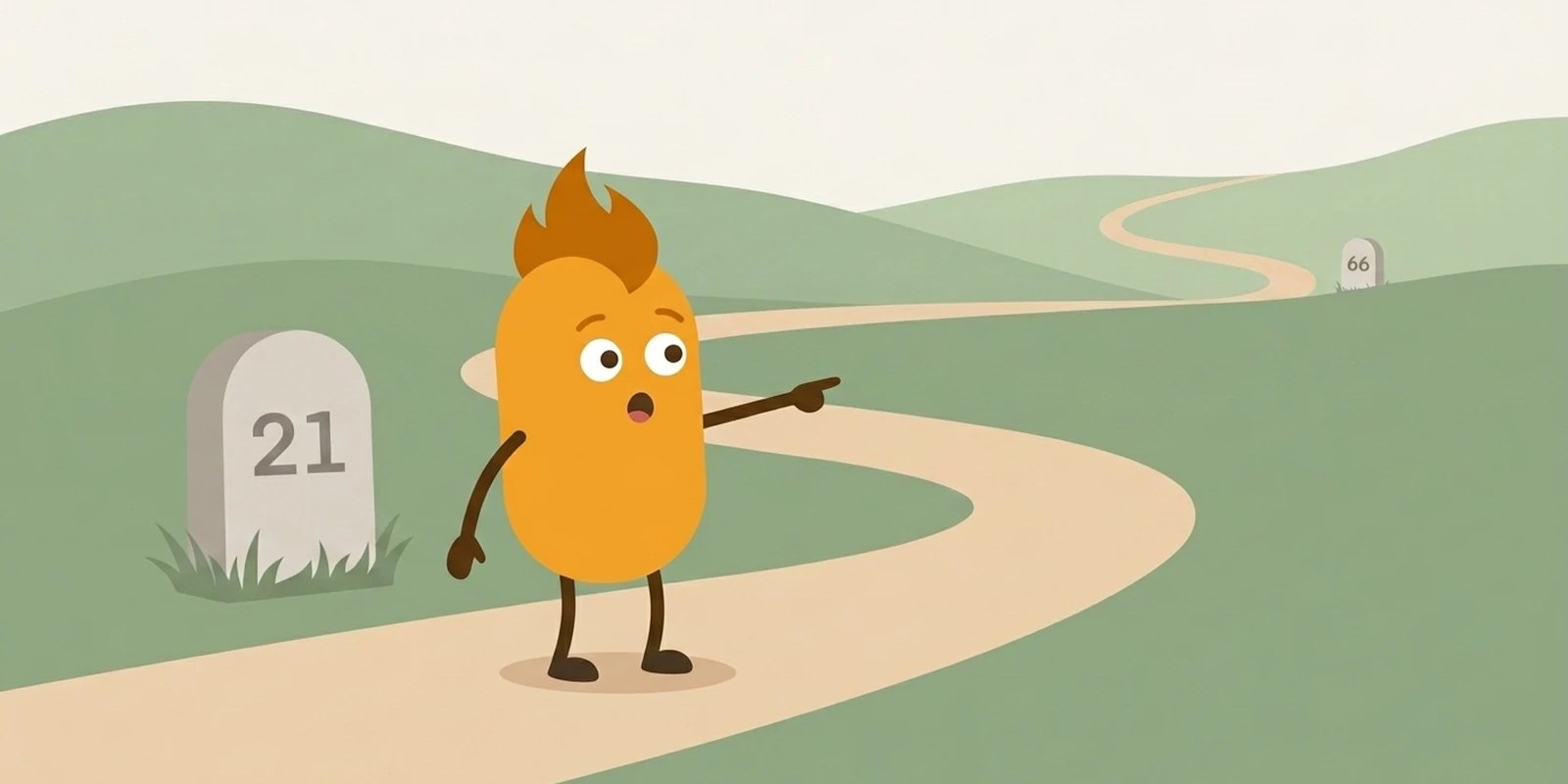
The 21/90 rule claims it takes 21 days to form a habit and 90 days to make it a permanent lifestyle change. It's a popular self-help shorthand — particularly in fitness and wellness communities — but neither number comes from research.
The 21-day component is the Maltz misquote described above. The 90-day extension appears to be a practical observation that behaviors maintained for a full quarter tend to stick — which is plausible, but hasn't been validated in controlled studies.
What the 21/90 rule gets right: longer time horizons for behavior change are more realistic than the 21-day figure alone. Committing to 90 days removes the pressure to feel "automatic" by week three, which reduces premature quitting.
What it gets wrong: it still implies a fixed, universal timeline that doesn't account for behavior complexity.
What Is the 3-3-3 Rule for Habit Formation?
The 3-3-3 rule suggests committing for 3 days, then 3 weeks, then 3 months — using each milestone as a deliberate check-in rather than a finish line. It's not peer-reviewed, but it captures something behaviorally sound: graduated commitment reduces overwhelm and creates natural reflection points.
The practical value is psychological. "I'll try this for three days" is a lower barrier to entry than "I'll do this for 66 days." Once three days pass, extending to three weeks feels achievable. The structure builds momentum without the pressure of a single large commitment.
If you use this framework, treat the 3-month mark as the point where consistency starts to generate real automaticity — not the 21-day mark.
Why Streaks and Tracking Help
Visual progress tracking — marking off days on a calendar, logging completions in an app, seeing a streak counter — accelerates habit formation through a mechanism the UCL study authors called "habit automaticity reinforcement."
More simply: the brain responds to visible evidence of progress. Seeing 14 consecutive days checked off creates an intrinsic motivation to protect the streak that adds to whatever external motivation you started with.
Research on implementation intentions — the planning framework of "I will do X at time Y in location Z" — shows that people who write down the specific when, where, and how of a habit are significantly more likely to follow through than those who rely on general intention. The specificity turns an aspiration into a behavioral script that is easier for the brain to retrieve.
Three tracking principles that the research supports:
Track the process, not the outcome. Mark "completed workout" not "lost 2 pounds." Outcomes are delayed; process completion is immediate. Immediate reinforcement builds stronger habit loops.
Don't break the chain — but don't treat one miss as failure. The Lally et al. data is clear: occasional missed days do not reset habit formation. What resets habit formation is quitting entirely. "Never miss twice" is a more evidence-based rule than "never miss once."
Match challenge duration to behavior complexity. A 21-day challenge is appropriate for a hydration habit. A 90-day challenge is more appropriate for an exercise habit. Setting the wrong timeline creates premature failure.
How GetMotivated.ai Approaches Habit Formation
Most habit apps are built around the 21-day myth — they celebrate 21-day streaks as if the work is done, and their engagement models assume habits form in a few weeks. The research shows this is why most people cycle through the same habit attempts repeatedly without the behavior sticking.
GetMotivated.ai's challenge durations are designed around the actual science. Challenges run for 30, 60, or 90 days depending on behavior complexity — not because those are round numbers, but because they reflect the realistic formation ranges the UCL data describes.
Two specific features address the hardest part of habit formation: the middle weeks.
Buddy matching pairs you with someone working on a compatible goal. The accountability mechanism that research consistently identifies as the strongest predictor of long-term behavior change isn't willpower — it's social commitment. When someone is checking on your progress, the friction of quitting increases.
Group challenges normalize the difficulty of weeks four through ten. When you're in a cohort of people who are all finding their exercise habit effortful on day 45, you stop interpreting "this is still hard" as evidence of personal failure. You recognize it as normal — because it is.
The behavioral science here is straightforward: habits form through consistent repetition within a reliable context, not through insight or motivation alone. The tools that support habit formation are the ones that make showing up on difficult days easier — not the ones that promise you'll be done in three weeks.