November 27, 20268 min readStudents and studying

How to Pay Attention in Class When Your Mind Keeps Leaving

Zoning out in lecture is common. Here is what studies of real classes say about seats, phones, notes, doodling, sleep, exercise and ADHD.

Rachel Stein

Last reviewed: October 2026

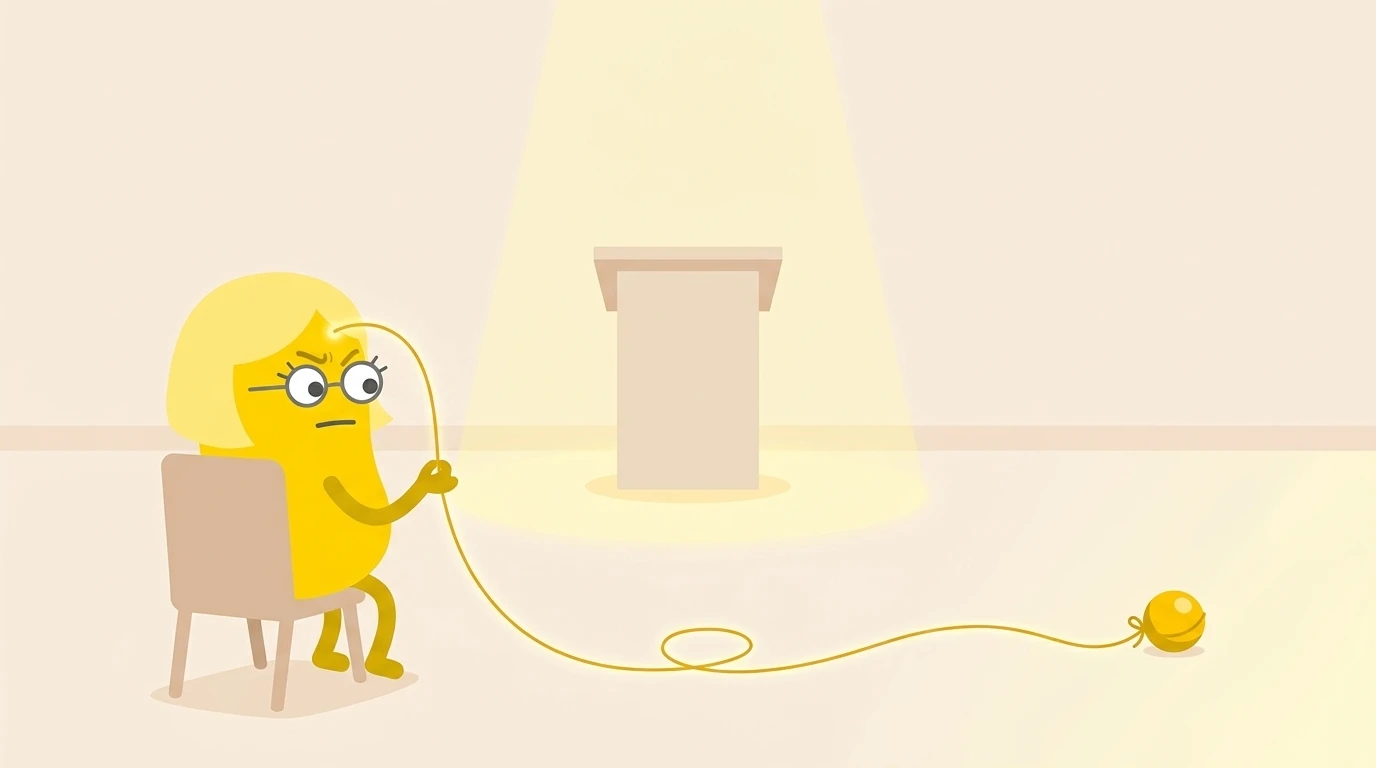
A yellow buddy with round glasses and a worried frown sits on a plain chair with its head turned away from a softly lit podium, pinching a golden thread from its forehead that runs along the floor to a small golden ball far to the right.

To pay attention in class, sit nearer the front, keep your phone out of reach, take notes instead of doodling, and protect your sleep. In one study of 851 students in real lectures, minds wandered 24% of the time on average, so the aim is to catch drifts sooner and bring yourself back.

Most of the research below comes from university students sitting through lectures, often in psychology courses, and much of it is correlational, including the seat and sleep links. Almost none of it selected students with ADHD. Treat each tip as an experiment, and keep the ones you see working in your own classes.

Why do I zone out in class even when I care about the subject?

Caring helps, and it still does not stop the drift. Michael Kane and colleagues rang a bell at set moments during two early-semester lectures and asked 851 undergraduates, across ten psychology classes at two US universities, what they had just been thinking (Memory & Cognition, 2021). Off-task thought averaged 24%, and individual rates varied widely (SD = 18%).

Three things predicted more off-task thought on their own: lower initial interest in the course topic, heavier classroom media-multitasking habits, and an everyday tendency toward mind wandering and boredom. Off-task thought tracked final grades and interest in the course, but only modestly.

So losing the thread in a class you like is ordinary. Some of the pull comes from who you are on a given day, and some comes from habits you can change. The next sections go through the habits.

Does sitting in the front of class help you pay attention?

Students in the front third of the room reported less off-task thought than students in the back third. In Kane's study, the average was about 18% for the front and 30% for the back at the first visit, with 17% and 31% at the second. The team described the rise from front to back as 67% and 82% across the two visits.

Students chose their own seats, so this is a correlation, and the authors note that an unmeasured trait could explain it. The pattern held after they adjusted for the classroom and for the course attitudes and habits they had measured, which makes a simple "motivated students sit in front" story less likely, though it does not rule out other differences.

What to do. Take a seat in the front third when you can. If the room is fixed, move to where you can see the slides and the instructor's face without a screen between you and them.

How do I stop my phone or laptop from distracting me in lecture?

Remove the option before the lecture starts. In Kane's study, self-reported classroom media-multitasking habits had the strongest link with off-task thought among the habits and attitudes measured (r = .34), stronger than everyday proneness to mind wandering and boredom (r = .21). Those habits also predicted unique variance in final grades.

That is a survey link, and it does not prove the phone caused the lapses. It still points at the one lever fully in your hands.

Phone. Put it in your bag, on silent, before you sit down.

Laptop. Keep only the note-taking window open and close messaging and browser tabs.

Our guide to avoiding distraction while studying covers the same setup for homework.

Related Challenges & Plans

Does doodling help you pay attention in class?

Doodling did not help in a controlled test. Spencer-Mueller and Fenske ran two experiments with 222 participants in total (Quarterly Journal of Experimental Psychology, 2024). In the second, listeners heard 45 minutes of a recorded lecture under one of four conditions: structured doodling, unstructured doodling, note-taking, or listening only.

Note-takers mind-wandered less than listen-only students (d = -.83) and remembered more of the lecture (d = .75). Neither kind of doodling beat passive listening on memory.

Two limits apply. The lecture was recorded audio rather than a live class, and ADHD was not studied. The paper also did not compare handwriting with typing, so the research here cannot tell you which is better.

What to do. Write notes in your own words, a short line at a time, with whichever tool you will keep using. Save the doodles for after class.

How do I pay attention in an online class?

Quizzing yourself may help a little. Welhaf, Phillips, Smeekens, Miyake and Kane randomly assigned 195 US undergraduates to watch a video lecture on introductory statistics with either short tests on the material or restudy of it between segments (Cognitive Research: Principles and Implications, 2022). Students who were tested reported less off-task thought (40% versus 47%, p = 0.046).

The authors call the effect small, and it had no support from Bayes-factor evidence. They found no statistical evidence that testing improved learning, and a pretest before the lecture did nothing for mind wandering. All participants came from a single university.

If you want to test it, run your own version as a free experiment. At each natural break, pause the video and write down what you can recall without looking back.

For recorded classes that can be paused, our post on keeping focus once you have started adds more ways to hold attention.

Does being tired make it harder to pay attention in class?

Probably, though the evidence only shows an association. Tan, Liu and Zang surveyed 1,377 university students in a southern province of China with an online questionnaire (Frontiers in Psychology, 2026). Daytime sleepiness went with lower academic engagement and more frequent mind wandering. Mind wandering accounted for about 31.8% of the link between sleepiness and engagement.

A cross-sectional survey cannot show that sleepiness causes the wandering, and the ratings were self-reported. The authors suggest student support should focus mainly on sleep education, attention support and schedule management.

What to do. Because the link is only an association, treat an earlier bedtime as a low-cost experiment before the days with the most lectures. If you lie awake and cannot get to bed, ADHD and sleep explains why that happens.

Does exercise before class help you focus?

It may, though the best evidence is small. Morava and colleagues randomized 40 post-secondary students to 30 minutes of high-intensity aerobic exercise or seated rest. Both groups then did a stress task and watched a 20-minute video lecture with mind-wandering checks (PLOS ONE, 2025).

The seated-rest group reported more mind-wandering minutes (d = 0.922) and scored lower on comprehension (d = 0.664, p = 0.042). Mind wandering and comprehension were negatively correlated (r = -0.417). Exercise did not lower the stress response itself.

The authors say they cannot tell how this carries over to longer lectures or later recall. The study tested hard exercise, not a short walk. In Tan's survey, general physical activity added very little as a buffer against sleepiness.

What to do. If you have a gym slot or a hard bike ride available before an important lecture, try it once and see how your attention feels.

How do I pay attention in class with ADHD?

Start by knowing that the lecture studies above did not select students with ADHD, so these tips are reasonable moves with no ADHD-specific trial behind them. The ADHD research behind this post points to a heavier load. In a survey of 1,879 Hungarian college students aged 18 to 35, Müller and Pikó grouped students by self-reported ADHD symptoms (Scientific Reports, 2026). The group with both inattentive and hyperactive-impulsive symptoms reported the highest maladaptive procrastination and ego depletion, with a moderate effect for intention to drop out.

That was a cross-sectional survey of screening scores, not diagnoses, and it did not measure lecture attention. It is a reason to build a plan instead of leaning on willpower.

What to do. Use the seat, phone and notes steps above, then add support. Ask your school's disability services office what is available, and talk to a clinician if lapses follow you into every setting. Our posts on ADHD in schools and how to study with ADHD go deeper, and body doubling for studying shows how working near someone helps.

If you struggle to keep a plan on your own, a buddy on GetMotivated.ai can check in after each class, and a challenge can give your routine a daily rhythm.

How can I focus in class starting with the next lecture?

Plan for the second half. Across Kane's lectures, off-task thought rose from 21.3% in the first half to 26.5% in the second (d = .214), a modest but reliable change. That gives you a point in the hour to guard.

Before class. Choose a seat in the front third, silence your phone and drop it in your bag, and open your notes with the date and topic.

At the halfway mark. Write one line summarizing what you have heard so far.

Afterward. Note one thing you drifted on, so you can adjust next time.

Spend the next ten minutes choosing tomorrow's seat, packing your notebook and pen, and setting a silent alarm for the halfway point of your first class.

Next time you search, our newest guide shows up.

Sources

Individual differences in task-unrelated thought in university classroomsResearch
Kane MJ et al.
This study investigated what academic traits, attitudes, and habits predict individual differences in task-unrelated thought (TUT) during lectures, and whether this TUT propensity mediates associations between academic individual differences and course outcomes (final grade and situational interest evoked by material). Undergraduates (N = 851) from ten psychology classes at two US universities responded to thought probes presented during two early-course lectures; they also indicated sitting in the front, middle, or back of the classroom. At each probe, students categorized their thought content, such as indicating on-task thought or TUT. Students also completed online, academic-self-report questionnaires at the beginning of the course and a situational interest questionnaire at the end. Average TUT rate was 24% but individuals' rates varied widely (SD = 18%). TUT rates also increased su
Interpolated testing and content pretesting as interventions to reduce task-unrelated thoughts during a video lectureResearch
Welhaf MS et al.
Considerable research has examined the prevalence and apparent consequences of task-unrelated thoughts (TUTs) in both laboratory and authentic educational settings. Few studies, however, have explored methods to reduce TUTs during learning; those few studies tested small samples or used unvalidated TUT assessments. The present experimental study attempted to conceptually replicate or extend previous findings of interpolated testing and pretesting effects on TUT and learning. In a study of 195 U.S. undergraduates, we investigated whether interpolated testing (compared to interpolated restudy) and pretesting on lecture-relevant materials (compared to pretesting on conceptually related but lecture-irrelevant materials) would reduce TUTs during a video lecture on introductory statistics. Subjects completed either a content-matched or content-mismatched pretest on statistics concepts and then
The effects of a single bout of high intensity exercise on stress reactivity, mind wandering, and lecture comprehension in young adultsResearch
Morava A et al.
Post-secondary students experience acute stressors daily. Acute stress has been associated with poor cognitive and learning outcomes. Prior work has demonstrated a single bout of exercise can attenuate acute stress responses. The present study examined the effects of a single 30-minute bout of high intensity aerobic exercise on multidimensional stress reactivity and learning-related outcomes. Forty participants were randomized to either engaging in an exercise bout or seated rest. Participants were then exposed to the Trier Social Stress Test followed by a 20-minute video lecture. The video lecture contained embedded mind wandering probes. Acute exercise did not attenuate stress responses, however promoted greater on-task behaviour (i.e., less mind wandering) and improved lecture comprehension scores. Notably, state anxiety was positively associated with mind wandering and mind wandering
Note-taking for the win: Doodling does not reduce boredom or mind-wandering, nor enhance attention or retention of lecture materialResearch
Spencer-Mueller EK & Fenske MJ
Doodling and fidgeting-traditionally viewed in educational contexts as markers of inattention and poor classroom behaviour-have more recently been considered as possible routes to improve performance by reducing boredom and its negative impact on memory. However, there is a surprising lack of well-controlled studies examining this possibility, despite the widespread adoption of fidget toys and doodling exercises within classroom settings. Here we report two experiments (total N = 222) that assess the impact of doodling on boredom, attention, mind-wandering, and subsequent recall of auditory information. In Experiment 1, participants first listened to a 15-min section of a lecture known to induce boredom. Immediately thereafter they were asked to jot down important information from a short voicemail that they listened to while either doodling (adding shading to shapes) or doing nothing in
Daytime sleepiness and academic engagement among university students: mind wandering as a partial mediator and physical activity as a limited moderatorResearch
Tan Y et al.
This cross-sectional study examined whether mind wandering statistically accounted for the association between daytime sleepiness and academic engagement, and whether physical activity served as a boundary condition in this association. University students in a southern province of China, completed an anonymous online questionnaire. After prespecified quality screening, 1,377 valid responses were included in the main analyses and 1,371 complete cases were included in the moderated mediation analysis. Daytime sleepiness was associated with lower academic engagement and more frequent mind wandering. Mind wandering partially accounted for the association between daytime sleepiness and academic engagement, with an indirect effect of -0.122 (95% bootstrap CI [-0.152, -0.094]), representing approximately 31.8% of the total association. Physical activity showed a statistically detectable intera
The combined ADHD profile faces the greatest risk of delay, depletion and disengagement in university studentsResearch
Müller V & Pikó B
Attention-deficit/hyperactivity disorder (ADHD) symptoms are increasingly recognized in adulthood, particularly among university students, yet their distinct psychological correlates remain underexplored. Using a cross-sectional design, this study examined Hungarian college students (N = 1,879, aged between 18 and 35 years) who responded online to a set of questionnaires that included the Adult ADHD Self-Report Scale, Procrastination Scale, Higher Education Retention Scale and Ego-Depletion Scale. We applied k-means cluster analysis to classify students into four ADHD-related groups (Combined, Inattentive, Hyperactive-Impulsive, Low-symptom) based on symptom criteria. Consequently, we compared these clusters across six theoretically relevant self-regulatory outcomes: maladaptive and adaptive procrastination, maladaptive and adaptive perfectionism, ego depletion and dropout intention. A m

Topics

AI-ready summary

Studies of real lectures find that students' minds wander about 24% of the time, more in the back rows and in the second half of class. Taking notes, putting phones away, quizzing yourself during video lectures, and getting enough sleep show links to less mind wandering in studies that are mostly correlational, while doodling showed no memory benefit.

Key takeaways

  • In a study of 851 undergraduates, off-task thought averaged 24% in lecture, with wide differences between students.
  • Students in the front third reported less off-task thought than students in the back third, though students chose their own seats.
  • Note-takers mind-wandered less and remembered more than listen-only students; doodling did no better than listening.
  • Quizzing yourself during a video lecture lowered mind wandering slightly (40% versus 47%) in a randomized experiment of 195 students.
  • Daytime sleepiness was linked to more mind wandering in a survey of 1,377 students, so an earlier bedtime is worth testing on heavy lecture days.

FAQs

How long can the average student pay attention in a lecture?

No fixed number came out of the research behind this post. In a study of 851 undergraduates by Kane and colleagues, off-task thought averaged 21.3% in the first half of lectures and 26.5% in the second half, a modest rise.

Is it better to take notes by hand or on a laptop to stay focused?

The studies here did not compare the two. In a 2024 experiment with 222 participants across two experiments, taking notes beat listening only and doodling for attention and memory, so pick the method you will actually keep doing and close every other app.

How do I stop my phone or laptop from distracting me in lecture?

Put the phone in your bag on silent and keep only your note-taking app open on a laptop. In Kane's classroom study, students' self-reported media-multitasking habits had the strongest link with off-task thought (r = .34).

Does being tired make it harder to pay attention in class?

Probably, though the evidence is correlational. A survey of 1,377 university students in China found daytime sleepiness linked to more mind wandering and lower academic engagement.

Does exercise before class help you focus?

In one randomized trial of 40 students, 30 minutes of hard aerobic exercise was followed by less mind wandering and better comprehension of a 20-minute video lecture than seated rest. The sample was small and the study did not test shorter or gentler activity.

How do I pay attention in class with ADHD?

The lecture studies in this post did not select students with ADHD, so the tips are untested for that group. Pair them with support from your school's disability services office and a clinician if lapses show up in every setting.

Related Challenges & Plans

Keep reading