GetMotivated.ai Logo
How It WorksBlogLog in
  1. Home
  2. /
  3. Blog
  4. /
  5. Virtual Body Doubling: What It Is and How to Do It Online
August 3, 20269 min readADHD & Neurodivergence

Virtual Body Doubling: What It Is and How to Do It Online

Virtual body doubling means working alongside another person over video or in a live co-working room instead of in the same room. Here's how it differs from in-person, the formats worth trying, and how to make it actually work.

The GetMotivated.ai Team

Last reviewed: August 2026

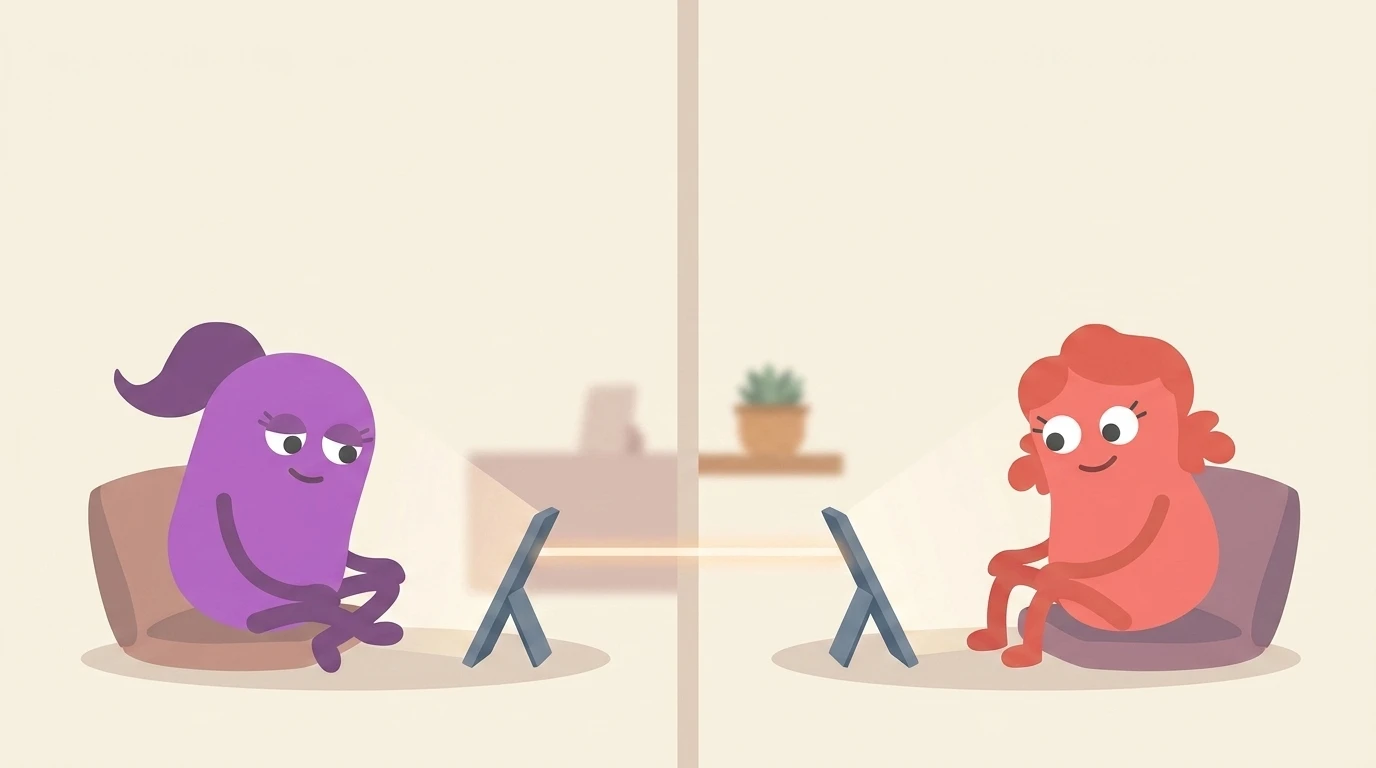
Illustration for the article: Virtual Body Doubling: What It Is and How to Do It Online

Virtual Body Doubling: What It Is and How to Do It Online

Virtual body doubling is working alongside another person over video, audio, or a live co-working room instead of in the same physical space, using their online presence to activate focus the way an in-person body double would. It works through the same mechanism as sitting next to someone at a desk: their presence, not their advice or supervision, is what helps you start and stay on task.

This guide covers what makes the online version different from being in a room together, the formats worth trying, how to run a session that actually holds your attention, and who it helps beyond ADHD.

What Is Virtual Body Doubling

[Body doubling](/blog/body-doubling) in its original form meant physically sharing a space with someone while you each worked on your own tasks. The virtual version keeps the core idea and drops the requirement that you be in the same room. You see or hear another person working, live, and that shared presence does the same job a coffee shop full of quiet strangers does for a lot of people: it makes starting easier and drifting off harder.

The practical difference from in-person body doubling is availability. You don't need someone in your house or a coworking membership nearby. A scheduled video call or a browser tab open to a live co-working room gets you the same effect on a schedule that fits your day, at almost any hour. For a fuller breakdown of what the concept means and where it came from, [body doubling meaning](/blog/body-doubling-meaning) covers the definition in more depth.

What virtual body doubling is not is a work session with another person. There's no expectation of collaboration, feedback, or conversation once the session starts. The other person is doing their own unrelated work. Their job is simply to be visibly, audibly there.

Adult ADHD Self-Report Scale v1.1 Part A Screener (ASRS-v1.1 Part A)

How often has this happened over the past 6 months?

How often do you have trouble wrapping up the final details of a project, once the challenging parts have been done?

1 of 6
Pick one to begin

Why Virtual Body Doubling Works

The clearest explanation still traces back to social facilitation, the century-old finding that the presence of another person changes how you perform a task. A 2025 pre-registered replication of the original 1898 experiment confirmed it still holds: 445 participants completed a simple task faster when paired with another person than when working alone. That effect doesn't require the other person to be doing anything in particular. It doesn't require them to be in the room. It requires only that their presence register as real.

That's worth being honest about: the research base for virtual body doubling specifically is still young. Most of what supports it is drawn from social facilitation theory and from the broader [body doubling and ADHD literature](/blog/body-doubling-adhd), applied to a video-call context rather than tested there directly. One of the first controlled looks at the virtual-specific question came in 2025, when Ara and colleagues ran a study comparing solo work, a human body double, and an AI body double inside a VR task. With twelve participants completing a simulated bricklaying task, people with ADHD finished faster and reported better sustained attention with either type of body double present than working alone. It's a small study on a lab task, not a large clinical trial, but it's a genuine signal that the presence effect survives translation into a virtual setting, and it's the kind of finding future research will likely build on.

The [fuller science behind why this works for ADHD brains specifically](/blog/adhd-body-doubling-guide), including the connection to task initiation and dopamine regulation, holds regardless of whether the other person is across the table or across a video call. What changes online is delivery, not mechanism.

Ways to Body Double Online

Virtual body doubling isn't one format. Different versions suit different focus problems, and it's worth trying more than one before deciding it doesn't work for you.

Live 1:1 Video Sessions

Two people, one scheduled call, cameras on. You each state your task at the start, work in near-silence for a set block (commonly 25 to 50 minutes), and check in briefly at the end. This is the most structured option and the closest match to sitting across from a focus partner at a desk.

Silent Group Co-working Rooms

A shared video room with several people working at once, usually with minimal or no talking. This suits people who find 1:1 video sessions too intense or too easy to skip, since a group room feels lower-stakes to join and doesn't hinge on one other person showing up.

Async Check-Ins

No live video at all. You post a message when you start a task and another when you finish, often in a shared chat or community channel. This trades the strongest version of the presence effect for near-zero scheduling friction, and it works well as a light-touch option on days when a live session isn't realistic.

Dedicated Apps and Platforms

Purpose-built tools remove the coordination work: they match you with a partner or a room automatically instead of requiring you to find someone yourself. [A comparison of the current body doubling apps](/blog/body-doubling-adhd-app) covers the major options in detail. GetMotivated.ai takes a slightly different angle on this: instead of one-off sessions with strangers, it pairs people with an ongoing accountability buddy as part of a structured plan, so the co-working relationship persists instead of resetting every time you need to find a new partner.

Related Challenges & Plans

Lifeplan

10-Day ADHD Habit Reset Plan: Stop the Cycle of Schedule Rebellion

Bypass executive function resistance and stop 'schedule rebellion' with a 10-day plan built specifically for the ADHD brain.

G
GetMotivated.ai
10 min3×/week10dL1
Lifeplan

14-Day RSD Toolkit: Stop the Emotional Spiral Plan

Master your response to perceived rejection and reclaim your confidence with this science-backed 14-day emotional regulation plan.

GetMotivated.ai
Created by GetMotivated.ai
10 min3×/week14dL2
Lifechallenge

30 Days Alcohol-Free

Reclaim your sleep, boost your daily energy, and clear the brain fog with this science-backed 30-day alcohol-free challenge.

Annie Grace
Inspired by Annie Grace · by GetMotivated.ai
10 min3×/week30dL2
Lifechallenge

Clean Any Room in 5 Steps with Ann Russell

Clean any room with Ann Russell’s 5-step method. A direct, realistic 14-day plan for building cleaning habits that actually stick.

Ann Russell
In partnership with Ann Russell · by GetMotivatedBuddies
10 min3×/week14dL1

How to Run a Virtual Body Doubling Session That Works

A session with no structure tends to drift into small talk or gets skipped entirely. A few habits keep it functional:

Say the task out loud at the start. Even a single sentence, something like "I'm going to draft this email for twenty minutes," turns a vague intention into a stated commitment, which is most of what makes the session work.

Keep cameras on if you can. Presence is the mechanism, and a visible person tends to register more strongly than an audio-only voice or a static avatar. If camera anxiety is the barrier, start with a trusted friend or family member before trying a stranger-matched platform.

Set a fixed length and stick to it. Twenty-five to fifty minutes is the common range. A defined end point makes the task feel bounded instead of open-ended, which matters most on days when starting is the hardest part.

Protect the silence. The temptation to chat, especially with someone you know, undercuts the whole point. Save conversation for the check-in at the end.

Close the loop. A short end-of-session check-in — what got done, what's next — gives the session a clear finish and reinforces that the time was used for something real.

Who Virtual Body Doubling Helps Beyond ADHD

Body doubling started in ADHD communities, and that's still where the strongest interest and the most research attention live. But the underlying need it addresses, ambient structure and social presence during solo work, is common well outside that group.

Remote workers. Working from home removes the incidental presence of coworkers that used to do this job without anyone naming it. In Buffer's 2023 State of Remote Work survey, 23% of remote workers named loneliness as a top struggle, second only to collaboration and communication difficulties. A broader 2025 review of 65 peer-reviewed studies found loneliness and isolation to be a consistent, underexplored risk of remote work, with measurable effects on both wellbeing and job performance. Virtual body doubling doesn't solve remote-work isolation on its own, but it puts a person back into otherwise silent hours.

Students. Studying alone in a dorm room or apartment lacks the ambient accountability of a library full of other people working. Virtual body doubling recreates that atmosphere on demand. For a broader look at study-specific strategies, [ADHD study habits](/blog/adhd-study-habits) covers techniques that pair well with a body doubling session.

Freelancers and anyone without an office. No coworkers, no manager checking in, no natural rhythm to the day. A scheduled body doubling session can substitute for the structure an office used to provide, without requiring a coworking membership.

It's worth distinguishing this from an [accountability partner](/blog/accountability-partner), which is a related but different tool. Body doubling helps you start and stay on a task right now, in the session. An accountability partner helps you follow through on a commitment over days or weeks, through check-ins and the mild social cost of reporting a miss. The two solve different problems, and many people get the most out of using them together.

How to Get Started Today

The lowest-friction way to try this is also the cheapest: ask a friend, partner, or coworker for a 30-minute video call where you each work quietly on your own thing. If that goes well, it tells you the format is worth building into a regular habit, before you spend anything on a dedicated platform.

From there, the main decision is how much structure you want. A free tier on a stranger-matched platform works if you just need occasional sessions. A community with a standing co-working channel works if you want a lower-commitment option to dip into. And if what you actually need is consistent, ongoing accountability rather than isolated sessions, that's the gap GetMotivated.ai's buddy matching is built to close: a matched partner and a structured plan, so the relationship holds without you having to re-coordinate it every single time.

Whichever format you start with, the goal is the same one body doubling has always served: making it easier to begin, and easier to keep going once you have.

Frequently Asked Questions

What is virtual body doubling?

Virtual body doubling is working alongside another person over video, audio, or in a live online room, instead of in the same physical space. The other person doesn't help with your task; their presence alone provides the activation cue that makes starting and sustaining focus easier.

Does virtual body doubling work as well as in-person?

For most people, yes. The active ingredient is perceived presence, not physical proximity, so a video call with the camera on typically produces a similar effect to sitting in the same room. Some people need camera-on sessions to feel the effect; others do fine with audio-only or a shared timer and a webcam thumbnail.

What's the best way to start body doubling online?

Pick a format that matches how much structure you need. A scheduled 1:1 video session works well if you need a hard commitment. A silent group co-working room works well if you find one-on-one video draining. State your task out loud at the start, and check in at the end so the session has a clear close.

Is virtual body doubling only useful for ADHD?

No. It was popularized in ADHD communities and the strongest research interest is still there, but remote workers, students, freelancers, and anyone who focuses better with ambient social presence use it too. The need for structure and connection during solo work isn't unique to any one diagnosis.

Is there a free way to body double online?

Yes. Informal arrangements with a friend on a video call cost nothing, and several platforms offer limited free sessions per week. Paid options add scheduling reliability, matched partners, or structured accountability layered on top of the co-working session.

What's the difference between virtual body doubling and a virtual accountability partner?

Body doubling works in the moment — the other person's presence helps you start and stay on a task right now. An accountability partner works over time — you report progress on a longer commitment, and the social cost of falling short keeps you on track. The two solve different problems and work well together.

Sources

  1. A Replication of Triplett's 'Social Facilitation Experiment' — Ciaran McHugh et al., Scientific Reports, 2025. Pre-registered replication (N=445) confirming the classic presence effect that underlies body doubling.
  2. You Are Not Alone: Designing Body Doubling for ADHD in Virtual Reality — Ara et al., 2025. Controlled study comparing solo work, human, and AI body doubles in a VR task.
  3. Loneliness and Isolation in the Era of Telework — Figueiredo, Margaça & Sánchez-García, Healthcare (Basel), 2025. Review of 65 studies on remote work and loneliness.
  4. State of Remote Work 2023 — Buffer. Survey data on remote worker struggles, including loneliness.
  5. Focusmate — Virtual co-working platform referenced as an example of a dedicated body doubling service.

Next time you search, our newest guide shows up.

Sources

A replication of Triplett's 'social facilitation experiment'Research
Ciaran McHugh et al.
A modern, pre-registered replication of Triplett's classic 1898 study finding people complete a simple task faster when another person is present than when working alone.
You Are Not Alone: Designing Body Doubling for ADHD in Virtual RealityResearch
Zinat Ara et al.
2025 controlled VR study (N=12) comparing solo work, human body double, and AI body double; participants with ADHD finished faster with either body double present.
Loneliness and Isolation in the Era of Telework: A Comprehensive Review of Challenges for Organizational SuccessResearch
Elisabeth Figueiredo et al.
2025 Healthcare (Basel) review of 65 peer-reviewed studies finding loneliness/isolation are consistent risks of remote work.
State of Remote Work 2023Article
buffer.com · Buffer
Annual Buffer survey of remote workers; 23% selected loneliness as a top struggle.
Focusmate—Virtual body doubling for getting anything doneArticle
focusmate.com · Focusmate
Focusmate is a virtual coworking platform that leverages body doubling and social accountability to help users stay productive. It matches individuals for timed video sessions to facilitate focus on tasks ranging from professional work to daily chores.

Topics

body doublingadhdaccountabilityCoworkingneuroscienceproductivity

AI-ready summary

Virtual body doubling is working alongside another person over video, audio, or a live co-working room to activate focus, the same mechanism as in-person body doubling but without needing shared physical space. Formats include 1:1 video sessions, silent group rooms, async check-ins, and dedicated apps. Direct research on the virtual version is still emerging, but a 2025 controlled study found people with ADHD completed tasks faster with a body double, human or AI, than working alone.

Key takeaways

  • Virtual body doubling replicates most of the benefit of in-person body doubling through webcam or audio presence, without requiring shared physical space or a matched schedule for commuting
  • A 2025 controlled VR study (Ara et al.) found adults with ADHD finished tasks faster and reported better sustained attention with a body double present, human or AI, than working alone
  • The direct evidence base for virtual-specific body doubling is still thin — most support comes from social facilitation theory and adjacent coworking research, and that should be stated plainly rather than oversold
  • Formats range from live 1:1 video sessions to silent group co-working rooms to asynchronous text check-ins, each suited to a different kind of focus problem
  • Remote workers report loneliness as a top struggle independent of ADHD, which is part of why virtual body doubling has spread well beyond neurodivergent communities

FAQs

What is virtual body doubling?

Virtual body doubling is working alongside another person over video, audio, or in a live online room, instead of in the same physical space. The other person doesn't help with your task; their presence alone provides the activation cue that makes starting and sustaining focus easier.

Does virtual body doubling work as well as in-person?

For most people, yes. The active ingredient is perceived presence, not physical proximity, so a video call with the camera on typically produces a similar effect to sitting in the same room. Some people need camera-on sessions to feel the effect; others do fine with audio-only or a shared timer and a webcam thumbnail.

What's the best way to start body doubling online?

Pick a format that matches how much structure you need. A scheduled 1:1 video session works well if you need a hard commitment. A silent group co-working room works well if you find one-on-one video draining. State your task out loud at the start, and check in at the end so the session has a clear close.

Is virtual body doubling only useful for ADHD?

No. It was popularized in ADHD communities and the strongest research interest is still there, but remote workers, students, freelancers, and anyone who focuses better with ambient social presence use it too. The need for structure and connection during solo work isn't unique to any one diagnosis.

Is there a free way to body double online?

Yes. Informal arrangements with a friend on a video call cost nothing, and several platforms offer limited free sessions per week. Paid options add scheduling reliability, matched partners, or structured accountability layered on top of the co-working session.

What's the difference between virtual body doubling and a virtual accountability partner?

Body doubling works in the moment — the other person's presence helps you start and stay on a task right now. An accountability partner works over time — you report progress on a longer commitment, and the social cost of falling short keeps you on track. The two solve different problems and work well together.

Related Challenges & Plans

Lifeplan

10-Day ADHD Habit Reset Plan: Stop the Cycle of Schedule Rebellion

Bypass executive function resistance and stop 'schedule rebellion' with a 10-day plan built specifically for the ADHD brain.

G
GetMotivated.ai
10 min3×/week10dL1
Lifeplan

14-Day RSD Toolkit: Stop the Emotional Spiral Plan

Master your response to perceived rejection and reclaim your confidence with this science-backed 14-day emotional regulation plan.

GetMotivated.ai
Created by GetMotivated.ai
10 min3×/week14dL2
Lifechallenge

30 Days Alcohol-Free

Reclaim your sleep, boost your daily energy, and clear the brain fog with this science-backed 30-day alcohol-free challenge.

Annie Grace
Inspired by Annie Grace · by GetMotivated.ai
10 min3×/week30dL2
Lifechallenge

Clean Any Room in 5 Steps with Ann Russell

Clean any room with Ann Russell’s 5-step method. A direct, realistic 14-day plan for building cleaning habits that actually stick.

Ann Russell
In partnership with Ann Russell · by GetMotivatedBuddies
10 min3×/week14dL1

Keep reading

What Actually Happens in a Peer Support Group
September 19, 20268 min readMental Health

What Actually Happens in a Peer Support Group

You don't have to talk. You don't have to have a diagnosis figured out. Here's what a peer support group actually is, and what really happens in the room.

peer supportmental healthcommunityaccountability
Rachel SteinRead →
ADHD Lack of Motivation: Why It Is a Daily State, Not a One-Time Crash
September 18, 20265 min readADHD & Neurodivergence

ADHD Lack of Motivation: Why It Is a Daily State, Not a One-Time Crash

ADHD lack of motivation is a chronic state, not a single collapse: understand why it holds steady day after day and what actually shifts it.

adhdadhd managementexecutive dysfunctionSelf-Esteem
Rachel SteinRead →
ADHD No Motivation to Do Anything: Why It Happens and What Helps
September 12, 20265 min readADHD & Neurodivergence

ADHD No Motivation to Do Anything: Why It Happens and What Helps

ADHD does not just kill motivation for boring tasks — it can flatten motivation for everything, including things you used to enjoy. Here is the mechanism, and what actually rebuilds it.

adhdexecutive dysfunctionmotivationSelf-regulation
Rachel SteinRead →
GetMotivated.ai

Behavioral health. Built with intention.

Structured support for ADHD, chronic health, recovery, focus, and long-term change.

Stay in the loop

Research, program launches, and behavioral health insights. Only useful updates.

By joining, you agree to receive emails from GetMotivated.ai. Unsubscribe anytime. See our Privacy Policy.

Explore

  • Browse Plans & Challenges
  • Challenges
  • ADHD Support
  • Health Support
  • Recovery Support
  • Blog
  • Creators
  • Sources
  • Tools
  • How It Works
  • Pricing

Topics

  • Focus
  • Habits
  • Work
  • Learn
  • Health
  • Life

Company

  • About
  • Contact
  • How We Research
  • Our Guarantee
  • Privacy
  • Terms

Work With Us

  • For Organizations
  • For Behavioral Health
  • For Education
  • Careers
  • Affiliates
  • Partners
  • Sponsors
Explore+
  • Browse Plans & Challenges
  • Challenges
  • ADHD Support
  • Health Support
  • Recovery Support
  • Blog
  • Creators
  • Sources
  • Tools
  • How It Works
  • Pricing
Topics+
  • Focus
  • Habits
  • Work
  • Learn
  • Health
  • Life
Company+
  • About
  • Contact
  • How We Research
  • Our Guarantee
  • Privacy
  • Terms
Work With Us+
  • For Organizations
  • For Behavioral Health
  • For Education
  • Careers
  • Affiliates
  • Partners
  • Sponsors

© 2026 GetMotivated.ai. All rights reserved.

PrivacyTerms

Calm structure. Clear next steps. Human accountability.