Habit Stacking: When It Works, When It Doesn't, and How to Do It Right
Habit stacking is a behavior change technique that links a new habit to an existing routine, making the new behavior automatic over time. Here's how to use it effectively, common mistakes that cause it to fail, and examples you can apply today.
The GetMotivated.ai Team
Habit stacking is a behavior change method where you attach a new habit directly to an existing one, using the formula: "After I [CURRENT HABIT], I will [NEW HABIT]." The logic is straightforward — instead of relying on willpower or memory to trigger a new behavior, you borrow the cue infrastructure from a routine you already perform automatically. When done correctly, it is one of the most reliable techniques for building new behaviors without heroic motivation.
This guide covers the habit stacking formula, 20+ concrete examples across different life domains, the most common reasons stacks collapse, and how to build chains that last beyond the first two weeks.
What Is Habit Stacking and Why Does It Work?
Habit stacking is a specific application of what researchers call implementation intentions — if-then plans that link a desired behavior to a specific trigger. In a landmark meta-analysis published in the American Psychologist, Peter Gollwitzer found that people who formed implementation intentions were 2-3 times more likely to follow through on a goal than people who relied on motivation alone, across 94 separate studies.
The mechanism is neurological. When you repeat an action consistently after a specific trigger, the brain builds a direct associative link between the two — eventually, the trigger activates the behavior without conscious effort. Existing habits are already automated in this way. By attaching a new behavior to an existing automated cue, you accelerate the process of making that new behavior automatic too.
James Clear, author of Atomic Habits, formalized this as habit stacking with the explicit formula. S.J. Scott's earlier book on the subject — one of the most searched references in this category with over 110 monthly searches — goes further, offering dozens of categorized micro-habits specifically designed to stack into coherent routines.
Habit stacking is a behavior change method where you attach a new habit to an existing one using the formula: 'After I [CURRENT HABIT], I will [NEW HABIT].' Popularized by James Clear in Atomic Habits and S.J. Scott's book on the subject, it works because existing habits serve as reliable triggers that remove the need for willpower or memory. It is most effective for habits under two minutes that fit naturally into the existing routine's context.
Key takeaways
Habit stacking uses the formula 'After I [CURRENT HABIT], I will [NEW HABIT]' to anchor new behaviors to existing routines.
James Clear, author of Atomic Habits, identifies habit stacking as one of the most reliable methods for building new behaviors because it eliminates the need to remember or motivate yourself separately.
Research on implementation intentions shows that people who specify when and where they will perform a habit are 2-3x more likely to follow through than those who rely on motivation alone.
The most common reason habit stacking fails is a mismatch between the anchor habit's context and the new behavior — stacking 'meditate for 20 minutes' onto 'pour morning coffee' is too large and contextually mismatched.
Habit stacks work best when the new habit takes less than two minutes and shares the same location or emotional state as the anchor habit.
FAQs
What is habit stacking?
Habit stacking is a technique where you attach a new habit to an existing one using the formula: 'After I [CURRENT HABIT], I will [NEW HABIT].' The existing routine acts as a trigger, removing the need to remember or motivate yourself to perform the new behavior.
What is an example of habit stacking?
A classic example: 'After I pour my morning coffee, I will write in my journal for two minutes.' The coffee ritual is already automatic, so it reliably cues the journaling. Other examples include stretching after brushing teeth, reviewing your to-do list after sitting down at your desk, or taking vitamins after eating lunch.
Does habit stacking really work?
Yes, when applied correctly. Research on implementation intentions — the scientific basis for habit stacking — shows people are 2-3x more likely to perform a new behavior when they link it to a specific existing cue. The critical factors are choosing an anchor habit that is already reliable and keeping the new habit small enough to complete consistently.
How long does habit stacking take to work?
Habit formation research, including a landmark 2010 UCL study by Phillippa Lally, found that habits take an average of 66 days to become automatic — not the commonly cited 21 days. Simpler habits in stable contexts form faster. Habit stacking accelerates this by borrowing the cue infrastructure of an existing routine.
What is habit stacking in Atomic Habits?
In Atomic Habits, James Clear presents habit stacking as a specific application of implementation intentions. He defines it with the formula: 'After I [CURRENT HABIT], I will [NEW HABIT].' He argues that the most reliable cue for a new habit is a behavior you already perform automatically — because you never have to remember to do the anchor.
What are good habits to stack?
Good habits to stack are small, context-matched, and take under two minutes. Examples: drink a glass of water after making coffee, do five push-ups after waking up, review your calendar after sitting at your desk, practice deep breathing after parking your car, read one page of a book after brushing teeth at night.
Starting an exercise habit is hard — but the research points to clear, specific factors that determine success or failure. This guide covers what beginners actually need to know to start exercising and stick with it.
The ATP data for this keyword shows "habit stacking examples" is searched 480 times monthly — nearly as much as the root keyword itself. People know the concept; they want concrete models to work from.
Here are examples organized by time of day and context:
Morning Routine Habit Stacks
• After I turn off my alarm, I will drink a full glass of water.
• After I drink my morning coffee, I will write three things I want to accomplish today.
• After I sit down at my desk, I will review my calendar for the next 24 hours.
• After I shower, I will take my vitamins.
• After I put on my shoes, I will do five minutes of stretching.
Evening Routine Habit Stacks
• After I eat dinner, I will go for a ten-minute walk.
• After I sit down on the couch, I will read for 15 minutes before turning on a screen.
• After I brush my teeth at night, I will write one sentence in my journal.
• After I get into bed, I will put my phone across the room and do a two-minute breathing exercise.
Work and Productivity Habit Stacks
• After I open my laptop, I will spend two minutes reviewing yesterday's unfinished tasks.
• After I send an email, I will immediately archive or delete the email I just replied to.
• After I finish a meeting, I will write one action item in my task manager before doing anything else.
• After I eat lunch, I will take a ten-minute walk before returning to my desk.
Health and Fitness Habit Stacks
• After I park my car at work, I will take the stairs instead of the elevator.
• After I finish a workout, I will spend five minutes logging what I did.
• After I sit down at my desk, I will drink one full glass of water before opening email.
How to Begin Habit Stacking Effectively
The most searched question in the ATP "how to begin" branch points to a genuine gap: most articles explain habit stacking but not how to start.
Step 1: Map your existing routine. Write down every habit you already perform reliably — not aspirationally, but actually. Coffee in the morning, locking the front door, sitting down at your desk, washing dishes after dinner. These are your anchor candidates.
Step 2: Select a highly reliable anchor. The anchor habit must be something you do every single day without thinking. "After I wake up" sounds appealing but is too vague — the moment of waking varies and carries no specific context. "After I pour my first cup of coffee" is more concrete and more reliable.
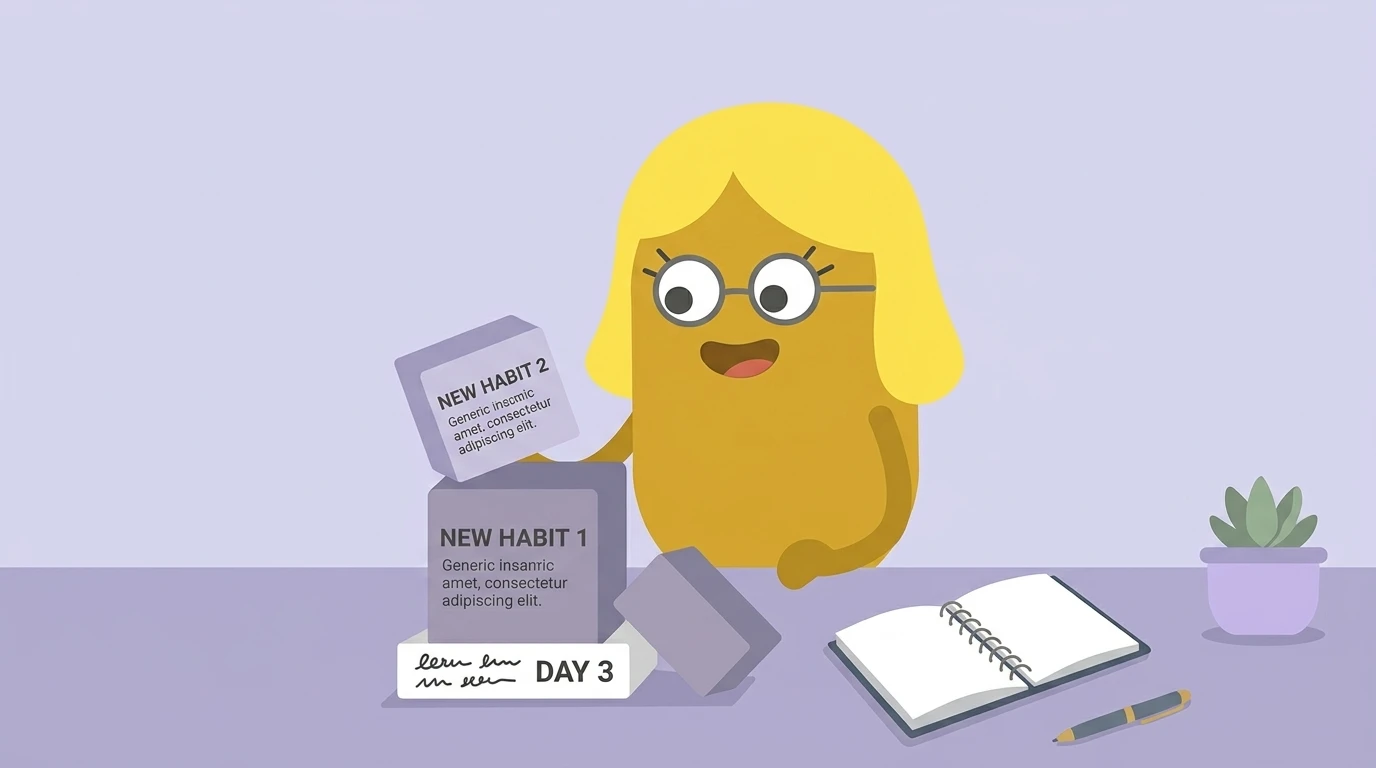
Step 3: Choose a new habit that is smaller than you think it should be. The biggest habit stacking mistake is choosing a new habit that is too large for the anchor. "After I make coffee, I will meditate for 20 minutes" fails because 20 minutes of meditation is cognitively and temporally mismatched with a two-minute coffee-making ritual. Start with two minutes or less for the new behavior.
Step 4: Write the stack explicitly. "After I [ANCHOR], I will [NEW HABIT]" — write this down somewhere you will see it. Habit stacking works via association, and in the early days before the association is established, the written cue replaces the neurological one.
Step 5: Repeat in context. The association forms through repetition in the same physical context. If your anchor habit happens at the kitchen counter, your new habit must also happen at the kitchen counter. Changing location breaks the stack.
When Habit Stacking Doesn't Work
The failure cases for habit stacking are consistent and worth understanding because most habit stacking guides only cover the success case.
The anchor isn't actually reliable. People choose aspirational anchors — "after I exercise" or "after I cook dinner" — when those activities only happen occasionally. Stack onto behaviors that happen daily without exception.
The new habit is too large. A common failure: stacking a 20-minute meditation, a full workout, or a 30-minute reading session onto an existing two-minute routine. The proportional mismatch breaks the link because the new behavior demands a different mental mode than the anchor habit.
The context doesn't match. Habit stacking is location-dependent. If your anchor happens standing at a coffee machine and your new habit requires sitting at a desk, the contextual shift weakens the associative link. Match the physical environment of anchor and new behavior as closely as possible.
Building chains too fast. Adding five new habits to a morning routine at once is habit stacking in name only. In practice, it's a new morning routine — much harder to maintain. Add one habit at a time and wait until it is consistently automatic before adding the next link.
The reward is absent. Habit formation research from UCL (Lally et al., 2010) confirms that habits form faster when the behavior produces an immediate positive signal. Stacking habits with delayed or abstract rewards (health, productivity) is slower than stacking habits with immediate satisfaction. Where possible, pair a new habit with something that feels good right away — a good song, a pleasant view, a check mark.
How Long Does Habit Stacking Take?
This is one of the most searched questions in the habit formation category. The commonly cited "21 days to form a habit" number comes from self-observation by a plastic surgeon in the 1960s — it has no scientific basis.
The Lally et al. (2010) UCL study, which tracked 96 participants performing real habits in real life, found that habits took an average of 66 days to become automatic — with a range of 18 to 254 days depending on the complexity of the behavior and stability of the context. Simpler habits in stable contexts (drinking water after coffee) formed faster. Complex habits in variable contexts (exercising after work) took far longer.
Habit stacking accelerates the lower end of this range by providing a reliable existing cue, but it does not eliminate the repetition requirement.
Building Habit Stacks You Can Track
One reason habit stacks fail is the absence of visibility. The stack exists only in your head, and when you miss a day, there's no record of the streak you're breaking or the pattern you're building.
This is the specific problem that structured programs address. Apps like Habitica and Streaks track individual habits but are primarily self-directed — you set your own habits and log them manually. HabitNow offers templates and reminders but still operates in isolation.
Platforms like GetMotivated.ai take a different approach: rather than tracking a habit list in private, you join a structured 30-day challenge with other people building the same habits at the same time. The social layer is not cosmetic. Research on accountability partnerships consistently shows that shared commitments with another person outperform private self-tracking — particularly past the two-week mark when novelty fades and discipline is required.
For anyone building a habit stack around a specific goal (morning routine, fitness, emotional regulation, productivity), having an accountability buddy who checks in on your progress changes the failure calculus. Missing a day feels different when someone else knows your plan.

Atomic Habits: An Easy and Proven Way to Build Good Habits and Break Bad OnesBook
Bestselling book that popularized habit stacking formula and the four laws of behavior change
A dopamine detox is a structured period of reducing high-stimulation activities to restore the brain's sensitivity to everyday rewards. Here's what the science says and how to do one that works.
The productivity world has convinced millions of people that waking up at 5 AM is the path to success. For people with ADHD, this advice doesn't just fail — it actively makes things worse. Here's what the neuroscience actually says about ADHD, chronotype, and building morning routines that work with your brain instead of against it.