How do you remove mobile addiction?
You remove mobile addiction by interrupting the specific chain that turns phone time into missed deadlines: excessive use lowers your self-control, lower self-control raises anxiety, and anxiety pushes you to avoid the work altogether. A study of 2,421 students found this chain accounts for more than half of the link between phone use and procrastination, which means the fix is not just less screen time. It is rebuilding self-control at the point where the phone interrupts it.
Why does my phone use turn into missed deadlines?
Most students already know their phone is involved in a missed deadline. What is harder to see is the mechanism, because it does not run in a straight line from "picked up phone" to "did not start assignment." A study of 2,421 adolescents from a high school and university in southwest China traced the actual pathway using structural equation modeling, and it runs through two intermediate steps rather than one.
Internet addiction predicted lower self-control (β = −0.552, p < 0.001). Lower self-control predicted higher anxiety (β = −0.249, p < 0.001) and more academic procrastination (β = −0.430, p < 0.001) on its own. Anxiety then added its own smaller push toward procrastination (β = 0.082, p < 0.001). When the researchers traced the full pathway, the direct effect of phone overuse on procrastination accounted for 45.43% of the total, and the indirect route through self-control and anxiety accounted for the remaining 54.56%.
That split matters for what you actually do about it. If more than half the damage runs through self-control and anxiety rather than the phone itself, then swearing off your phone for a week fixes the smaller half of the problem. The larger half needs you to rebuild the self-control that phone use has been quietly wearing down, and to manage the anxiety spike that follows once it is worn down.
Why willpower alone does not fix mobile addiction
Telling yourself to have more discipline treats self-control as a mood you can decide to have. The research treats it as a resource that gets depleted by specific behavior, which is a different problem with a different fix. In the same study, self-control was the single strongest predictor of academic procrastination in the entire model, stronger than anxiety and stronger than the direct effect of phone use itself.
This is why deleting one app for a week rarely works on its own. The app was never the whole mechanism. It was one input into a self-control system that phone use has already been degrading, so removing it addresses the trigger without repairing the capacity the trigger had worn down. You need something that rebuilds the capacity, not just something that removes the temptation.
The anxiety spike nobody warns you about
Cutting phone use cold often produces a short anxiety spike before it produces calm, and that spike is not a sign the plan is failing. It is the second link in the same chain working in reverse. Anxiety in the study was linked to lower self-control and, independently, to more procrastination. When self-control starts to recover, but anxiety has not caught up yet, the temptation is to reach for the phone again because it reliably lowers anxiety in the short term, even while it is rebuilding the same problem it just relieved.
Expect three to five days where checking your phone less feels worse before it feels normal. Knowing that in advance is the difference between treating the discomfort as proof you failed and treating it as a predictable, temporary part of the process.
Does burnout make mobile addiction worse?
Yes, and the relationship runs in both directions. A meta-analysis pooling 79 studies, 115 effect sizes, and 68,162 participants found a moderate positive correlation between academic burnout and problematic smartphone use (r = 0.438, 95% CI [0.409, 0.467]). Burnout and phone overuse feed each other: exhaustion from schoolwork makes the phone feel like the only available relief, and the time lost to the phone adds to the workload pressure that produced the exhaustion in the first place.
This means a student who is already burned out will find phone limits harder to hold, not because they lack willpower but because the relief the phone provides is doing real work for an already-depleted system. Addressing sleep, workload, and rest matters alongside any phone-specific change, especially in exam periods when both burnout and phone use tend to climb together.
How to interrupt the chain, step by step
Target each link separately rather than treating "less phone time" as the whole plan.
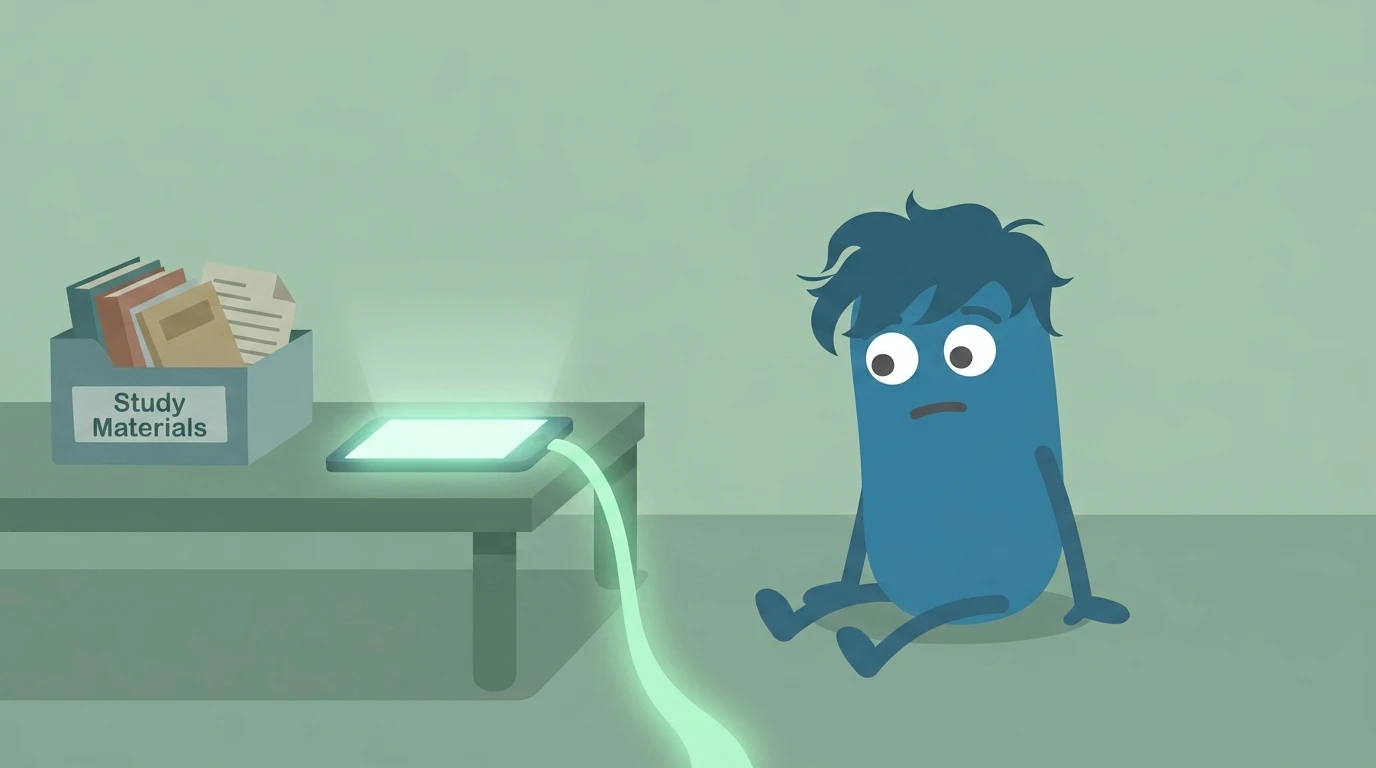
Interrupt the self-control drain. Put your phone in another room during study blocks, not just on silent. Distance removes the repeated small decisions that wear self-control down over a session, which matters more than willpower in the moment you reach for it.
Give anxiety somewhere else to go. When the urge to check your phone arrives, name what you are feeling before you act on it. "I am anxious about starting this" is a more accurate description than "I need my phone," and it opens a different response: a two-minute walk, a glass of water, five slow breaths. Anxiety that gets named tends to pass faster than anxiety that gets numbed.
Protect the first ten minutes of a task. Procrastination is heaviest at the start of a task, before momentum exists to carry you. Commit to ten minutes with your phone out of reach, no target beyond opening the document and writing one line. Momentum, once started, needs far less self-control to sustain than it took to begin.
Rebuild self-control with small reps, not one big test. A single successful evening without your phone teaches you less than five short daily wins. Fifteen phone-free minutes at the same time each day, repeated for a week, trains the capacity the chain depends on more reliably than an occasional all-or-nothing attempt.
Watch for the burnout feedback loop. If you notice you are reaching for your phone specifically because you are exhausted, treat that as a signal to address sleep and workload that week, not just a signal to try harder at phone limits.
When to get more support
If low mood or anxiety persists beyond a few weeks, or starts interfering with sleep, eating, or getting through the day, that is worth raising with a doctor or counsellor rather than managing alone. Phone habits are one input among several, and persistent low mood deserves its own attention regardless of what triggered it.
Where to start this week
Pick one study block this week and put your phone in another room for it, no exceptions. Notice what you feel in the first ten minutes rather than trying to eliminate the feeling. That single change targets the strongest link in the chain, self-control, and gives you a concrete week-one win to build the next change on.