Dopamine Detox Side Effects: What to Expect
The first few days of a dopamine detox are uncomfortable. Understanding why makes it manageable.
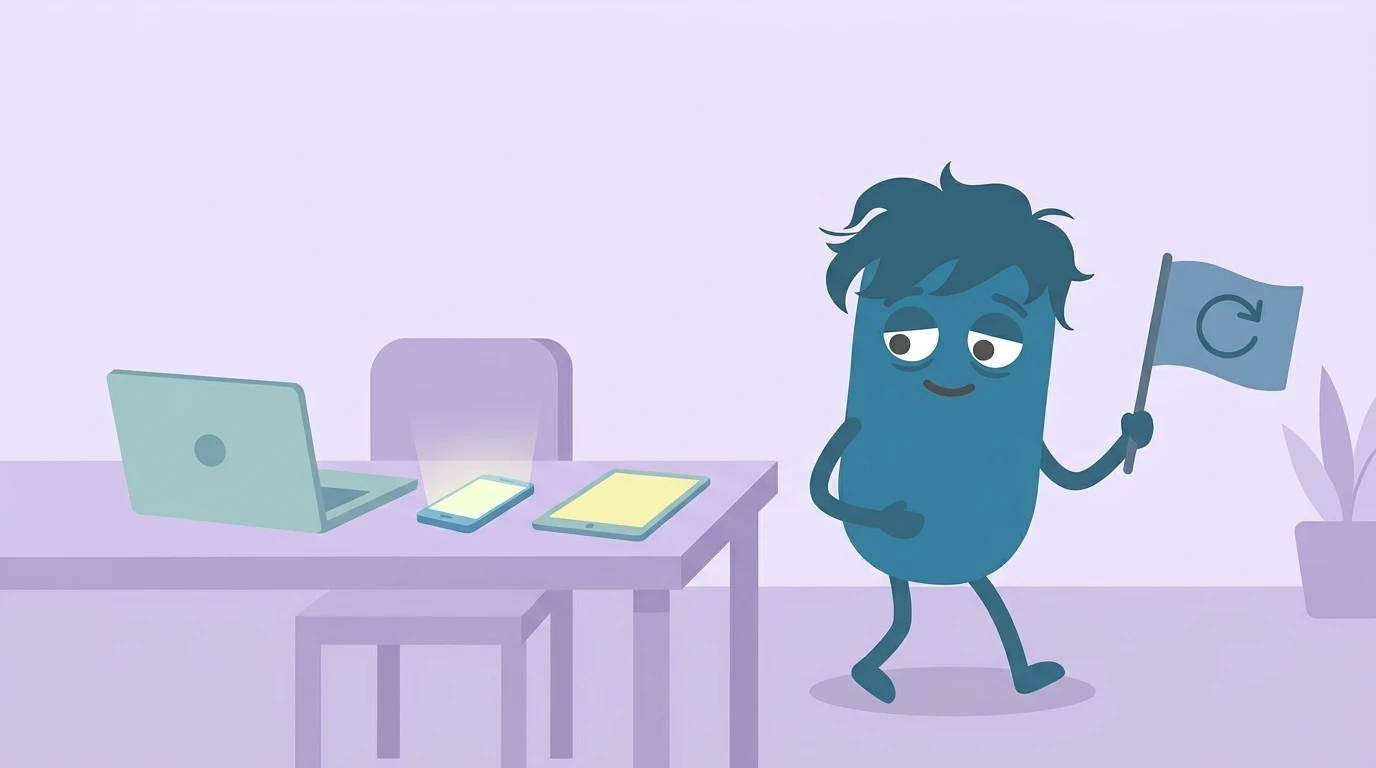
Days 1-3: The Withdrawal Phase Your brain expects its accustomed level of stimulation. When it doesn't arrive, it protests. Common experiences:
• Intense restlessness — physically unable to sit still
• Irritability and short temper
• Difficulty concentrating on anything (reading feels impossible)
• Reaching for your phone every 30 seconds on autopilot
• Mild anxiety or a vague sense that something is wrong
Days 3-7: The Boredom Valley The acute withdrawal fades but is replaced by a profound boredom. This is actually progress — your brain is adjusting its expectations downward. You may notice:
• Time moves incredibly slowly
• Moments of genuine boredom (which feels alarming if you haven't experienced it in years)
• Occasional urges that are sharp but brief
• The first hints of finding simple activities satisfying
Days 7-14: The Recalibration This is where the benefits begin. Most people report:
• Improved ability to focus on single tasks
• Physical books become readable again
• Conversations feel more engaging
• Sleep quality improves
• Exercise feels more rewarding
• A general sense of "clearing" — like mental fog lifting
Key Stat: Volkow et al.'s neuroimaging research shows that dopamine transporter levels — a marker of dopamine system function — begin recovering within weeks of reduced stimulation, with significant improvement at 3-4 months. — Source: American Journal of Psychiatry
Clinical Warnings
Extreme fasting from pleasure can trigger withdrawal-like symptoms: irritability, insomnia, and intrusive thoughts. For people with ADHD or prior addiction, these swings can mimic relapse cues and should be supervised by a clinician (Melemis 2015).
How to Do a Dopamine Detox: Step-by-Step
Step 1: Audit Your Dopamine Triggers
Before eliminating anything, spend 2-3 days tracking what you actually do when you're avoiding work, feeling bored, or procrastinating. Write it down — literally. You'll find patterns:
• "Every time I sit down to study, I open Instagram within 3 minutes"
• "I watch YouTube for 45 minutes before getting out of bed"
• "I eat chips while scrolling Reddit every night from 9-11 PM"
These are your targets. Not "all screens" or "all fun" — these specific behaviors.
Step 2: Choose Your Protocol
The 7-Day Reset (recommended for first-timers): Remove your top 3 identified triggers completely for 7 days. Replace each with a specific low-stimulation alternative. Not "I'll read instead" — "I'll read this specific book that's already on my nightstand."
The 14-Day Deep Reset: Remove all high-stimulation digital entertainment. Keep communication tools (messages, calls) but disable notifications. Replace screen time with physical activity, face-to-face interaction, and creative projects.
The 30-Day Protocol (for significant overstimulation): Full elimination of identified triggers plus a structured daily routine. This is where the most robust receptor changes occur based on the research.
Step 3: Design Your Environment
This is where most detoxes fail. Willpower is finite — environment design is not.
• Phone: Move social apps to a folder on the last screen. Better yet, delete them and use browser-only versions (deliberately friction-heavy).
• Computer: Use website blockers (Freedom, Cold Turkey) on autopilot — set them the night before so morning-you can't negotiate.
• Physical space: Put a book where your phone charging station is. Put running shoes by the door. Remove junk food from the house entirely.
• Social: Tell people what you're doing. "I'm taking a week off social media" creates accountability that willpower alone doesn't.
Step 4: Expect the Dip and Plan for It
Day 2-3 will be hard. Plan for it specifically:
• Schedule physical activity during your highest-craving times
• Have a "break glass in case of emergency" activity list (walk, cold shower, call a friend)
• Write down WHY you're doing this and put it where you'll see it during weak moments
The 48-Hour Reset Protocol
Preparation (Day -2)
- Audit triggers: List your top three high-dopamine inputs (e.g., reels, sports betting, sugary snacks).
- Set hard stops: Use app timers or physical barriers (router off, snacks out of house).
- Schedule dopamine-safe activities: walking, stretching, journaling, coffee with a friend.
Pause (Day 0-1)
- Morning: 20-minute brisk walk in daylight. Light exercise raises dopamine receptor availability without overstimulation (Weir 2011).
- Midday boredom wave: Expect it at 2-3 p.m. Sit with the discomfort for 15 minutes; label emotions aloud (“I feel restless”). This mindfulness act recruits prefrontal control circuits (Linehan 2014).
- Evening wind-down: No screens 60 minutes before bed. Read paper fiction or take a warm shower. Sleep loss itself blunts dopamine, so protect 7-9 hours (Ilardi 2009).
Re-entry (Day 2+)
Reintroduce one previously avoided stimulus on a timer. Example: 10 minutes of social media at 7 p.m. followed immediately by an offline task. Pairing the stimulus with a “stop cue” keeps the seesaw balanced.
Dopamine Detox and ADHD: A Different Approach
If you have ADHD, a standard dopamine detox protocol can backfire. The ADHD brain already operates with lower baseline dopamine activity — that's the core neurological difference. Removing stimulation entirely can worsen executive dysfunction, not improve it.
ADHD-adapted dopamine detox principles:
• Target specific supernormal stimuli only — remove social media, gaming, pornography. Keep exercise, music, and social interaction as healthy dopamine sources.
• Shorter initial period — start with 3-5 days instead of 7-14. Monitor executive function closely.
• Maintain medication — if you take ADHD stimulants, continue them. They address baseline dopamine, not overstimulation.
• Add structure, don't just subtract stimulation — the ADHD brain needs external scaffolding. A timer, a task list, a body-doubling partner fill the gap that removed stimulation leaves.
People also search for "body doubling ADHD" (12.1K monthly) — a complementary strategy where working alongside someone else provides the external stimulation the ADHD brain needs. [Read our full guide on body doubling for ADHD.]
What Actually Resets Your Reward System
If periodic deprivation does not move the needle, what does?
Reduce the specific behaviors causing problems
The research supports targeting specific high-stimulation inputs rather than going on a general pleasure fast. If you are compulsively checking social media, the intervention is reducing social media, not also giving up music and interesting food. Blanket deprivation adds suffering without improving precision. Behavioral specificity does.
Extend the gap before acting on impulse
One mechanism Lembke and others describe is the value of creating space between impulse and action. Waiting ten minutes before opening a feed, delaying a snack, finishing a task before checking a notification: these small delays, repeated consistently, recondition the brain's tolerance for the delay of gratification. This is concrete and incremental, and the research on habit formation backs it up.
Replace, do not just remove
Empty time tends to refill. If you remove high-stimulation behavior without replacing it, the pull back toward it is strong. Huberman's protocols for sustaining motivation and attention emphasize that low-stimulation activities, reading physical books, slow walks, analog hobbies, need to be deliberately cultivated before they feel rewarding, because the reward system takes time to recalibrate to slower inputs.
Consistency over intensity
Two weeks of slightly reduced phone use produces more lasting change than one dramatic detox weekend followed by a return to normal patterns. This runs directly against the appeal of the dopamine detox as a concept, which is that a single dramatic gesture can fix a chronic pattern. It usually cannot.
Why Most Dopamine Detoxes Fail — And What Actually Works
The Reddit community r/ADHD and self-improvement subreddits (880 monthly searches for "dopamine detox reddit") consistently report the same failure pattern: strong start, cave by day 2, feel worse about themselves than before they started.
The failure isn't about willpower. It's structural:
Problem 1: No replacement activities. Removing stimulation without adding anything creates a vacuum your brain will fill with the first available hit.
Problem 2: No accountability. Solo detoxes have the same completion rate as solo gym memberships — around 15%. Without someone checking in, the path of least resistance always wins.
Problem 3: No gradual reintroduction plan. Even successful detoxes fail long-term when the person goes back to unrestricted access on day 8.
GetMotivated.ai addresses all three gaps:
• Structured challenges give you a day-by-day protocol with specific replacement activities — not just "don't use your phone" but "here's exactly what to do at 7 AM, 12 PM, and 9 PM instead."
• Buddy matching pairs you with someone doing the same detox. When day 2 hits and your brain is screaming for a scroll, there's a real person expecting to hear from you. Accountability partnerships improve follow-through rates from roughly 15% to over 65% across behavioral change research.
• AI coaching helps identify your specific trigger patterns and builds a personalized reintroduction plan — because the goal isn't to never use social media again. It's to use it intentionally instead of compulsively.
Apps like the Dopamine Detox iOS app provide timers and tracking, but they don't address the isolation problem. TalktoAngel offers online counseling, but at therapy prices that aren't accessible for a 7-day reset. A challenge-based platform fills the gap between a solo willpower attempt and professional treatment.