Body Doubling for ADHD: Why Working Alone Doesn't Work
Most adults with ADHD can focus at a coffee shop but struggle at home. Body doubling explains why — and how to replicate that effect anywhere.
The GetMotivated.ai Team
The ADHD Productivity Paradox
There's a pattern that shows up constantly in people with ADHD: they can do in two hours at a coffee shop what takes them eight hours at home. Same tasks. Same person. Same brain.
The difference isn't caffeine. It's the presence of other people.
This isn't a quirk or a crutch. It's a well-documented neurological phenomenon called body doubling, and for many people with ADHD, understanding it is the single most useful productivity insight they'll ever encounter.
What Body Doubling Actually Is
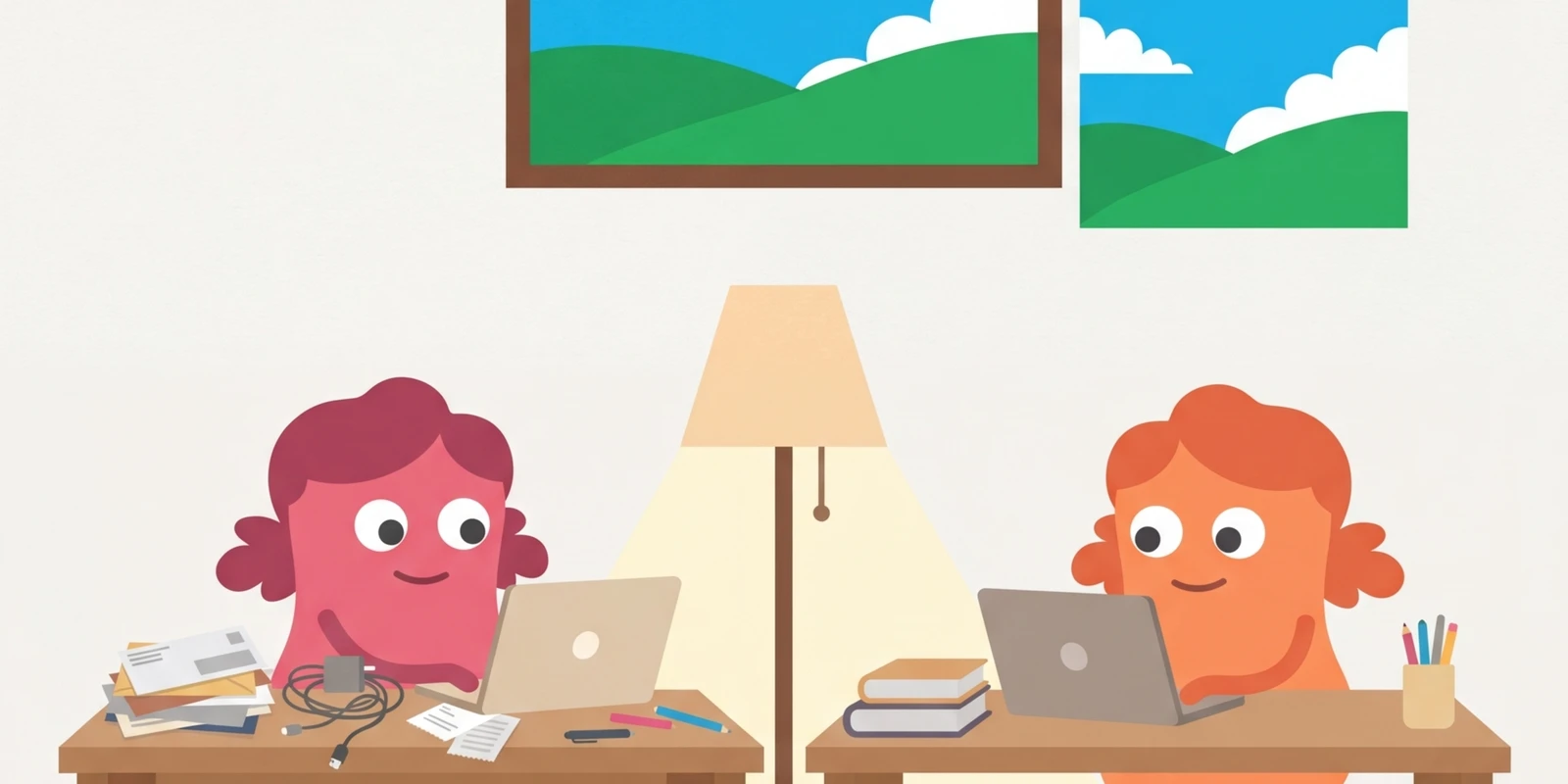
Body doubling is the practice of working alongside another person — not for their input, not for supervision, but simply for the ambient social presence they create. The other person might be doing something completely unrelated. They might be silent. They might be across a video call with their camera on. What matters is that they exist in the space.
The term originates in ADHD coaching, where practitioners noticed that clients who struggled to initiate or sustain tasks alone would often complete those same tasks without difficulty when someone else was nearby. A person who couldn't bring themselves to start a tax return for weeks might finish it in an afternoon if a friend sat across the table working on their own laptop.
This isn't metaphorical. The cognitive shift is measurable and consistent enough that body doubling has become a standard recommendation in ADHD treatment contexts.
The Science Behind It
The theoretical foundation starts with Robert Zajonc's social facilitation theory, introduced in 1965. Zajonc demonstrated that the mere presence of others increases arousal in both humans and animals — and that this heightened arousal improves performance on well-learned or straightforward tasks. Being observed (or even just not being alone) activates the autonomic nervous system in ways that boost alertness and focus.
Body doubling is the practice of working alongside another person for the neurological benefit of their presence, not their input. For ADHD brains, social presence provides external arousal that compensates for dopamine underactivity in the prefrontal cortex. This article covers the science (Zajonc's social facilitation theory, ADHD dopamine regulation), how to body double effectively in person and virtually, why it differs from accountability, and how GetMotivated.ai's buddy matching and group challenges create consistent access to social presence for people who need it most.
Key takeaways
Body doubling works by providing external social arousal that ADHD brains cannot reliably generate internally
The other person's presence — not their attention, help, or oversight — is the active ingredient
Body doubling and accountability are different mechanisms that serve different functions
Virtual body doubling is as effective as in-person for many people — camera presence is enough
Consistent access to a matched body doubling partner is more effective than occasional sessions
FAQs
Does body doubling actually work for ADHD, or is it just a distraction?
The evidence is strong. Social facilitation research (Zajonc, 1965) established that human presence increases arousal and improves task performance. For ADHD specifically, studies in the Journal of Attention Disorders show significantly better task completion and reduced procrastination when working alongside others. The mechanism is neurological: ADHD brains underperform on dopamine regulation, and social presence provides the ambient stimulation that activates the prefrontal cortex. The key is that the other person should be working quietly and not engaging in conversation — interaction competes with the focus that presence enables.
What's the difference between body doubling and just working in a coffee shop?
A coffee shop is an unstructured version of body doubling. The ambient social presence of strangers can activate focus in the same way, and many people with ADHD report the same phenomenon: tasks that feel impossible at home become manageable at a café. The difference with structured body doubling is intentionality and consistency. A matched partner who shows up at a scheduled time, works alongside you without interruption, and does this regularly is more reliable than hoping the coffee shop has the right noise level on any given day. The coffee shop effect is real; structured body doubling makes it dependable.
Can body doubling work over video call, or does it need to be in person?
Virtual body doubling is effective for most people. The key element is the perception of shared presence — knowing someone else is there and engaged in their own work. Video calls with cameras on replicate this well. Research on Focusmate sessions (a dedicated virtual co-working platform) shows completion rates above 90% for tasks users commit to in sessions. Some people find camera-off audio-only sessions less effective; others find them equivalent. Experiment with what activates focus for you specifically. The ambient sound of another person working — typing, shifting, breathing — is often the cue the brain responds to most strongly.
How is body doubling different from having an accountability partner?
Accountability operates through social consequence: you report what you did or didn't do, and the mild social cost of admitting failure motivates follow-through. Body doubling operates through co-presence: the other person's existence in your space activates neurological arousal that makes starting and sustaining work easier. Accountability is useful for long-term commitment and habit tracking. Body doubling addresses the moment-to-moment inability to initiate or stay on task. Many people with ADHD find that accountability partnerships alone don't help much because the problem isn't lack of commitment — it's that they genuinely can't activate the executive function needed to begin. Body doubling addresses that root cause directly.
Every year, adults with ADHD pay a tax no one voted for — late fees, lost time, strained relationships, and the cumulative cost of executive dysfunction in a world that doesn't accommodate it. Here's what the research says it actually costs, and what structural solutions actually help.
For neurotypical people, this effect is real but modest. For people with ADHD, the effect appears significantly amplified — and the reason connects directly to how ADHD affects brain chemistry.
ADHD is fundamentally a dopamine regulation disorder. The prefrontal cortex, which governs executive functions like task initiation, sustained attention, and impulse control, depends heavily on dopamine signaling. In ADHD brains, this system is underactive at baseline. The brain struggles to generate the internal motivation and alertness needed to engage with tasks that aren't immediately stimulating or high-stakes.
Social presence changes that calculation. The mild activation that comes from having another person nearby — the subtle awareness of being seen, the low-level social engagement — provides an external source of the arousal that the ADHD brain cannot reliably generate from within. It's not pressure. It's stimulation at the right level.
Research published in the Journal of Attention Disorders has found that individuals with ADHD show significantly better task completion and reduced procrastination when working in the presence of others versus working alone. Executive function coaching literature consistently identifies social facilitation as one of the highest-leverage, lowest-friction interventions available.
The mechanism matters because it explains why body doubling works even when the other person isn't watching, isn't helping, and doesn't know what you're working on. Their presence alone is the active ingredient.
Body Doubling vs. Accountability: A Critical Distinction
These two concepts are often conflated, and the distinction is important.
Accountability involves reporting to someone about what you did or didn't do. It works through social consequence — the mild social cost of having to admit you didn't follow through. Accountability partners check in, ask for updates, and create a soft external deadline structure.
Body doubling works through co-presence, not consequence. There's no report-out, no check-in structure, no social cost for getting distracted. The mechanism is purely neurological: shared space creates shared arousal that enables focus.
Both have value, but they serve different functions. Accountability helps with commitment and follow-through over time. Body doubling helps with the moment-to-moment capacity to sit down and work at all.
For ADHD, the inability to initiate and sustain work is often the primary obstacle — not a lack of commitment. That's why body doubling frequently outperforms pure accountability structures for people with significant executive dysfunction.
How to Body Double Effectively
In-person body doubling is the most natural form. Working in a library, coffee shop, or co-working space provides ambient social presence continuously. Study halls work for this reason. So does sitting at a family member's kitchen table while they cook.
The key is that the environment has enough social presence to activate focus, but not so much social interaction that attention is pulled away from the task. A busy restaurant during peak hours is too stimulating for most people. A quiet library reading room is usually ideal.
Structured in-person body doubling involves arranging to work in the same space as a specific person — a friend, partner, or colleague — with the explicit agreement that both will work independently for a defined period. No helping each other, minimal conversation. Just parallel presence.
Virtual body doubling has become widely practiced since remote work normalized video calls. Two people join a video call, state briefly what they're working on, mute themselves, and work in silence for 25–90 minutes. Camera-on versus camera-off matters less than the shared commitment to the session.
Several dedicated platforms now host virtual co-working rooms where strangers work silently together in real time. The accountability is minimal; the presence is the point.
Choosing the right body doubling partner matters more than most guides acknowledge. The ideal partner is:
• Engaged in their own focused work during the session (not distracted themselves)
• Non-interruptive — comfortable with silence, not prone to starting conversations
• Consistent — someone whose availability is predictable, so sessions can be scheduled reliably
• Non-judgmental about what you're working on or how you work
Partners who ask too many questions, offer unsolicited help, or treat the session as social time undermine the mechanism. The presence should be calming, not activating in the wrong direction.
Virtual Options and How to Find Them
Focused work apps like Focusmate pair strangers for 50-minute video co-working sessions. Users book slots, join at the agreed time, state their intention, and work. The accountability layer (a stranger is expecting you) combined with the presence layer makes it particularly effective for people who need both mechanisms.
Discord communities built around productivity often have dedicated "study with me" or "co-working" voice channels that operate around the clock. The ambient sound of others typing, occasional background noise, and the visual indicator that others are present replicates the coffee shop effect digitally.
YouTube "study with me" videos — extended recordings of someone working at a desk, often with ambient sound — provide a simplified version of body doubling. They lack the reciprocal presence element but offer low-friction access to social atmosphere. Many people with ADHD report them genuinely helpful for low-demand work.
Buddy-matched co-working platforms go further by pairing people with similar work styles, schedules, and goals. This removes the friction of finding a compatible partner and increases session consistency — which matters because body doubling works best as a regular practice, not an occasional intervention.
Where GetMotivated.ai Fits In
GetMotivated.ai is built around the insight that behavior change is harder alone. The platform's buddy matching system pairs users based on working style, schedule, goals, and personal context — not just availability. A matched buddy becomes a consistent body doubling partner, someone whose presence is reliably available at the times when focus is hardest to find.
The group challenge format extends this to co-working cohorts: groups of people tackling shared goals together, with structured check-ins that blend accountability with the social presence that makes work feel possible. Members report that showing up to a group session, even silently, produces the same shift they've noticed in coffee shops.
The AI coaching layer adds a second dimension: helping users understand when body doubling is the right tool versus when the problem is something else — sleep, overwhelm, task structure, or something that needs a different intervention entirely.
For adults with ADHD who have spent years trying to will themselves into productivity alone, the shift to a social-presence-based approach is often the reframe that changes everything.
The Bottom Line
Working alone is a structural disadvantage for ADHD brains. It removes the external arousal that the prefrontal cortex relies on to function. The solution isn't more willpower or better time management systems — it's changing the environment.
Body doubling works because it gives the brain what it needs to activate: the quiet signal that comes from human presence. Understanding this removes the self-blame from the equation. The person who can write for three hours at a café but can't start a paragraph at home isn't lacking discipline. Their brain is working exactly as it was built to.
The goal isn't to fix the ADHD brain. It's to build a working environment that matches how it actually operates.

Research on Focusmate sessions showing completion rates above 90% for tasks users commit to during virtual co-working sessions.
How do I find a reliable body doubling partner?
The most common approaches are informal arrangements with friends or colleagues who also do focused work, virtual platforms like Focusmate that pair strangers for scheduled sessions, and dedicated communities (Discord servers, Reddit groups) with co-working channels. The challenge with informal arrangements is consistency — schedules shift, and the friction of coordinating each session erodes the habit. GetMotivated.ai's buddy matching system addresses this by pairing people based on schedule, working style, and goals, then structuring the ongoing relationship so sessions happen regularly without re-coordination effort. For ADHD specifically, reducing the activation energy required to set up each session is itself part of the solution.
The productivity world has convinced millions of people that waking up at 5 AM is the path to success. For people with ADHD, this advice doesn't just fail — it actively makes things worse. Here's what the neuroscience actually says about ADHD, chronotype, and building morning routines that work with your brain instead of against it.
Most productivity systems fail people with ADHD — not because of a lack of willpower, but because they were designed for a different kind of brain. Understanding why ADHD causes system abandonment is the first step to building something that actually holds.