Body Doubling: The Most Underused ADHD Study Tool
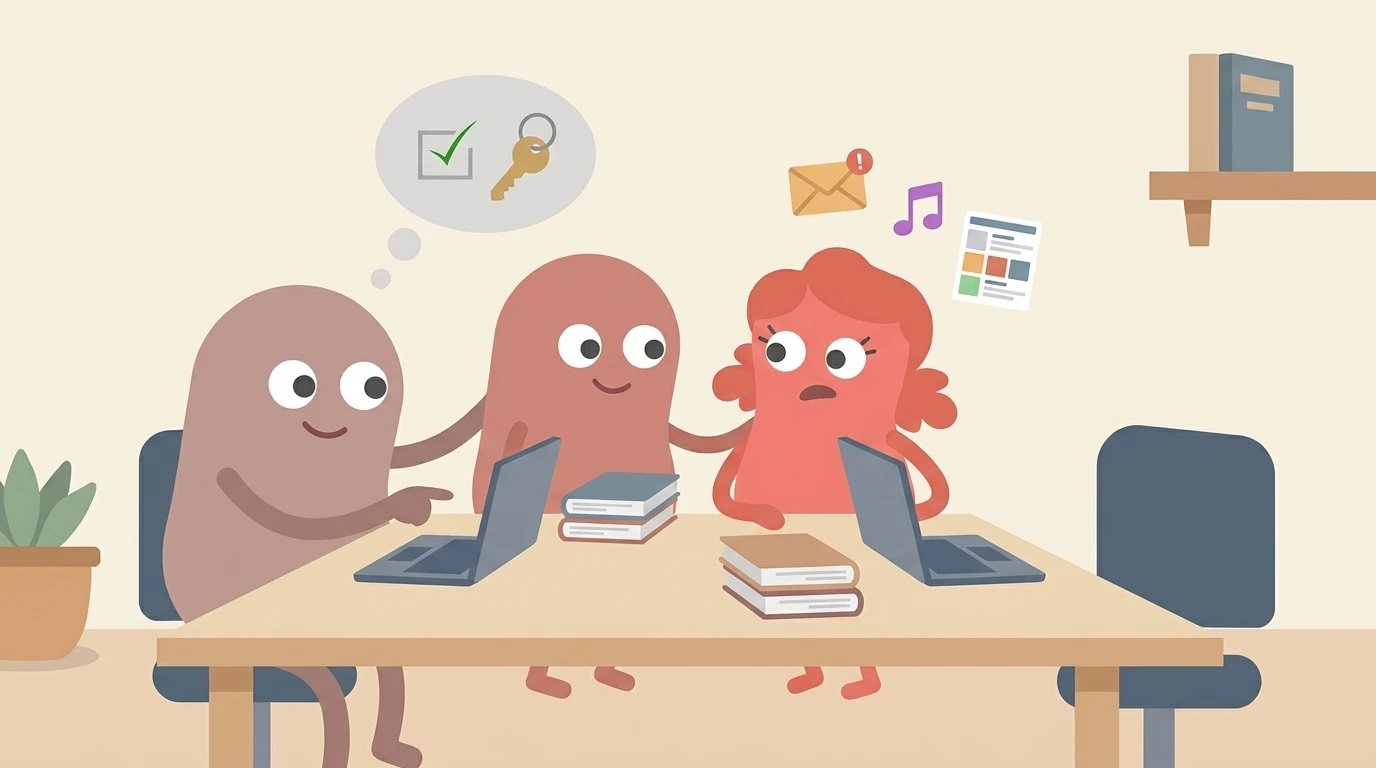
Body doubling is studying in the presence of another person — even if they're doing entirely different work. The other person doesn't need to help you, explain anything, or even talk to you. Their presence is the tool.
CHADD (Children and Adults with Attention-Deficit/Hyperactivity Disorder), the leading US ADHD organization, describes body doubling as one of the most commonly reported effective strategies among adults with ADHD. The mechanism is behavioral: the awareness of another person's presence creates ambient accountability that keeps the ADHD brain on task. It substitutes external social stimulation for the internal regulation the ADHD brain struggles to generate alone.
Body doubling works in person and virtually:
• In person: Library study rooms, coffee shops, study groups
• Virtual: Video calls with a friend, both working silently
• Structured virtual sessions: Platforms like Focusmate match you with a stranger for a defined work session
Key Stat: In surveys of ADHD adults, body doubling is reported as effective by approximately 75% of respondents — higher effectiveness rates than most productivity apps and tools. — Source: CHADD Research Overview
The reason body doubling is underused: most ADHD students don't know it's a named, researched strategy. They feel embarrassed that they "can't study alone" — when in fact they're experiencing a neurologically normal ADHD pattern, not a personal failing.
The Best Study Environment for ADHD
Silence is not automatically better. Most ADHD research on study environments finds that moderate background noise — coffee shops, library common areas — outperforms total silence for ADHD students.
The reason is counterintuitive: total silence creates no external input, which means the ADHD brain generates its own stimulation (daydreaming, internal thoughts, distraction). Moderate ambient noise provides just enough external stimulation to occupy the "background" processing that would otherwise pull attention away.
What actually impairs studying: competing high-interest stimuli in the environment. Studying in a room with a TV, near a conversation you're interested in, or with a phone visible and unlocked. The ADHD brain is pulled toward novelty — its job is to detect interesting changes in the environment. Remove those signals, not all signals.
Practical rules:
• Phone in another room or in a drawer (not just face-down)
• Use website blockers during study blocks (Freedom, Cold Turkey)
• Low-stimulation music or white noise — not podcasts, not songs with lyrics you know
• Study at the same time in the same place to reduce friction
How Accountability Makes ADHD Study Habits Stick
Habits are harder to build with ADHD because the brain's dopamine system — which reinforces behavior through anticipated reward — functions differently. Long-term rewards (good grades, graduation, career) don't generate the neurochemical signal required for habit formation the way they do in neurotypical brains.
Evans et al.'s research on external accountability structures in ADHD populations found that scheduled check-ins with an accountability partner significantly improved task follow-through compared to self-monitoring alone. The mechanism: accountability creates an immediate, social consequence for not following through — and immediate consequences are what ADHD brains respond to.
Langberg et al.'s study on organizational skills interventions in college students with ADHD found that structured external accountability (coach check-ins, scheduled reviews) produced significantly better academic outcomes than self-directed strategy use alone.
What accountability looks like in practice:
• Texting a friend "Starting my 2-hour study session now" and "Done, here's what I covered"
• A weekly study accountability partner who asks what you planned and what you actually did
• Apps that track study sessions and share them with someone (or a group)
The key ingredient is someone else knowing your plan. Not to judge you, but because the awareness of that external witness creates the urgency the ADHD brain needs.
How GetMotivated.ai Supports ADHD Study Habits
Apps like Todoist and RescueTime help with task management and time tracking — and they're useful tools. But tracking what you did or planning what you should do doesn't solve the fundamental ADHD problem: getting started and following through alone.
GetMotivated.ai takes a different approach. Rather than adding another tool to manage, it provides the social and structural infrastructure that makes other strategies actually work:
• Buddy matching pairs you with an accountability partner for your specific goal — in this case, building a consistent study habit. This is the structured, ongoing body-doubling relationship that random forum posts or app notifications can't replicate.
• Group study challenges put you in a cohort of students working on the same goal. When everyone in your group is checking in about their Pomodoro sessions, logging their study hours, and reporting back — consistency becomes a group norm rather than a solo willpower battle.
• AI coaching helps you identify which specific strategies from this article match your personal ADHD presentation: if you're primarily impaired by task initiation, the approach differs from someone whose main challenge is sustaining focus once started.
For Indian students preparing for JEE, NEET, UPSC, and board exams — where the study volume is extreme and the stakes are high — the pressure compounds ADHD symptoms. External structure isn't a nice-to-have; it's essential. GetMotivated.ai's group challenges are designed for exactly this: building sustainable habits in high-pressure, high-stakes contexts where solo motivation consistently fails.