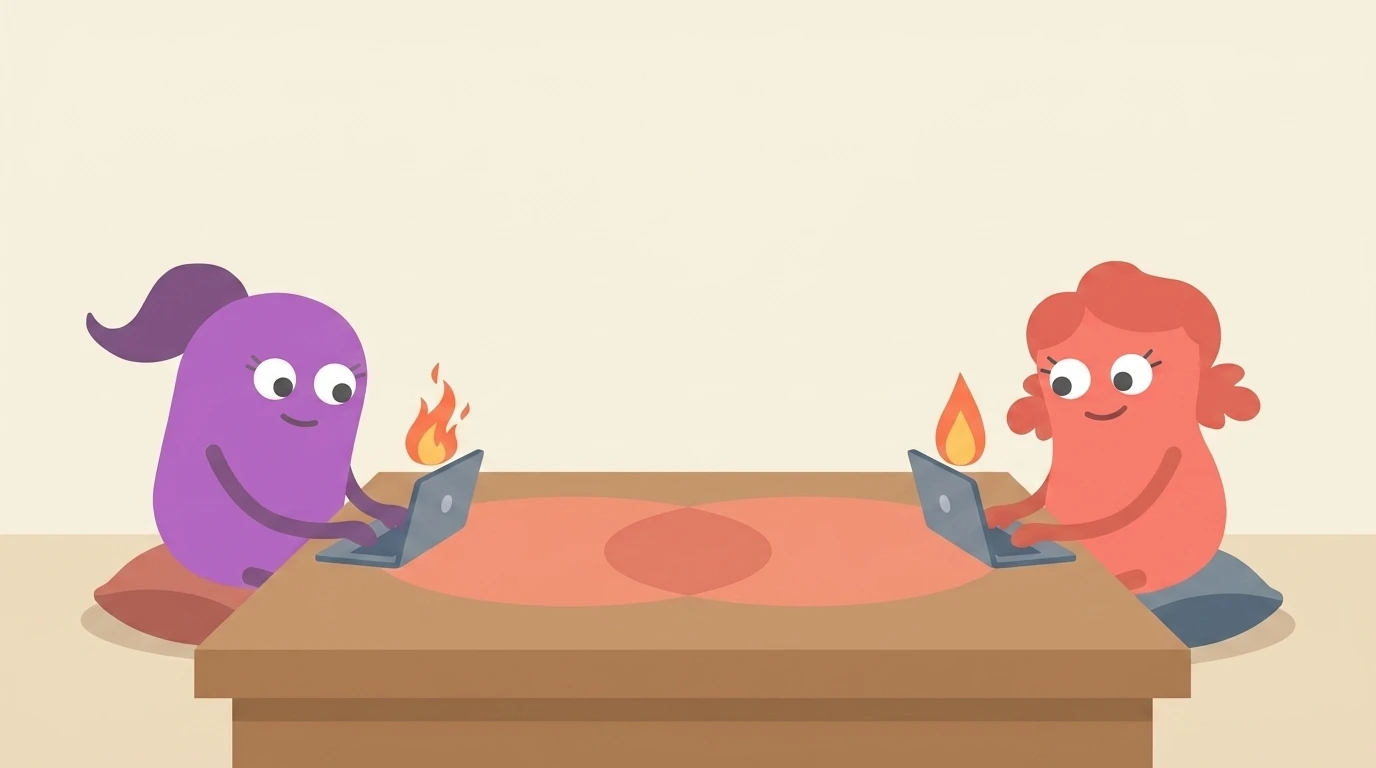
State the subject out loud at the start
One sentence each: what you are studying and where you plan to stop, chapter four, page ninety. It takes twenty seconds and it converts a vague session into a defined one, the same externalising principle Kreider and colleagues found central to strategies that worked for students with ADHD managing time-related challenges.
Keep it silent in the middle
Talking turns a study session into a study group, and a study group turns into a conversation about the exam instead of preparation for it. Agree on silence between the opening and the end, with the understanding that a genuine question can break it, but small talk cannot.
Close by saying what happened
One sentence each again: what got covered, what did not. Finishing out loud marks the session as complete, which makes the next one, tomorrow, or the night before the exam, easier to schedule because the last one has a clear ending instead of trailing off.
In person or on a call for study sessions
Both work for studying. They fail differently, and the failure mode depends on what the material demands.
A recurring video call tends to be the most durable option for ordinary homework and revision, because the cost of showing up is close to zero and the schedule already exists on the calendar. In-person sessions earn their extra effort in exam week, when the material genuinely benefits from being in the same room. Virtual body doubling covers the online formats in more detail, and body doubling covers the general approach for tasks beyond studying.
When it does not work for studying
The call turns into a study group. Agree the silent middle explicitly, before the first session rather than after the third one has already dissolved into talking about the exam instead of preparing for it.
The partner is unreliable. A cancelled session before an exam leaves you worse off than one you never scheduled, because you were counting on it. A study group holds up better than a single partner, since the group still meets even if one person cancels.
The material is undefined. A body double gets you into the chair with the book open. It cannot decide what chapter to review or which practice questions to attempt. Arrive with a specific starting point, or the session becomes an hour of deciding what to study instead of studying.
You need it the night before an exam. A standing slot already on the calendar is easier to use under pressure than one you have to arrange from scratch when you are already anxious about the material.
Making it a standing arrangement through the term
The difficulty with body doubling for studying is not the first session before a single test. It is arranging the twelfth, in week six of a term, with no exam close enough to feel urgent.
That is the case for a group that already meets on a schedule rather than a study partner coordinated fresh each week. A fixed daily slot with other people in it removes the arranging entirely. The Learn Daily Check-in is built around exactly that: the same time each day, other students showing up to the same one, so the routine survives the weeks with no test on the horizon.
Where to start
Pick one subject you have not been getting to. Ask one person for a fixed time this week. State what you are studying, work silently, say what happened when the time is up.
One study session that runs cleanly tells you more than a month of intending to try it, and the arrangement gets easier once the slot already exists on both calendars. The wider set of supports for the classroom side of this is in the ADHD accommodations guide, and the session mechanics for solo studying are in these ADHD study tips.