High Novelty and Variation
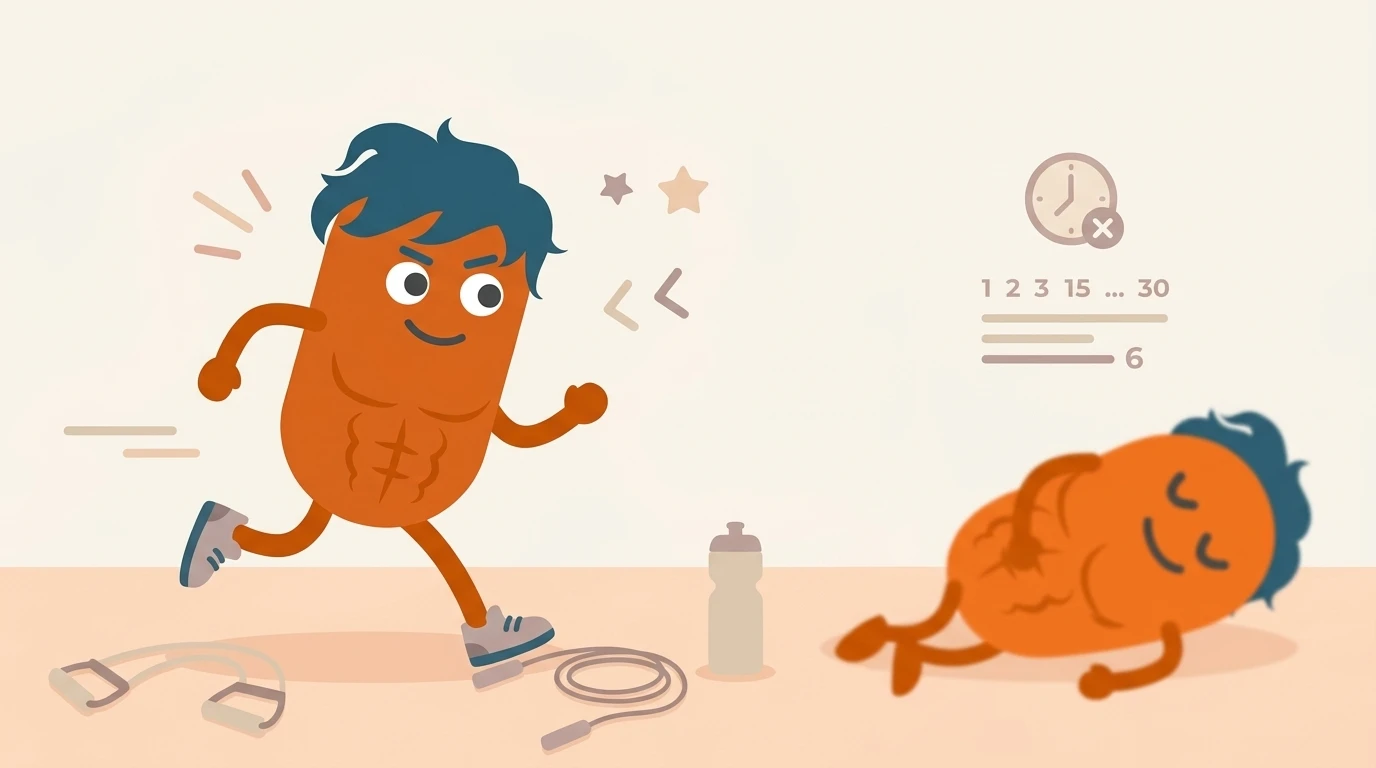
Martial arts — Brazilian jiu-jitsu, boxing, Muay Thai, kickboxing — have an exceptionally strong track record with ADHD populations. The reason: every session is genuinely different. Technique refinements, new sparring partners, evolving combinations. The ADHD brain never habituates because the stimulus keeps changing.
Rock climbing (both indoor bouldering and rope climbing) offers similar novelty: every route is a new problem, physically and cognitively demanding, with immediate feedback on success. The problem-solving component actively engages prefrontal function that exercise for its own sake does not.
Team sports provide novelty, social engagement, and immediate consequence in one package. Missing your recreational basketball game has a real social cost — your teammates notice. That accountability structure is exactly what a solo gym session lacks.
Social Embedding
Irwin et al.'s meta-analysis on exercise behavior found that exercising with a partner or in a group increases both frequency and duration of exercise compared to solo sessions — a finding that is particularly pronounced in populations with motivation regulation difficulties.
Group fitness classes (HIIT, cycling, CrossFit) add two retention mechanisms: the instructor keeps you moving when your internal motivation flags, and the social environment creates a mild accountability pressure. You're less likely to stop early when others around you are continuing.
Immediate Feedback
Sports that score in real time — tennis, squash, swimming lap times, lifting PRs — give the ADHD brain the immediate feedback signal it needs to stay engaged. The scoreboard IS the dopamine. Structuring gym sessions around trackable, session-by-session metrics (beating last week's deadlift, shaving 10 seconds off your mile) creates a feedback loop that abstract health goals cannot.
Body Doubling at the Gym: The Evidence-Backed Hack
Body doubling is one of the most consistently reported ADHD strategies that translates directly to exercise. The principle: the presence of another person working alongside you significantly increases task completion rates in ADHD.
The mechanism, as explained in Knouse and Mitchell's review, involves the ADHD brain's heightened sensitivity to social observation. With another person present, the brain's social monitoring circuits are activated — creating a mild, productive pressure that compensates for the executive function needed to self-motivate.
Applied to exercise, body doubling means:
• Gym partner with a shared schedule: Not someone who waits for you to feel like going — someone who expects you at 7 AM on Monday, Wednesday, Friday and will text if you don't show.
• Virtual body doubling: Services like Focusmate (designed for work tasks) have been adapted by ADHD communities for gym sessions — video calls where both people are exercising, each serving as witness to the other's effort.
• Structured group accountability: A fitness challenge group where members check in daily creates a persistent low-level social accountability pressure that functions like body doubling at scale.
The key variable is not who the person is — it's the presence of an expectation and a consequence for absence. Vague "let me know if you want to work out sometime" offers don't create this structure. Committed, scheduled, specific arrangements do.
How Accountability Structures Beat Motivation
Here is what people with ADHD discover, often after years of trial and error: waiting to feel motivated is not a viable strategy for ADHD habit formation. Motivation is unreliable, variable, and for ADHD brains, heavily dependent on novelty and urgency — conditions that a regular gym routine cannot sustain indefinitely.
Accountability structures bypass the motivation problem entirely. You don't need to feel like going to the gym when someone is expecting you there.
Apps like MyFitnessPal and Beachbody are useful for programming and tracking but provide primarily self-accountability — which is exactly the mechanism that ADHD weakens. They work well for neurotypical users but hit a wall for ADHD because they still require the user to generate internal motivation consistently.
GetMotivated.ai approaches this differently with buddy matching: you're paired with someone working on the same goal who checks in on a regular schedule. For ADHD gym habits specifically, this creates the external commitment structure that makes body doubling work at scale.
The fitness challenges on the platform also address a second ADHD-specific problem: the loneliness of quitting. When you drop out of a solo gym routine, the only person who knows is you. When you're in a cohort of 20 people tracking a 30-day fitness challenge, your absence is visible. That social visibility is not a punishment — it's a support structure. The research on group accountability consistently shows that positive social consequence (people noticing and caring whether you show up) outperforms willpower-based self-monitoring for ADHD populations.
Building a Gym Habit That Survives Contact with ADHD
The following framework combines the evidence-based strategies above into a practical sequence.
Week 1-2: Eliminate friction and establish the anchor
Choose one specific workout slot (days and time) and treat it as immovable. Get a gym partner or join a group with a set schedule during this slot. Your only goal is showing up — not performance, not duration. Remove every barrier between you and the door: bag packed, clothes ready, route pre-planned.
Week 3-4: Add novelty to prevent habituation
Introduce one new element per week — a new exercise type, a different area of the gym, a new playlist. This is not about variety for its own sake; it's about giving the ADHD brain just enough novelty to prevent the boredom response that typically hits around the 3-week mark.
Week 5-6: Reinforce with tracking that delivers immediate feedback
Start measuring something that shows progress weekly — not just "I went" but "I lifted X" or "I ran Y in Z time." Progress tracking gives the ADHD brain the forward-looking reward stimulus that abstract goals cannot provide.
Ongoing: Maintain the social structure
The accountability relationship is not a scaffolding you eventually remove. For most adults with ADHD, the social structure IS the habit. Schedule regular check-ins even when the routine feels established — ADHD means the habit is always more fragile than it appears after a good run of consistency.
The ADHD gym failure cycle — enthusiasm, decline, dropout, guilt, new enthusiasm — is not inevitable. But breaking it requires a system designed for how your brain actually works, not how you wish it worked.