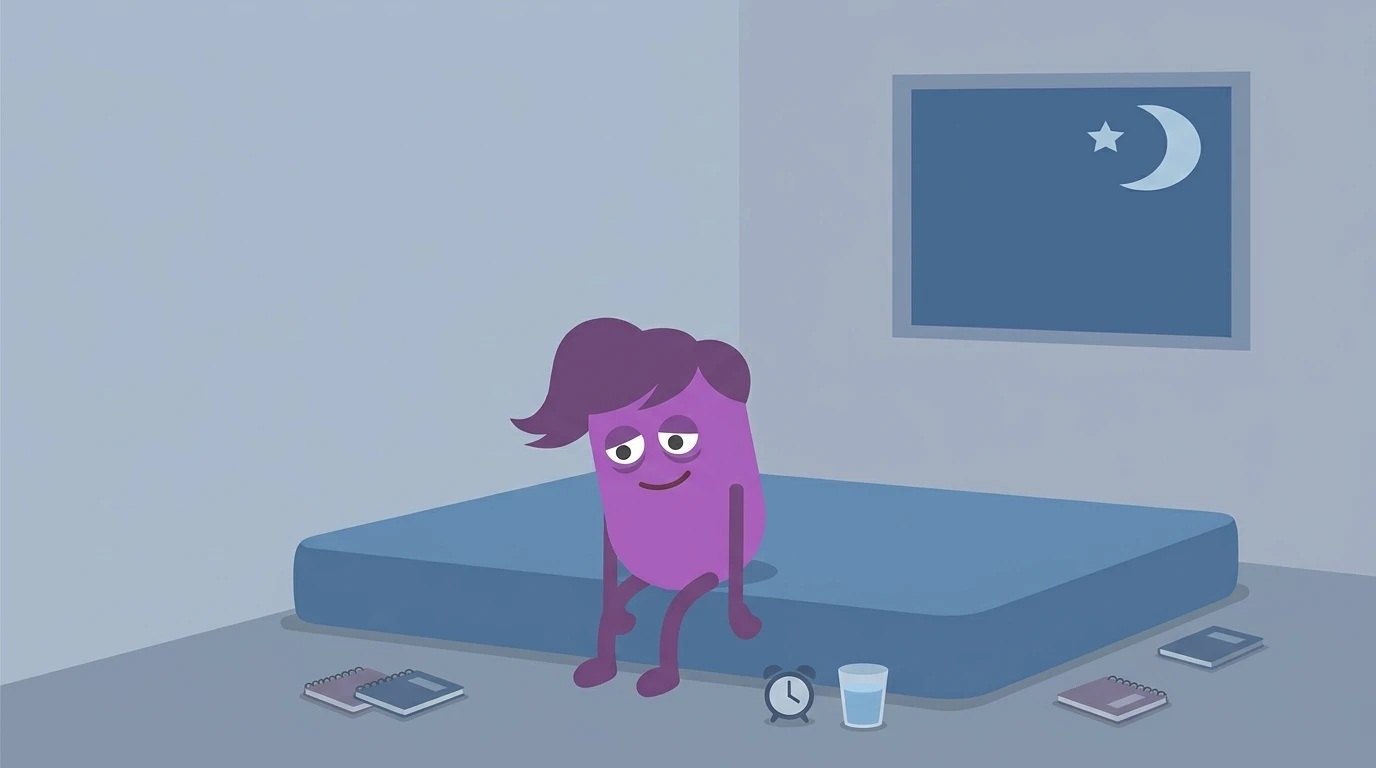
6. Loss of interest in your special interests
One of the more counterintuitive signs: the activities that usually restore you — your hobbies, creative pursuits, the things that used to generate hyperfocus — suddenly feel flat. This is a significant warning sign. When the restorative activities stop working, recovery without intervention becomes very difficult.
7. Cognitive symptoms that feel like sudden ADHD worsening
Forgetting things you never forgot before. Losing words mid-sentence. Reading the same paragraph four times and retaining nothing. Kessler et al.'s population-level research on ADHD and workplace functioning shows that cognitive symptoms accelerate under sustained occupational stress — what looks like ADHD getting worse is often burnout degrading the compensatory capacity that was managing ADHD.
What ADHD Burnout Recovery Actually Requires
Here is where most generic advice fails people with ADHD burnout: "take a vacation" and "practice self-care" assume the person's recovery system is intact. For someone in ADHD burnout, it's not.
Rest means reduced cognitive load, not just reduced activity
A vacation that involves planning, navigating new environments, and managing social dynamics can deepen ADHD burnout rather than relieve it. Recovery requires reducing total cognitive demands — not just switching the type of demand. This means: familiar environments, reduced decision volume, lower social performance expectations, and protected time with no output requirements.
Masking reduction is non-negotiable
If the primary cause of burnout is the energy cost of masking ADHD, then recovery requires reducing masking demands. This is harder than it sounds — it may mean disclosing your ADHD to an employer, reducing commitments that require constant neurotypical performance, or restructuring your environment to allow more authentic functioning.
Recovery pacing matters
A common mistake: feeling slightly better and immediately returning to previous load levels. ADHD burnout recovery follows a nonlinear path. Several days of improved functioning doesn't mean recovery is complete. Without deliberate pacing, most people return to full load too quickly and re-enter burnout within weeks.
Key Stat: Research by Kessler et al. found that adults with ADHD lose an average of 22.1 days of work productivity per year due to ADHD-related impairment — a figure that increases substantially when burnout compounds underlying symptoms.
How GetMotivated.ai Approaches ADHD Burnout Recovery
Generic burnout advice — "sleep more," "journal," "set boundaries" — consistently fails people with ADHD because it ignores the mechanics of how ADHD burnout develops and resolves.
Apps like Headspace or Calm offer individual mindfulness tools, which can be genuinely useful. But they don't address the accountability gap: knowing what you need to do for recovery and actually doing it consistently are two different problems for the ADHD brain.
Platforms like GetMotivated.ai take a different approach. Recovery challenges are structured specifically around sustainable pacing — not productivity maximization, but deliberate, scaffolded rest with check-ins that keep you honest about your load. The buddy matching feature pairs you with someone who understands the ADHD burnout cycle from the inside, creating an accountability structure that doesn't require you to be at full executive function to use it.
For people in the early warning stage — still functioning but noticing the signs — this kind of structured support is most valuable before the crash. The AI coaching layer provides a judgment-free space to identify which specific masking demands are costing you the most, and to build a sustainable pacing plan that accounts for your actual neurological profile, not a neurotypical template.
The pattern in every burnout recovery community — whether r/ADHD, r/burnout, or ADHD-specific forums — is the same: people who recover fastest are those with consistent social support and external accountability, not those who try to manage it alone. Structured programs designed for this provide both without requiring the person to build that infrastructure from scratch while already depleted.
The Re-Entry Problem: Getting Back Without Crashing Again
Recovery creates a specific trap: once you feel better, everything that was waiting for you is still waiting. Returning to the same environment and load that caused burnout, without changing the underlying conditions, is a reliable path to re-entry burnout within three to six months.
Before returning to full capacity, it's worth identifying specifically what drove the burnout:
Masking demands: Which environments or relationships required you to mask most intensively? Can those be restructured?
Compensatory strategy failure points: Which systems were working but fragile? Can they be made more robust or redundant?
Recovery capacity: What was your recovery doing between high-demand periods? Was there genuine restoration happening, or were you running on borrowed time?
Dr. Russell Barkley's work on ADHD and self-regulation consistently emphasizes that sustainable functioning requires building external structures that reduce the executive function burden — not developing stronger willpower. The same principle applies to burnout prevention: structural changes are more durable than behavioral resolve.
What the Research Says About Long-Term Prevention
A 2021 study on masking in neurodivergent populations found that reduced masking demands — not coping strategy upgrades — were the most significant predictor of improved wellbeing. This is an important framing: the goal isn't to become better at withstanding burnout-inducing conditions. The goal is to reduce those conditions.
For ADHD specifically, this research points toward environmental modification as primary: disclosure and accommodation, restructuring high-demand commitments, building in genuine recovery periods rather than treating recovery as incidental. Coping strategies and accountability tools support this process — they don't replace the structural changes.
ADHD burnout is not inevitable. But preventing it requires recognizing the early warning signs, understanding the neurological mechanism behind it, and having an accountability structure that catches the drift toward overload before it becomes collapse. That's the gap that structured recovery programs — and the people who use them — consistently close.