GetMotivated.ai Logo
How It WorksBlogLog in
  1. Home
  2. /
  3. Blog
  4. /
  5. ADHD Procrastination: Why Your Brain Won't Start (And What Actually Unsticks It)
April 4, 20268 min readADHD & Neurodivergence

ADHD Procrastination: Why Your Brain Won't Start (And What Actually Unsticks It)

ADHD procrastination isn't a willpower problem — it's a neurological one. The ADHD brain struggles to initiate tasks without sufficient dopamine, turning simple to-dos into immovable walls. Here's why it happens and what actually works.

Rachel Stein

Last reviewed: July 2026

ADHD Procrastination Isn't Laziness: Why Your Brain Won't Let You Start cover image

ADHD procrastination is not a willpower problem — it's a neurological one. The ADHD brain lacks sufficient dopamine to activate the prefrontal cortex's task-initiation system, making starting a low-interest task feel genuinely impossible — not hard, not uncomfortable, but impossible — regardless of how important the task is or how much you want to complete it.

This is not a character flaw. It's a brain-based difference in how motivation and attention work. Understanding the mechanism is the first step toward finding strategies that actually work.

Why Do People with ADHD Procrastinate So Much?

The short answer: dopamine.

Dr. Russell Barkley, one of the world's leading ADHD researchers, describes ADHD as fundamentally a disorder of self-regulation — and task initiation is one of the most impaired self-regulatory functions. Research by Pychyl and Flett (2015) found that ADHD symptom severity is one of the strongest predictors of chronic procrastination, even when controlling for perfectionism, depression, and anxiety.

Here's the neurological mechanism:

The prefrontal cortex needs dopamine to work. This region of the brain handles planning, prioritization, and the decision to act. In the neurotypical brain, anticipating a task's completion generates enough dopamine to motivate action. In the ADHD brain, this anticipatory dopamine signal is weaker — particularly for tasks that aren't immediately rewarding, urgent, or interesting.

The ADHD brain runs on interest, not importance. Dr. Barkley describes this as an interest-based nervous system: the ADHD brain reliably engages when tasks are novel, urgent, challenging, or personally meaningful — and reliably fails to engage when they're not. This is why someone with ADHD can spend six hours deep in a video game and not start a 30-minute work report: it's not inconsistency, it's neurological architecture.

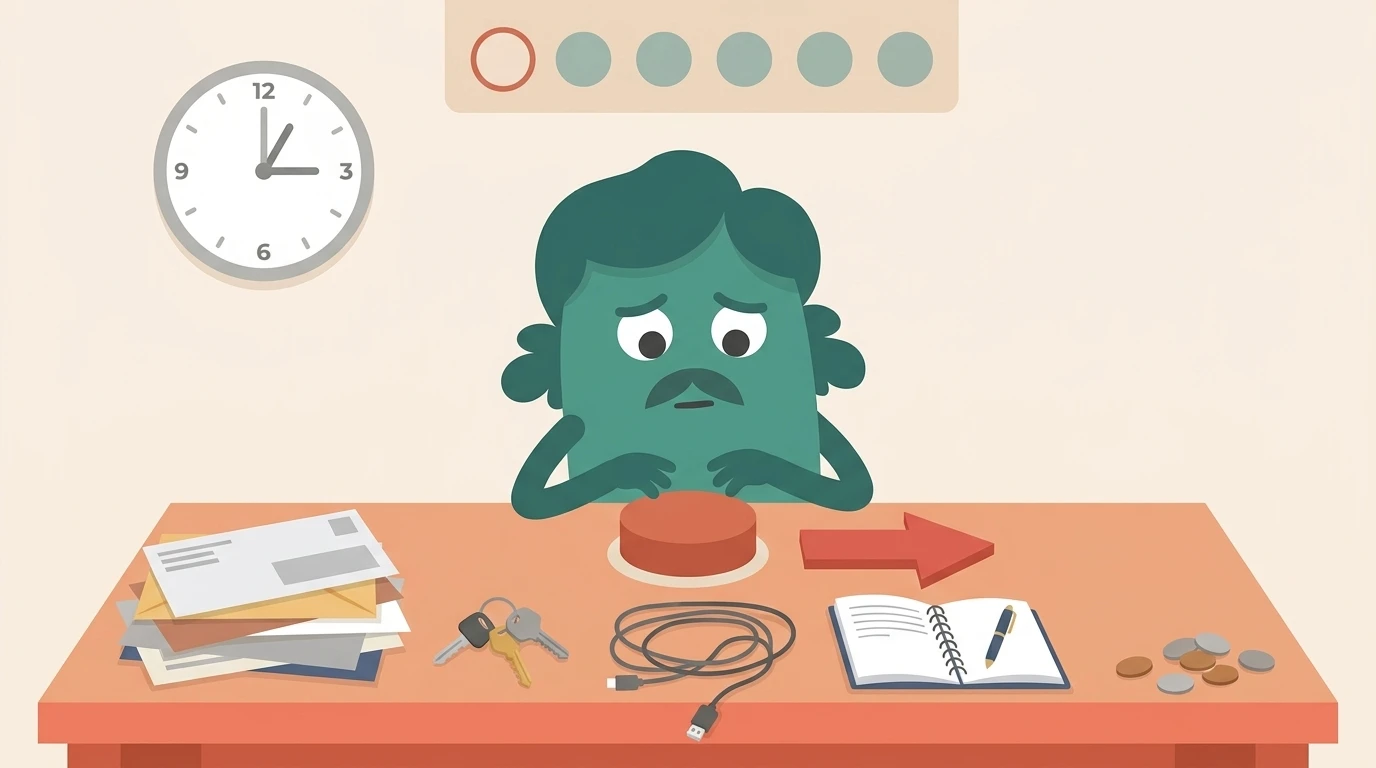
The result is task paralysis. You sit at your desk. You know what you need to do. You want to do it. You watch the clock. You open a different tab. You feel a rising shame. You still can't start. This experience — described across Reddit's r/ADHD community with striking consistency — is not laziness. It's the brain's task-initiation system failing to fire.

Key Stat: Up to 80% of adults with ADHD report chronic procrastination as one of their most impairing symptoms, according to Dr. Russell Barkley's decades of clinical research. — Source: ADHD and the Nature of Self-Control, Barkley (1997)

How ADHD Procrastination Differs from Regular Procrastination

Everyone procrastinates. But ADHD procrastination has distinct features that separate it from the ordinary kind:

It's not about dread — it's about activation. Standard procrastination is often driven by anxiety about a task, perfectionism, or avoidance of discomfort. ADHD procrastination frequently involves tasks the person wants to do and feels no particular anxiety about — but still cannot start. The barrier is activation energy, not emotion.

It scales inversely with importance. Neurotypical procrastination tends to increase with task difficulty. ADHD procrastination often peaks for moderately important tasks — not urgent enough to trigger the ADHD brain's crisis response, not interesting enough to trigger hyperfocus. The tax return, the doctor's appointment, the email that needs a thoughtful reply.

Deadlines don't work the way they should. The neurotypical brain responds to a deadline by gradually increasing urgency over time. The ADHD brain often stays disengaged until the deadline is close enough to feel like a crisis — then shifts into hyperdrive. This pattern produces work, but it also produces burnout, poor quality from rushing, and the sustained shame of watching the deadline approach without being able to act.

It co-exists with hyperfocus. One of the most confusing features of ADHD procrastination is that the same person who cannot start a work task can spend hours in absorbed, effortless focus on something interesting. This paradox — described by researchers Berridge and Kringelbach (2015) as the difference between dopamine-mediated "wanting" and "liking" — confirms the neurological account. The ADHD brain doesn't lack the capacity to focus; it lacks the ability to direct focus to low-dopamine tasks on demand.

Key Stat: Neuroimaging studies show that adults with ADHD have measurably reduced dopamine transporter density in the prefrontal striatum compared to neurotypical controls — a structural difference in the brain's motivational architecture, not a learned behavior. — Source: Berridge & Kringelbach, Annual Review of Neuroscience (2015)

What ADHD Procrastination Looks Like Day-to-Day

Recognizing ADHD procrastination in your own life is harder than it sounds, because it often disguises itself as productivity.

The task shuffle: You have one important task. You complete six small, easy tasks around it, feeling productive, until the day is gone and the important task hasn't started.

The rewrite loop: You make a new to-do list. You reorganize your notes. You read about strategies for starting tasks. You feel like you're preparing. The task remains untouched.

The research spiral: You need to write an email. First you need to understand the full context. Two hours later you know everything about the topic and the email still isn't written.

The avoidance project: You clean the kitchen, rearrange your desk, answer low-priority emails — anything that feels like doing something. The real task waits.

The hyperfocus escape: The task is due. You find yourself deeply, effortlessly absorbed in something completely unrelated — a YouTube video, a side project, a book. Your brain has found a dopamine source and locked in, away from the aversive task.

None of these patterns reflect a lack of intelligence or effort. They reflect a brain trying to meet its dopamine needs through available means. The shame that follows — the spiral of feeling broken for not being able to do something that seems simple — is often as impairing as the procrastination itself. If you also experience intense emotional reactions to perceived failure or criticism, that pattern has a name: rejection sensitive dysphoria, which affects up to 99% of adults with ADHD and frequently compounds procrastination shame.

How to Overcome ADHD Procrastination: What the Evidence Actually Supports

Willpower-based advice — "just start," "set a timer," "make a schedule" — doesn't work for ADHD procrastination because it targets motivation, not the underlying neurological deficit. These strategies do:

Related Challenges & Plans

Lifechallenge

ADHD Sleep Reset

Reset your circadian rhythm in 30 days with a neurobiologically optimized screen shutdown protocol designed for ADHD brains.

GetMotivatedBuddies
Created by GetMotivatedBuddies
10 min3×/week30dL1
Lifechallenge

Clean Any Room in 5 Steps with Ann Russell

Clean any room with Ann Russell’s 5-step method. A direct, realistic 14-day plan for building cleaning habits that actually stick.

Ann Russell
In partnership with Ann Russell · by GetMotivatedBuddies
10 min3×/week14dL1
Health & Fitnesschallenge

Health & Fitness Daily Check-In

Intro challenge with 5-min daily check-ins. Build consistency with diet or exercise—alongside peers.

GetMotivatedBuddies
Created by GetMotivatedBuddies
10 min3×/week21dL1
Lifechallenge

Reclaim Focus: Quit Porn

Beat porn addiction: 30 days of real accountability via daily SMS/email check-ins & cohort support. Science-backed. Private.

Anna Lembke
Based on Anna Lembke · by GetMotivatedBuddies
10 min3×/week30dL1

Make the First Step Smaller Than Feels Necessary

The activation threshold is the problem. Lower it.

"Write the report" is not a task for the ADHD brain — it's a project. "Open the document" is a task. "Type one sentence" is a task. The goal is to make the first step so small that it creates no resistance, then rely on the brain's tendency to continue once started.

Neil Fiore's research on procrastination (The Now Habit) found that the friction is almost always in starting, not continuing. Once the ADHD brain is engaged with a task, it will often maintain engagement — the problem is crossing the activation threshold.

Use Body Doubling

Body doubling — working in the presence of another person — is one of the most consistently reported effective strategies for ADHD task initiation, and it works for a specific neurological reason: other people provide low-level social stimulation that keeps the ADHD brain's arousal system engaged enough to work.

You don't need to interact with the person. You don't need them to monitor your work. The physical (or virtual) presence of another person is enough for many people with ADHD to sustain task engagement that would be impossible alone.

This is why coffee shops work. Why study halls work. Why people with ADHD report doing their best work in open offices. The environment provides ambient human presence that their home desk doesn't.

Apps like Focusmate have built this into a structured service — pairing users for virtual co-working sessions. It works for the same reason: accountability through presence.

Create Real Accountability

The ADHD brain responds to external accountability in ways it doesn't respond to internal resolve. Telling yourself you'll do something activates less dopamine than telling someone else you'll do something by a specific time.

This isn't weakness — it's neurology. Social consequences register in the brain's threat-detection system more reliably than abstract future consequences. An accountability partner, a check-in group, or even a scheduled call with someone creates real external stakes.

Key Stat: A study by the American Society of Training and Development found that people who commit to a goal with a specific accountability partner have a 65% chance of completing it — compared to 10% for those who merely decide to do something. Having an ongoing check-in increases this to 95%.

Reduce Friction Before the Task

Environment design is more powerful than willpower for ADHD brains. Remove everything that needs to be done before the task begins:

• If the task involves your computer, have it open and the relevant document in the foreground when you sit down.

• If it's a physical task, lay out every tool needed the night before.

• If it's an email, open the compose window and address line before you close your laptop.

Every setup step is a micro-decision that can trigger an avoidance detour. Eliminating setup eliminates that risk.

Work With Urgency, Not Against It

The ADHD brain initiates reliably under urgency. Rather than fighting this pattern, create artificial urgency for tasks that lack natural deadlines:

• Set public commitments with real people ("I'll send this to you by 3 PM")

• Use a Pomodoro-style countdown timer (the ticking creates a mild urgency signal)

• Schedule work sessions immediately before an existing hard commitment — the meeting at 2 PM creates a natural deadline for the work that should be done before it

How GetMotivated.ai Addresses the ADHD Procrastination Trap

The core problem with most ADHD procrastination advice is that it's designed to be read once and implemented alone. But accountability, consistency, and external structure — the actual neurological needs — require other people.

Unlike tools like Focusmate that focus purely on co-working sessions, or Talkspace that provides therapy (valuable, but not available at 9 PM when the task is due tomorrow), GetMotivated.ai builds the social scaffolding that the ADHD brain needs directly into the experience:

• Task breakdown challenges provide the micro-step structure that lowers the ADHD brain's activation threshold. Instead of "complete project," you have a sequence of specific, small next actions — each one achievable, each one checked off.

• Buddy matching gives you a consistent accountability partner — someone who knows your goals, checks in on your progress, and creates the social commitment that ADHD brains respond to. This is the mechanism behind body doubling, applied consistently over weeks instead of just one session at a time.

• Group challenges put you in a cohort of people working on the same type of goal, normalizing the struggle and creating community-based accountability. When everyone in your group is reporting their daily task completion, reporting zero creates a mild social accountability signal — exactly the kind the ADHD brain responds to.

• AI coaching helps identify your specific procrastination patterns — the task shuffle, the rewrite loop, the avoidance project — and build personalized response strategies for each.

The goal isn't to cure ADHD procrastination. It's to build an external structure that compensates for the internal structure your brain doesn't generate on its own.

When to Seek Professional Help

Behavioral strategies help, but they work best alongside appropriate treatment:

Stimulant medication (Adderall, Ritalin, Vyvanse) increases dopamine availability and directly improves task initiation for most people with ADHD. If you have diagnosed ADHD and procrastination is significantly impairing your work or relationships, discuss medication options with a psychiatrist familiar with ADHD.

Non-stimulant options (Strattera, Intuniv/guanfacine) can also improve executive function and are sometimes better tolerated by people who experience anxiety with stimulants.

CBT adapted for ADHD (not standard CBT) directly addresses executive function deficits and procrastination patterns. Research by Safren et al. demonstrated significant improvements in ADHD symptoms including task avoidance with ADHD-specific CBT protocols.

If you've tried multiple behavioral strategies without improvement, and your procrastination is causing real harm — missed deadlines, relationship strain, job performance problems — a proper ADHD evaluation is worth pursuing. Many adults discover ADHD in their 30s and 40s after decades of attributing their struggles to personal failure.

The brain you have is the brain you have. But with the right structure, support, and treatment, ADHD procrastination can go from a daily source of shame to a manageable challenge.

Sources

ADHD and the Nature of Self-ControlBook
Russell A. Barkley
A seminal exploration of ADHD as a disorder of self-control, offering a neuropsychological framework for understanding executive dysfunction and its practical management.
The Now Habit: A Strategic Program for Overcoming ProcrastinationBook
Neil Fiore
A strategic program to overcome procrastination by reframing work habits, reducing perfectionism, and using the 'Unschedule' to balance productivity with guilt-free leisure.

Topics

adhdexecutive dysfunctionbehavioral changedopaminehabit formationmental healthbody doubling

AI-ready summary

ADHD procrastination is not laziness — it's a neurological problem caused by dopamine deficits in the brain's task-initiation system. Adults with ADHD have structural differences in the prefrontal cortex that make starting low-interest tasks genuinely difficult without external structure, accountability, or urgency. Evidence-based approaches include body doubling, task breakdown, accountability partners, and structured challenges.

Key takeaways

  • ADHD procrastination is driven by dopamine dysregulation, not character flaws — the brain literally struggles to generate the activation energy to start tasks.
  • Up to 80% of adults with ADHD report chronic procrastination as one of their most impairing symptoms, according to research by Dr. Russell Barkley.
  • The ADHD brain responds to interest, urgency, challenge, and passion — tasks that lack these qualities trigger task paralysis regardless of importance.
  • Body doubling — working alongside another person — is one of the most consistently effective low-cost interventions for ADHD task initiation.
  • Breaking tasks into the smallest possible first step (under 2 minutes) lowers the activation threshold enough for the ADHD brain to begin.

FAQs

Why do people with ADHD procrastinate so much?

ADHD procrastination is caused by dopamine dysregulation in the prefrontal cortex, which controls task initiation and self-regulation. Without sufficient dopamine, the brain cannot generate the activation energy to start tasks that feel boring, unclear, or low-urgency — regardless of how important they are.

How do you overcome ADHD procrastination?

Effective strategies include body doubling (working alongside someone), breaking tasks into 2-minute micro-steps, using external deadlines and accountability partners, applying the '5-minute rule,' and structuring your environment to reduce friction before uninteresting tasks.

Is ADHD procrastination the same as laziness?

No. ADHD procrastination is neurological, not motivational. People with ADHD often procrastinate on tasks they genuinely want or need to complete. The barrier is brain-based: insufficient dopamine for task initiation, not a lack of desire or effort.

What is task paralysis in ADHD?

Task paralysis is when the ADHD brain becomes completely unable to begin a task despite knowing it needs to be done. It often feels like being frozen — you know what you need to do, you want to do it, but no amount of willpower can generate the first action.

Does ADHD medication help with procrastination?

Yes, for many people. Stimulant medications (Adderall, Ritalin, Vyvanse) increase dopamine availability, which directly improves task initiation. However, medication alone is rarely sufficient — behavioral strategies and structure provide the scaffolding medication can't replace.

Why can people with ADHD hyperfocus but still procrastinate?

Hyperfocus and procrastination are both symptoms of the same dopamine system: the ADHD brain engages intensely with high-interest, high-stimulation tasks (hyperfocus) while failing to initiate low-interest ones (procrastination). It's not inconsistency — it's a neurological interest-based attention system.

Related Challenges & Plans

Lifechallenge

ADHD Sleep Reset

Reset your circadian rhythm in 30 days with a neurobiologically optimized screen shutdown protocol designed for ADHD brains.

GetMotivatedBuddies
Created by GetMotivatedBuddies
10 min3×/week30dL1
Lifechallenge

Clean Any Room in 5 Steps with Ann Russell

Clean any room with Ann Russell’s 5-step method. A direct, realistic 14-day plan for building cleaning habits that actually stick.

Ann Russell
In partnership with Ann Russell · by GetMotivatedBuddies
10 min3×/week14dL1
Health & Fitnesschallenge

Health & Fitness Daily Check-In

Intro challenge with 5-min daily check-ins. Build consistency with diet or exercise—alongside peers.

GetMotivatedBuddies
Created by GetMotivatedBuddies
10 min3×/week21dL1
Lifechallenge

Reclaim Focus: Quit Porn

Beat porn addiction: 30 days of real accountability via daily SMS/email check-ins & cohort support. Science-backed. Private.

Anna Lembke
Based on Anna Lembke · by GetMotivatedBuddies
10 min3×/week30dL1

Keep reading

Metabolic Psychiatry: The Emerging Science Linking Metabolism and Mental Health
August 10, 202611 min readMental Health

Metabolic Psychiatry: The Emerging Science Linking Metabolism and Mental Health

Metabolic psychiatry studies how metabolism, inflammation, and brain energy production shape mental illness — and how metabolic interventions like ketogenic therapy might help. The evidence is early and promising, not a proven treatment yet.

mental healthneuroscienceketometabolic psychiatry
The GetMotivated.ai TeamRead →
ADHD Motivation: Why Interest Moves You When Willpower Doesn't
August 9, 20269 min readADHD & Neurodivergence

ADHD Motivation: Why Interest Moves You When Willpower Doesn't

ADHD motivation runs on interest, autonomy, and connection more than on deadlines or willpower. Here's what the dopamine and self-determination theory research actually shows — and how to use it instead of fighting it.

adhddopaminemotivationself-determination theory
The GetMotivated.ai TeamRead →
ADHD Hyperfocus: Why It Happens and How to Work With It
August 8, 20269 min readADHD & Neurodivergence

ADHD Hyperfocus: Why It Happens and How to Work With It

ADHD hyperfocus is a real, measurable attentional state — not the same as flow — where the brain locks onto an interesting task and everything else disappears. Here's what the research shows and how to use it without losing your day.

adhddopamineexecutive dysfunctionhyperfocus
The GetMotivated.ai TeamRead →
GetMotivated.ai

Behavioral health. Built with intention.

Structured support for ADHD, chronic health, recovery, focus, and long-term change.

Stay in the loop

Research, program launches, and behavioral health insights. Only useful updates.

By joining, you agree to receive emails from GetMotivated.ai. Unsubscribe anytime. See our Privacy Policy.

Explore

  • Browse Plans & Challenges
  • ADHD Support
  • Health Support
  • Recovery Support
  • Blog
  • Creators
  • Sources
  • Tools
  • How It Works
  • Pricing

Company

  • About
  • Contact
  • How We Research
  • Our Guarantee
  • Privacy
  • Terms

Work With Us

  • For Organizations
  • For Behavioral Health
  • For Education
  • Careers
  • Affiliates
  • Partners
  • Sponsors
Explore+
  • Browse Plans & Challenges
  • ADHD Support
  • Health Support
  • Recovery Support
  • Blog
  • Creators
  • Sources
  • Tools
  • How It Works
  • Pricing
Company+
  • About
  • Contact
  • How We Research
  • Our Guarantee
  • Privacy
  • Terms
Work With Us+
  • For Organizations
  • For Behavioral Health
  • For Education
  • Careers
  • Affiliates
  • Partners
  • Sponsors

© 2026 GetMotivated.ai. All rights reserved.

PrivacyTerms

Calm structure. Clear next steps. Human accountability.