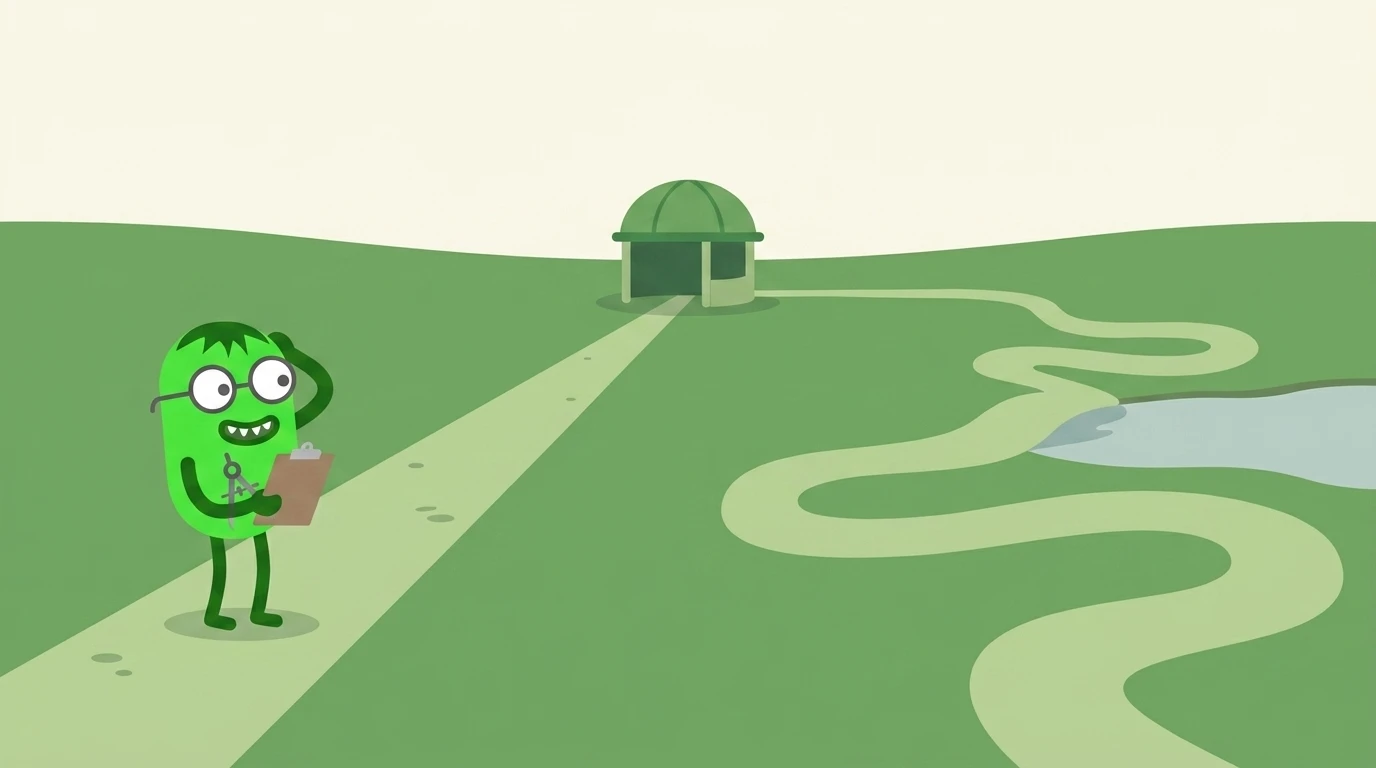

Most new habits fail not because of weak willpower, but because they were never designed to survive real life. Research from University College London tracking 96 people over 12 weeks found that habit formation takes an average of 66 days — ranging from 18 to 254 — and the first two weeks are where the majority collapse. The good news: the failure is almost always traceable to three fixable design flaws, not personal inadequacy.
Here's what the science says about why habits fall apart, and what actually prevents it.
Why Do Most Habits Fail in the First Two Weeks?
The first two weeks of a new habit are the highest-risk period. Before a behavior becomes automatic, it requires conscious decision-making — which means it competes with everything else demanding your attention, energy, and motivation.
Social psychologist Wendy Wood, who has spent over 30 years studying habit formation at USC, describes motivation as a "terrible engine" for sustaining habits. Motivation is a feeling, and feelings fluctuate. The Wednesday morning you decide to start running is not the same as the Sunday after a brutal week when the alarm goes off at 6 AM.
The research confirms this: habits that rely primarily on motivation fail at dramatically higher rates than habits built on environmental triggers. Wood's data shows that up to 80% of new behavior attempts collapse before they become automatic — most within the first two weeks.
The mechanism matters here. A habit is not a decision you make every day. It's a cue-routine-reward loop that eventually runs without deliberate thought. Until that loop is established, you're making the decision fresh every single time — and that's exhausting.
The 21-Day Habit Myth Is Costing You
The 21-day rule is one of the most persistently cited pieces of advice about habits. It originates from Dr. Maxwell Maltz, a 1960s plastic surgeon who observed that patients took approximately 21 days to adjust to their changed appearance after surgery. At no point did he study habits. The number was extrapolated into self-help culture and repeated so many times it calcified into "fact."
The actual research tells a different story. The Lally et al. (2010) study from University College London — the most rigorous study of real-world habit formation to date — followed 96 participants performing a new health behavior daily for 12 weeks. The results:
• Average time to automaticity: 66 days
• Range: 18 to 254 days
• Simple habits (drinking a glass of water with lunch) formed faster
• Complex habits (50 sit-ups before breakfast) took significantly longer
Key Stat: The 21-day rule has no empirical basis. The UCL study found habit formation averages 66 days, with a range that extends past eight months for complex behaviors. — Lally et al. (2010), European Journal of Social Psychology
This matters because people who believe in the 21-day rule quit at day 22 thinking they've failed. They haven't failed — they're only a third of the way through the average formation window.
The 3 Reasons Habits Fail (And How to Fix Each One)
Fix 1: Design Your Environment Before You Design Your Habit
The most consistent finding in habit research is that environment beats intention. Wendy Wood's studies show that when people change their physical or social context, old habits weaken and new ones form more easily — independent of motivation or resolve.
This is why the gym bag matters more than the gym membership. If your running shoes are under your bed, you'll talk yourself out of using them. If they're by the front door with your keys on top of them, you've reduced the decision to zero.
The friction principle: Every additional step between you and a habit reduces its likelihood of completion. Every step you add between you and a bad habit increases the chance you'll skip it.
Practical applications:
• Want to meditate: Put the app on your home screen. Sit in the same chair each morning. Remove two taps from the path to starting.
• Want to read before bed: Put the book on your pillow. Remove the phone charger from your nightstand.
• Want to exercise: Sleep in your workout clothes. Schedule it immediately after an existing daily anchor (coffee, waking up, lunch).
Environment design is not a trick. It's how the habit-forming brain actually works — and it's the single most actionable lever you have.
Fix 2: Understand the 4 Stages of Habit Formation
James Clear's framework in Atomic Habits — building on Charles Duhigg's original habit loop — identifies four stages every habit must complete to become automatic:
1. Cue — The trigger that initiates the behavior. This is environmental (alarm, location, time of day, preceding action) not motivational. A weak cue produces an unreliable habit.
2. Craving — The motivation to act on the cue. This is where habit design can be intentional: attaching a new behavior to something you already want (listening to a podcast only during walks, watching your favorite show only while folding laundry).
3. Routine — The behavior itself. This should start as small as possible. "Do two minutes of yoga" is a better starter than "do a 30-minute yoga session." The goal is to make the cue → routine connection, not to perform perfectly from day one.
4. Reward — The outcome that reinforces the loop. Immediate, tangible rewards work better than long-term ones. Don't rely on "I'll feel healthy in six months" — that's too distant. Track, acknowledge, or celebrate the behavior immediately after completing it.
Key Stat: In Clear's framing, the goal is not to "be disciplined" but to make the cue obvious, the craving attractive, the routine easy, and the reward satisfying. Habits that fail at any one of these four stages will not survive.
Most habit failures can be traced to a broken link in this chain. If you're consistently skipping your habit, diagnose which stage is failing before trying harder.
Fix 3: Add External Accountability Before You Need It
This is the most consistently underused fix, and the research on it is unambiguous.
A study by the American Society of Training and Development found that people who commit to a specific accountability partner for a goal have a 65% higher rate of following through compared to people who only set an intention. The effect is not subtle — it's the difference between two-thirds succeeding and two-thirds failing.
The mechanism is social psychology: humans are wired to care about how they are perceived by others in their group. When someone else knows you've committed to a behavior, the cost of skipping it includes a social cost — and social costs activate a different, more consistent part of our motivation system than personal intention does.
Key Stat: Accountability partner commitment increases goal follow-through by 65% compared to intention-setting alone. — American Society of Training and Development
The timing matters: accountability is most effective when established before the habit gets difficult, not after you've already started to slip. Adding accountability on day 14 of a struggling habit is harder than building it in on day one.
What this looks like in practice:
• Telling a specific person what you're doing and when
• Checking in on a schedule (not just "when something goes wrong")
• Having a consequence for missed commitments — social, financial, or logistical
• Reporting results, not just intentions
Missing a Day Won't Break Your Habit — Missing Two Will
One of the most destructive cognitive patterns in habit failure is what researchers call the "what-the-hell effect": you miss one day, interpret it as evidence that you've failed, and use that interpretation as permission to abandon the habit entirely.
Wendy Wood's research is clear on this: missing one day has minimal long-term impact on habit formation. What matters is whether you allow one miss to become two or more consecutive misses. Two missed days in a row significantly predicts habit abandonment.
The practical rule: never miss twice. A 6 AM run becomes a missed day becomes a 10-minute evening walk becomes a return to the pattern. The behavior doesn't need to be perfect. It needs to be continuous.
This is also why habit streaks — tracking consecutive days — can backfire. Breaking a streak of 30 days triggers the same cognitive collapse as breaking a streak of 3. A better metric: completion rate over a rolling 30-day window. 85% compliance over 30 days is a successful habit regardless of whether day 12 was skipped.
How GetMotivated.ai Addresses the Three Failure Points
The habit science all points to the same gap: most people try to build habits alone, with no environmental design support and no external accountability. The tools that exist — apps like Habitica or Streaks — solve the tracking problem but not the accountability problem. Tracking streaks is not the same as having someone who notices when you break them.
GetMotivated.ai was built specifically around the accountability failure point. Where other platforms focus on self-monitoring, GMAI adds the social layer that research shows is most predictive of follow-through:
• Buddy matching pairs you with an accountability partner working on a similar challenge — not a random forum, but a specific person who checks in on a schedule. This is the 65% follow-through advantage, built into the structure.
• 30/60/90-day habit challenges solve the timeline problem. Instead of committing to a vague "forever," you're committing to a defined period that maps to actual habit formation research. A 66-day challenge is not arbitrary — it reflects the UCL average.
• Built-in failure recovery acknowledges that missed days happen and provides a structured re-entry, so one missed day doesn't become the end. The design removes the "what-the-hell effect" from the equation.
• AI coaching helps diagnose which of the four habit stages is failing before you conclude you're just undisciplined.
The pattern across the most common questions people ask about habits — "why can't I stick to habits," "how do I make habits automatic," "what's the best accountability app" — reflects the same unmet need: not more information about habits, but a structured system that holds them in place during the formation window.
The Real Reason Habits Feel Hard
Habits feel hard because the period before automaticity is genuinely effortful. Every day you're exercising conscious decision-making that will eventually become unconscious — but you have to survive the conscious phase first.
The three failure points are not character flaws. Poor environment design, misunderstanding of formation timelines, and absence of accountability are design problems. Design problems have design solutions.
A habit that's set up to survive the first 66 days — with a clear cue, an accessible routine, and someone who knows you're trying — is not the same project as a habit attempted by sheer force of will. The science is unambiguous about which one wins.